
CSMP IAS : India's Premier Coaching Institute for IAS / PCS
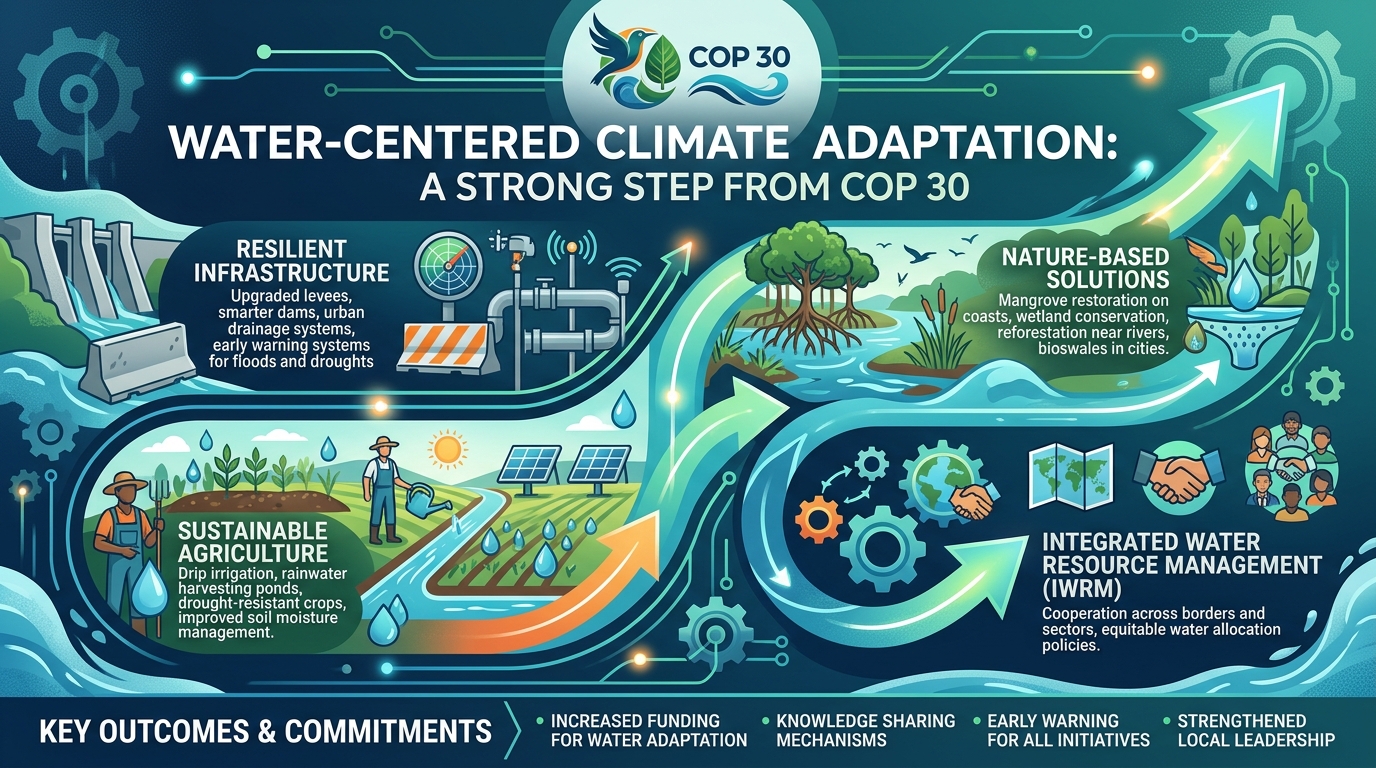
Water-Centered Climate Adaptation: A Strong Step from COP 30
Table of Contents
Water-centered climate adaptation has emerged as a major focus at COP 30, highlighting how managing water resources is key to tackling climate change. This approach strengthens resilience in agriculture, cities, and communities.
Why in the News?
- The global climate conference COP 30 was held in Belém, Brazil, in November 2025.
- This conference is part of annual meetings under the United Nations Framework Convention on Climate Change where countries discuss climate action.
- It was called the “COP of Implementation” because countries focused on real action instead of only making promises.
- Earlier COP meetings mainly discussed targets, but now the focus is on measurable results.
- Water was placed at the center of climate adaptation because most climate problems are seen through water.
- Climate adaptation means adjusting systems to reduce damage caused by climate change.
- Global indicators now include WASH, which means Water, Sanitation, and Hygiene.
- This shows that clean water and sanitation are directly linked with climate resilience and human survival.
What are the Key Highlights?
Climate Change Felt Through Water
- Climate change is most visible through water-related events.
- Floods are increasing due to heavy rainfall and rising sea levels.
- Droughts are becoming more frequent due to lack of rainfall.
- Glacial melt is increasing due to rising temperatures, which affects river flow.
- Saline intrusion means seawater enters freshwater sources, making water unfit for drinking and farming.
- Erratic monsoons mean rainfall is unpredictable, which affects agriculture.
- Agriculture is a major contributor to methane emissions, which is a powerful greenhouse gas.
- About 40 percent of human-caused methane comes from farming activities.
- Rice fields release methane due to waterlogged conditions.
- Livestock like cows produce methane during digestion.
- Organic waste decomposition also releases methane.
- Key solutions focus on improving water management.
- Water-use efficiency means using less water to produce more output.
- Wastewater reuse means treating used water and using it again.
- Aquifer recharge means refilling underground water sources.
- Resilient sanitation means building systems that can survive floods and extreme weather.
Belém Adaptation Indicators for Water-centered climate adaptation
- A set of 59 indicators has been created under the UAE Framework for Global Climate Resilience.
- Indicators are measurable signs used to track progress in climate adaptation.
Climate-Resilient Water and Sanitation Systems
- Water systems must be strong enough to handle climate stress.
- Reducing water scarcity means ensuring water is available even during droughts.
- Building flood and drought resilience means preparing systems to handle extreme events.
- Universal access means every person should get safe drinking water.
- Sanitation infrastructure must be strong enough to work during floods and disasters.
Risk Governance
- Risk governance means managing risks through planning and systems.
- Countries aim to build early warning systems for disasters by 2027.
- Early warning systems give alerts before floods, cyclones, or droughts.
- Hydrometeorological services study weather and water patterns.
- These services help predict rainfall, floods, and climate events.
- National vulnerability assessments must be updated by 2030.
- These assessments identify areas and people most at risk.
- Countries aim to build early warning systems for disasters by 2027.
India’s Existing Foundations
- India has already taken several steps to improve water management.
Institutional Framework
- The Ministry of Jal Shakti manages water resources in India.
- It was created in 2019 to combine different water-related departments.
Water Vision 2047
- Water Vision 2047 is a long-term plan for sustainable water management.
- It focuses on fairness, sustainability, and resilience.
NAQUIM Programme 2.0
- The National Aquifer Mapping and Management Programme studies underground water.
- It now focuses on using data to manage water at the local level.
National Mission for Clean Ganga
- The National Mission for Clean Ganga works to clean and protect the Ganga River.
- It uses digital monitoring and promotes biodiversity conservation.

What are the Significance?
Water Security
- Water security means having reliable access to safe water at all times.
- Water systems must continue working even during floods and droughts.
- Reliable water supply is essential for drinking, farming, and industry.
Climate-Resilient Development
- Development must now consider climate risks in all sectors.
- Agriculture must adapt to changing rainfall patterns.
- Cities must manage water supply and drainage systems.
- Rural areas need strong water and sanitation systems.
Technology and Data Integration
- Technology helps improve water management and climate response.
- Hydrological data means information about water sources and flow.
- Digital platforms can combine weather data, crop advice, and insurance.
- Real-time systems help farmers and governments take quick decisions.
Global Leadership
- India has the potential to lead developing countries in climate adaptation.
- By implementing global indicators effectively, India can show successful models.
- Sharing knowledge can help other countries improve their systems.
Challenges
Water Scarcity
- Water availability is uneven across regions.
- Some areas face drought while others face floods.
- Systems must be designed to handle different types of stress.
Adaptation Finance
- Large amounts of money are required for climate adaptation.
- The global target is 1.3 trillion dollars per year by 2035.
- Lack of steady funding slows down projects.
- Water projects are often not treated as climate investments.
Digital Fragmentation
- Data is available but not fully connected.
- Different departments use separate systems.
- Real-time decision-making using AI is still limited.
Systemic Coordination
- Many government departments work on water and climate issues.
- Lack of coordination reduces efficiency.
- Climate indicators are not fully integrated into planning systems.
Way Forward
Strengthen Water Systems
- Infrastructure must be made climate-proof.
- Systems should work even during extreme weather events.
- Sanitation and hygiene systems must be durable and reliable.
Secure Adaptation Finance
- Funding must be stable and easily available.
- Governments should treat water projects as climate investments.
- Long-term financial planning is necessary.
Enhance Digital Integration
- Technology should be used for better planning and management.
- AI can help predict water shortages and floods.
- Integrated dashboards can support quick decision-making.
Align Missions and Policies
- Existing programs should be connected with global indicators.
- Water, sanitation, and climate policies must work together.
- Focus should be on improving existing systems instead of creating new ones.
Lead Through Operational Implementation
- Policies must be converted into real action.
- Results should be measurable and visible.
- India can share successful models with other developing nations.
Conclusion
Water has emerged as the most practical way to understand and respond to climate change in everyday life. The future of climate action will depend on how effectively countries can manage water systems, use technology, and ensure fairness in access. A clear focus on implementation and cooperation will help build a safer and more sustainable world.
Relevant Articles:
Global Oil Crisis and Energy Security Challenges for India
SC Status and Religion Debate in India: Supreme Court Clarifies Reservation Rules
India Heart Attack Care Crisis: Delays in Treatment Increasing Preventable Deaths
Read Also:
Magnetic Field Discovery: New Study Reveals Longer Earth Reversal Duration
HALEU-Thorium Debate: Nuclear Fuel Controversy Challenges India’s Energy Strategy
Captive Power Boost: Electricity Rules Amendment 2025 Strengthens India’s Energy Sector
Turning the tide on drought: How COP30 can make …