CSMP IAS : India's Premier Coaching Institute for IAS / PCS
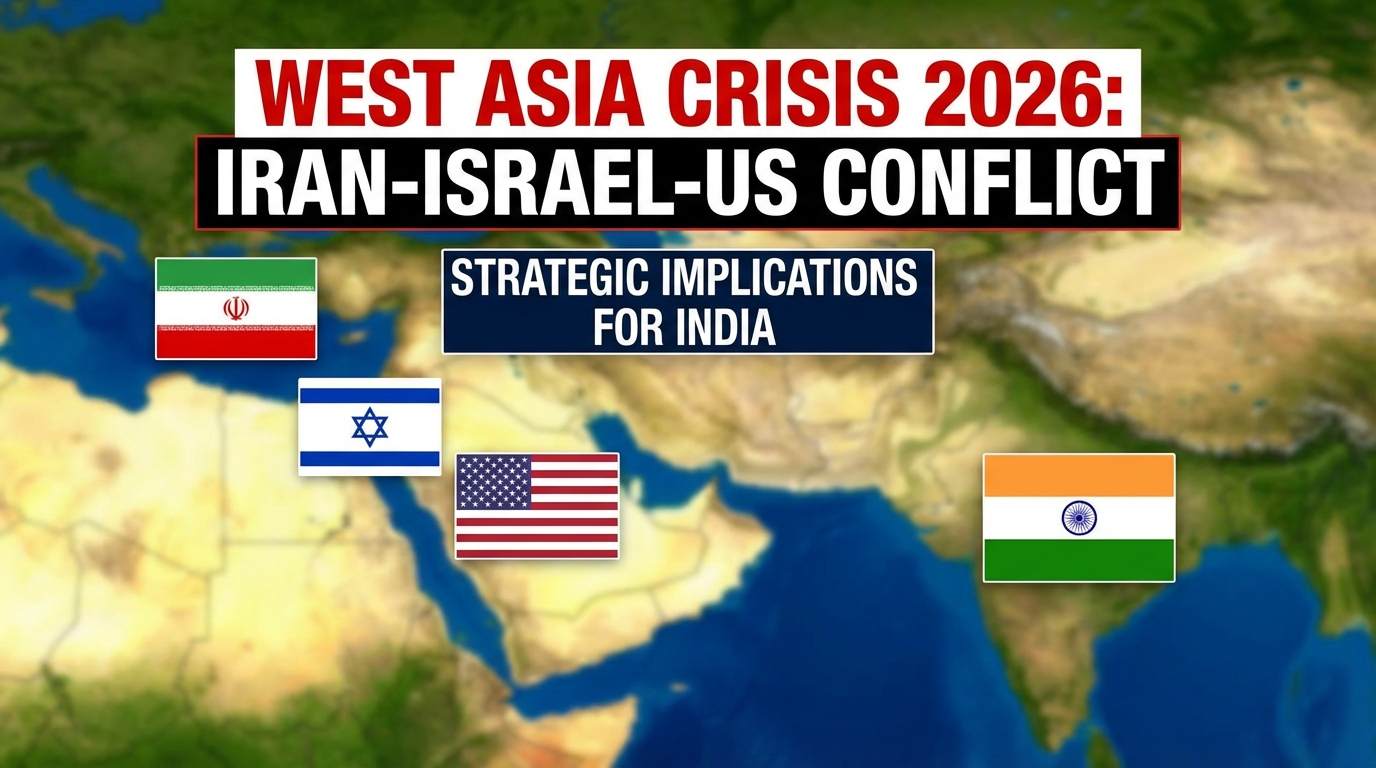
West Asia Crisis 2026: Iran-Israel-US Conflict and Strategic Implications for India
Table of Contents
The West Asia Crisis 2026, involving Iran, Israel, and the United States, is escalating with major regional and global implications. The conflict, driven by objectives of regime change in Iran, proxy warfare, and strategic dominance, affects energy markets, regional stability, and India’s interests. India must carefully balance relations with Iran, Israel, Gulf countries, and the United States while safeguarding energy security and diaspora concerns. The West Asia Crisis 2026 highlights the need for diplomatic negotiation, protection of maritime trade routes, and long-term regional security planning.
Why in the News?
- The conflict involving Iran, Israel, and the United States has intensified in West Asia.
- Many analysts argue that the objective of the war is not only military, such as destroying nuclear facilities or missiles.
- The larger goal is believed to be changing the ideology and political system of Iran through regime change.
- The conflict has major implications for regional stability, global energy markets, and countries like India.
What are the Key Highlights?
- The war is not primarily aimed at eliminating an immediate threat to the United States.
- It is also not only about preventing Iran from attacking Israel or U.S. assets.
- The conflict is not just about stopping Iran’s nuclear programme or destroying ballistic missiles.
Objective of Regime Change
- The United States and Israel believe that Iran’s ruling ideology drives regional instability.
- Therefore, they see regime change in Iran as the long-term solution.
- The war aims to weaken the Iranian government and remove the ideology that supports militant groups.
Iran’s Proxy Strategy
- Iran has supported several non-state armed groups across the region.
- These groups act as proxies against Israel and its allies.
- Major Iranian-backed groups include:
- Hezbollah in Lebanon
- Controls areas of Lebanon.
- Has influenced political processes and government formation.
- Houthi Movement in Yemen
- Controls a large part of Yemen.
- Launched missile attacks on regional targets including Saudi infrastructure.
- Shia militias in Iraq
- Supported politically and militarily by Iran.
- Hezbollah in Lebanon
Role of Hamas
- Iran supported Hamas, which carried out the October 7 Hamas Attack on Israel (2023).
- Israel responded with strong military retaliation against Hamas and its allies.
- Historically, Hamas was once indirectly encouraged by Israel to weaken the Palestine Liberation Organization led by Yasser Arafat.
Regional Political Changes
- Many Gulf countries felt threatened by Iran’s regional influence.
- Under U.S. encouragement, several Arab countries signed the Abraham Accords.
- These agreements normalized relations between Israel and some Arab states.
2025 Military Campaign
- A major bombing campaign in June 2025 targeted Iran’s:
- Military bases
- Security infrastructure
- Oil and economic infrastructure
- The aim was to:
- Damage the Iranian state structure.
- Create internal political pressure for regime change.
Iran’s Response Strategy
- Iran has decentralised its leadership structure to survive possible assassinations.
- It has widened the conflict to include regional strategic targets.
- Iran has threatened shipping routes in the Strait of Hormuz.
Differences Between the U.S. and Israel
- Israel is willing to continue a purely military campaign.
- The United States prefers a political settlement after weakening Iran.
- This difference may influence the duration of the conflict.
U.S. Strategic Dilemma
- Donald Trump prefers short and quick conflicts.
- However, Iran has proven more difficult than other cases such as:
- Venezuela
- Syria
- Iran has threatened shipping through the Strait of Hormuz.
- The U.S. has even requested India to increase purchases of Russian oil to stabilize global prices.
Global Power Competition in West Asia
- If the United States becomes deeply involved in West Asia:
- China may strengthen its position regarding Taiwan.
- Russia may gain strategic advantage in the Russia–Ukraine War.
India’s Position
- India has strong relations with:
- Israel
- Iran
- Gulf countries
- The United States
- India also has major interests in the region:
- Energy imports
- Trade routes
- Indian diaspora in Gulf countries
- India participated as an observer in a peace meeting in Washington.
- However, its response to major events such as:
- The assassination of Ali Khamenei
- The torpedoing of an Iranian naval vessel
has been limited.
What are the Significance?
Transformation of the West Asian Security Order
- The conflict may lead to a complete restructuring of regional security arrangements.
- Iran’s weakening could change the power balance in West Asia.
Rise of New Regional Powers
- With Iran weakened, other countries may expand influence:
- Türkiye
- Saudi Arabia
- Pakistan
- These countries may compete to fill the strategic vacuum.
Global Energy Market Impact
- The Strait of Hormuz is a key oil shipping route.
- Any disruption could lead to:
- Higher oil prices
- Economic instability
- Global inflation.
Strengthening of Israel’s Regional Position
- Israel may emerge as the dominant military power in West Asia.
- Its strategic partnerships with Gulf states may grow.
Impact on Global Power Balance
- A prolonged war could weaken U.S. focus on other regions.
- This could benefit:
- China in East Asia.
- Russia in Europe.
Strategic Implications for India
- India’s strategic space may shrink due to growing influence of major powers.
- India must balance relations with:
- Iran
- Israel
- Gulf countries
- The United States
Challenges
Risk of Regional War
- The conflict may spread across West Asia.
- Proxy groups could expand the fighting into multiple countries.
Energy Security Threat
- Disruption of shipping routes can affect global oil supply.
- India and other oil-importing countries may face economic pressure.
Expansion of Proxy Warfare
- Iran’s network of militant groups could continue attacks across the region.
- This can destabilize several countries.
Great Power Rivalry
- The conflict may intensify competition between:
- United States
- China
- Russia
- This may deepen global geopolitical divisions.
Diplomatic Complexity for India
- India maintains friendly relations with both sides.
- Taking a clear position may affect important partnerships.
Way Forward
Promote Diplomatic Negotiations
- Global powers should encourage dialogue between the parties.
- Negotiations can prevent escalation and wider war.
Develop a Regional Security Framework
- West Asian countries should create cooperative security mechanisms.
- Regional cooperation can reduce reliance on external powers.
Protect Maritime Trade Routes
- International coordination is needed to protect shipping lanes.
- Ensuring safety in the Strait of Hormuz is essential for global trade.
Strengthen India’s Regional Strategy
- India should move beyond bilateral diplomacy.
- It should develop a comprehensive West Asia policy.
Balance Strategic Partnerships
- India must maintain stable relations with all key players.
- A balanced policy will help protect energy security and diaspora interests.
Conclusion
The evolving conflict is reshaping political influence, alliances, and strategic calculations across multiple regions of the world. Managing its consequences requires careful diplomacy, long-term strategic thinking, and cooperative international efforts to maintain stability and protect global economic interests.
Relevant Articles:
Project Cheetah in India: Successful Reintroduction and Wildlife Conservation
Affordable Cancer Medicines in India: Customs Duty Exemption Reduces Treatment Costs
India–Canada Economic Partnership 2026
Read Also:
Viksit Bharat Rural Employment Mission: Transforming India’s Rural Jobs Landscape
India’s AI Self-Reliance: Sarvam AI Launches Open-Source Large Language Models
Great Nicobar Project: Development, Ecology, and the Question of Justice
Prime Minister Shri Narendra Modi addresses the Lok …