CSMP IAS : India's Premier Coaching Institute for IAS / PCS
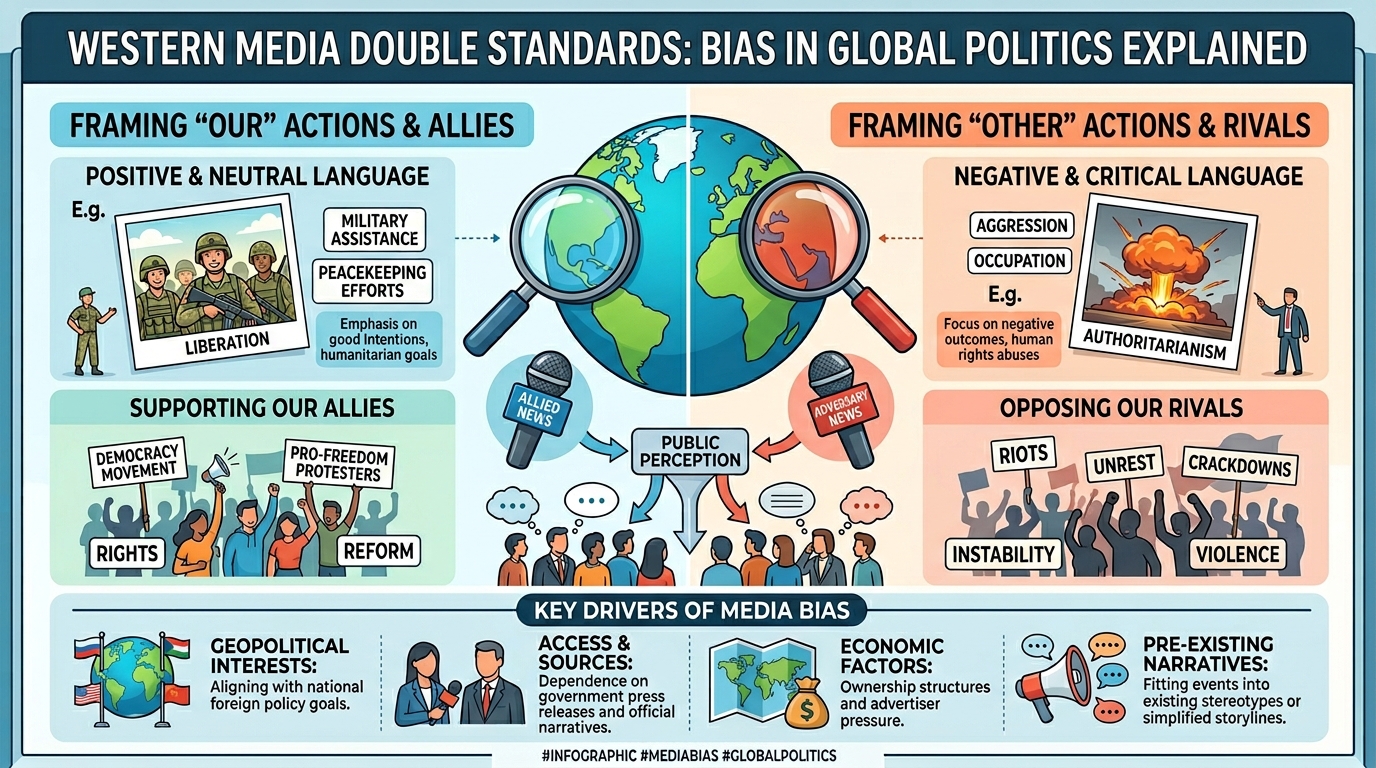
Western Media Double Standards: Bias in Global Politics
Table of Contents
The issue of Western Media Double Standards has become a major concern in understanding global politics and international relations. Recent debates involving countries like United States, Iran, and Cuba show how similar situations are often reported differently by Western media. This selective approach raises important questions about fairness, sovereignty, and truth in global narratives. Understanding this topic is very important for students preparing for UPSC, UPPCS, and UPPSC exams.
Why in the News?
- A recent opinion article by Badr Albusaidi has brought attention to the ongoing conflict involving the United States, Israel, and Iran.
- He criticised the military strikes carried out by the United States and Israel against Iran.
- He also expressed concern about Iran’s retaliation, calling it regrettable but understandable in the given situation.
- At the same time, contrasting views in global media, especially by The Economist, have raised questions about double standards in international reporting.
- The issue has sparked debate on how powerful countries and media institutions treat different nations differently based on political and ideological considerations.
- This has also highlighted the challenges faced by countries of the Global South in understanding international events through Western media narratives.
What are the Key Highlights?
- The conflict in West Asia has intensified due to:
- Military strikes by the United States and Israel on Iran
- Retaliatory actions by Iran
- Badr Albusaidi stated that:
- The war threatens regional peace and prosperity
- Iran’s response, though unacceptable, may have been the only rational option
- In contrast, The Economist supported:
- Strong U.S. actions against Cuba
- Continued sanctions and pressure on Cuba
- The situation in Cuba includes:
- Fuel shortages
- Power outages
- Food crisis
- Western media has shown inconsistency:
- Criticism of U.S. actions in some cases
- Support for similar actions in other cases
- Historical examples include:
- Iraq War 2003 based on incorrect intelligence
- Media support for U.S. actions in Venezuela
- The article highlights the dependence of Global South countries on Western media for international news.
What are the Significance?
Significance of Western Media Double Standards in Global Politics
- Double standards weaken trust in international systems.
- Different rules are applied to different countries.
- This creates:
- Inequality in global governance
- Bias in decision-making
Impact on Sovereignty of Nations
- Sovereignty means a country’s right to control its own affairs.
- Selective respect for sovereignty leads to:
- Interference in weaker nations
- Protection of stronger nations
- The article argues that:
- Sovereignty should be equal for all countries
Role of Media in Shaping Global Opinion
- The media plays a major role in influencing public opinion.
- It shapes how people understand global events
- When media shows bias:
- It can justify certain actions
- It can hide the suffering of affected populations
Significance for the Global South
- Countries in the Global South depend on Western media.
- They lack global reporting networks
- This leads to:
- Limited perspectives
- Risk of misinformation
Importance of Critical Thinking
- Readers must analyse information carefully.
- Not all reports are neutral
- Critical thinking helps:
- Separate facts from opinions
- Identify bias
Lessons from Historical Events
- Events like the Iraq War 2003 show:
- Media can make serious mistakes
- These mistakes can:
- Lead to war
- Cause long-term damage
Ethical Responsibility of Media
- The media should provide balanced reporting.
- It should present facts clearly
- Ethical journalism is important for:
- Democracy
- Global peace
Importance of Independent Narratives
- Countries should develop their own perspectives.
- Not depend entirely on external sources
- This helps:
- Protect national interests
- Improve understanding of global issues
Relevance to International Relations
- The issue highlights power dynamics in global politics.
- Powerful countries influence narratives
- This affects:
- Policy decisions
- Diplomatic relations
What are the Challenges?
Dependence on Western Media
- Many countries rely on Western news sources.
- Limited alternative sources are available
- This creates:
- Information imbalance
- Lack of diversity in viewpoints
Bias in Global Reporting
- Media may favour certain countries.
- Political and economic interests influence reporting
- This results in:
- Distorted narratives
- Misleading information
Weak Media Infrastructure in Global South
- Many countries lack strong international reporting networks.
- Limited resources and investment
- This affects:
- Quality of journalism
- Global coverage
Influence of Powerful Nations
- Powerful countries shape global narratives.
- They influence media and policies
- This leads to:
- Unequal representation
- Suppression of alternative views
Lack of Critical Awareness
- Many readers accept information without questioning.
- Limited awareness about media bias
- This increases:
- Spread of misinformation
- Manipulation of public opinion
Political Pressure on Media
- Media organizations may face pressure.
- Governments and corporations influence content
- This affects:
- Independence of journalism
- Objectivity in reporting
What is the Way Forward?
Developing Independent Media Networks
- Countries should invest in their own media systems.
- Build global reporting capabilities
- This will:
- Provide diverse perspectives
- Reduce dependence on Western media
Promoting Media Literacy
- Educate people about how media works.
- Teach critical thinking skills
- This helps:
- Identify bias
- Understand complex issues
Encouraging Balanced Journalism
- Media organizations should follow ethical standards.
- Present multiple viewpoints
- This ensures:
- Fair reporting
- Informed decision-making
Strengthening Global Cooperation
- Countries should work together to share information.
- Promote transparency
- This improves:
- Trust among nations
- Accuracy of reporting
Supporting Local Journalists
- Provide resources and training to journalists.
- Encourage investigative reporting
- This enhances:
- Quality of news
- Global understanding
Holding Media Accountable
- Media organizations should be accountable.
- Correct errors openly
- This builds:
- Public trust
- Credibility
Encouraging Diverse Perspectives
- Include voices from different regions.
- Represent Global South viewpoints
- This leads to:
- Balanced narratives
- Inclusive global discourse
Conclusion
The discussion highlights the importance of fairness, awareness, and responsibility in understanding global events. It reminds us that information is powerful and must be handled with care. A more thoughtful and informed approach can help societies make better decisions and contribute to a more balanced and just world order.
Relevant Articles:
India China Military Gap: Urgent Need for Defence Reforms
Strait of Hormuz Crisis: Global Energy Security and India’s Strategic Response
India China Military Gap: Urgent Need for Defence Reforms
Read Also:
Strait of Hormuz Crisis: Global Energy Security and India’s Strategic Response
Persian Gulf Ecosystem Crisis: Marine Biodiversity Under Threat and Conservation Efforts
India New Climate Goals 2035: Ambitious NDC Targets for Non-Fossil Energy Expansion
Unveiling The Western Media’s Biases In Reporting On …