
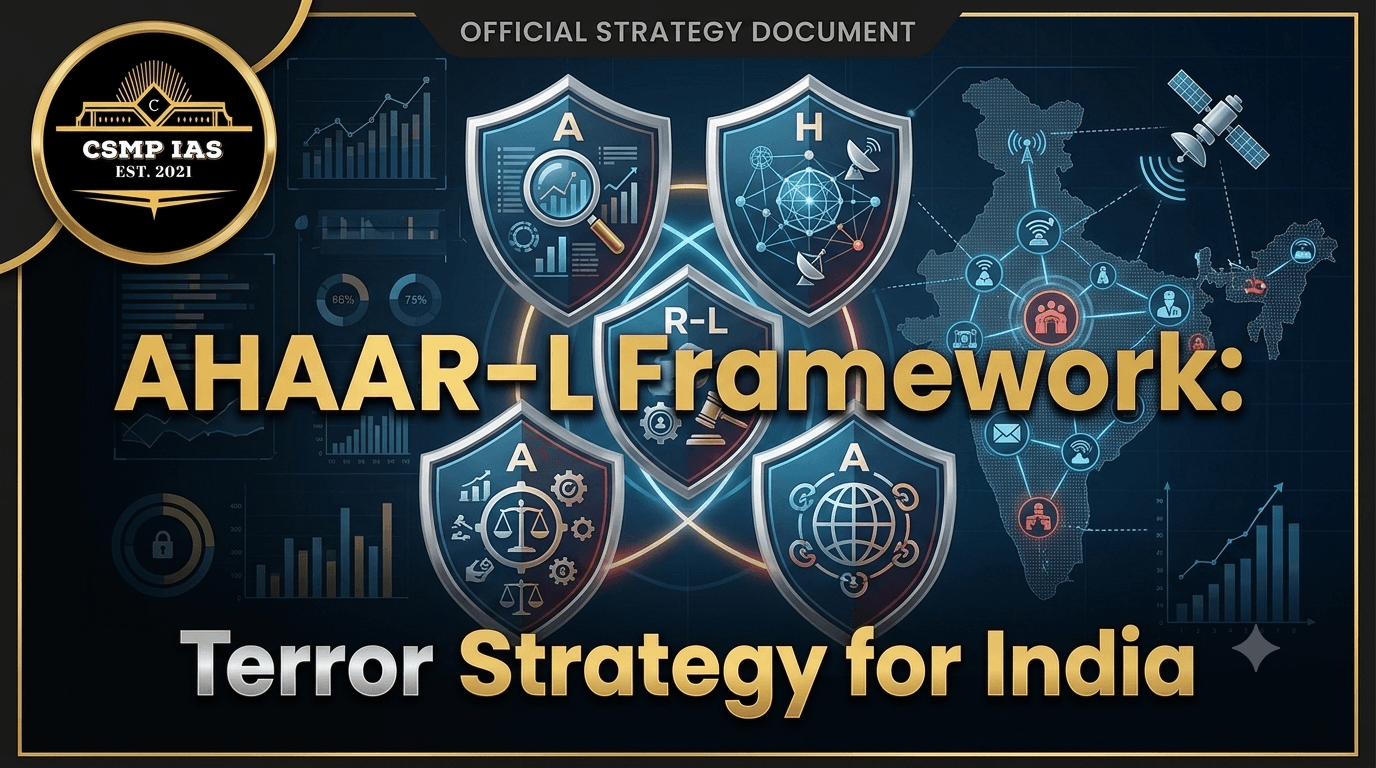
(GS-III | Internal Security | Advanced Analytical Notes): Although AHAAR is not an officially codified doctrine, it can be conceptualised as a multi-dimensional counter-terror framework integrating intelligence, security, finance, socio-political measures, diplomacy, and legal safeguards.
India's Counter-Terrorism Strategy: The AHAAR–L Framework
A mains-answer-ready model for UPSC aspirants covering GS-III (Internal Security)
I. Context: The Changing Face of Terrorism in India
India today confronts a layered and evolving threat landscape rather than a single, uniform enemy. Any answer on internal security should open by naming this complexity:
Threat Category Nature Cross-border terrorism State-sponsored, often using proxy groups Left Wing Extremism (LWE) Ideological, rural/forest-belt insurgency Urban sleeper cells Low-visibility networks embedded in cities Lone-wolf attacks Individual actors, hard to detect via conventional intelligence Digital radicalisation Online recruitment and propaganda, borderless in nature
Illustrative example: The 2008 Mumbai (26/11) attacks remain the benchmark case study — the post-attack reforms exposed serious gaps in intelligence coordination and emergency response time, and continue to shape India's security architecture today.
II. The AHAAR–L Model: Six Pillars of Counter-Terrorism
AHAAR–L is a mnemonic framework useful for structuring mains answers on counter-terrorism policy. Each letter stands for a pillar of the strategy.
A — Anticipatory Intelligence & Analytics
Component Detail Key mechanisms NATGRID-type data integration, Multi-Agency Centre (MAC) Emerging tools AI-based predictive policing, OSINT + cyber surveillance Ground-level layer Community intelligence networks
Analytical insight: The strategic shift is from reactive to anticipatory security — acting before an attack rather than merely responding after one.
Challenges: Privacy concerns, encryption barriers, and Centre–State coordination gaps (policing is a State subject, intelligence is often Central).
H — Homeland Security & Hard Power
Component Detail Policing SMART policing (Strategic, Meticulous, Adaptable, Reliable, Tech-savvy) Coastal security Post-26/11 coastal security architecture Border technology Comprehensive Integrated Border Management System (CIBMS), drones Special forces NSG regional hubs
Relevance: 26/11 exposed the need for rapid-response capability closer to potential targets rather than centralised in one city.
Issues: Low conviction rates, allegations of misuse of force/laws, procedural delays in trials.
A — Anti-Terror Financing & Economic Disruption
Component Detail Domestic monitoring Financial Intelligence Unit–India (FIU-IND) Informal channels Hawala crackdown New-age tracking Crypto-currency transaction tracking Enforcement tool Asset freezing
Linked institution: Financial Action Task Force (FATF)
Core insight: "Terror networks survive on shadow financing." Choking funds is often more effective than kinetic operations alone.
Emerging threats: Misuse of crowdfunding platforms; NGOs being used as fronts for fund diversion.
A — Addressing Radicalisation & Socio-Political Drivers
Component Detail Direct intervention De-radicalisation programs Information space Counter-narratives on digital platforms Root-cause approach Skill development in vulnerable/border regions Post-conflict Reintegration of ex-militants into society
Linkage: Aspirational Districts Programme, addressing governance deficits in underdeveloped regions.
Key phrase for answers: "Security–development nexus" — underdevelopment and alienation are often exploited as radicalisation triggers.
R — Regional & Global Cooperation
Component Detail Bilateral tools Intelligence-sharing agreements, extradition treaties Multilateral tools FATF diplomacy, multilateral pressure campaigns Global platform United Nations Security Council (UNSC)
Core insight: "Terrorism is transnational; the response must be cooperative." No single state can address cross-border terror networks unilaterally.
L — Legal Architecture & Liberty Balance (Value Addition)
Component Detail Legal strengthening Robust statutory framework Checks Judicial oversight, due process safeguards Modern concern Data protection norms in surveillance
Key provisions to cite in answers:
Unlawful Activities (Prevention) Act (UAPA)
Article 21 of the Indian Constitution (Right to Life and Personal Liberty)
Core debate: Security vs Civil Liberties
UPSC-style closing line: "National security must operate within constitutional morality."
III. Emerging Threat Landscape
Modern counter-terrorism answers should acknowledge the next generation of threats:
Cyber terrorism
AI-driven misinformation
Drone-based attacks
Hybrid warfare
Lone-wolf radicalisation (often via encrypted apps/social media)
Conceptual takeaway: Terrorism today is network-centric and technology-enabled, rather than confined to physical, hierarchical organisations.
IV. Case Studies for Answer-Writing (High Value)
Case Study Relevance 26/11 Mumbai Attacks Exposed intelligence and response coordination gaps ISIS-inspired modules in India Illustrates the power of digital radicalisation FATF grey-listing pressure (e.g., on Pakistan) Shows financial diplomacy as an anti-terror tool
V. Diagram for Mains Answers
A simple flow diagram to sketch in the answer booklet:
                AHAAR–L MODEL
        ─────────────────────────────
        Intelligence  →  Security
              ↓              ↓
         Financing  →  Radicalisation
              ↓              ↓
               Global Cooperation
                      ↓
                Legal Safeguards
VI. Critical Evaluation
Strengths Weaknesses Multi-dimensional approach to a multi-dimensional problem Centre–State coordination remains difficult Strong preventive/anticipatory focus Raises genuine privacy concerns Enables financial disruption of terror networks Risk of over-securitisation Encourages global alignment (FATF, UNSC) Allegations of legal misuse (e.g., UAPA)
VII. Way Forward
Institutionalise a dedicated Intelligence Fusion Centre
Implement police reforms as recommended by the 2nd Administrative Reforms Commission (ARC)
Strengthen forensic and cyber investigation capabilities
Conduct periodic review of anti-terror laws to prevent misuse
Expand community policing models
Deploy tech-driven surveillance with built-in legal safeguards
VIII. Conclusion
The AHAAR–L framework represents a "whole-of-government and whole-of-society approach" to counter-terrorism. India's response must move beyond coercive force alone to include:
Intelligence precision
Financial disruption
Socio-political integration
Global cooperation
Constitutional balance
Final line for answers: "Effective counter-terrorism lies not in eliminating threats alone, but in building resilient, lawful, and inclusive security systems."
IX. UPSC Practice Questions
Prelims Question
With reference to India's counter-terror framework and global mechanisms, consider the following statements:
The Unlawful Activities (Prevention) Act empowers the Central Government to designate both organisations and individuals as terrorists, but such designation is subject to judicial confirmation within a prescribed time.
The Financial Action Task Force has a legally binding mandate under international law to impose sanctions on countries that fail to curb terror financing.
The National Investigation Agency can take suo motu cognisance of terror-related offences without prior approval of the Central Government under certain circumstances.
India's obligations under United Nations Security Council resolutions require automatic domestic criminalisation of all entities listed under UN terror sanctions lists without legislative backing.
Which of the statements given above are correct?
(a) 1 and 3 only (b) 2 and 4 only (c) 1 only (d) 1, 2 and 3 only
Correct Answer: (c) 1 only
Mains Questions
"Counter-terrorism policy must evolve from hard power to a multi-dimensional framework." Discuss using the AHAAR model. (250 words)
Examine the tension between national security and civil liberties in India's anti-terror legal framework. (250 words)
Terror financing remains the backbone of extremist networks. Analyse India's response considering FATF standards. (150 words)
Related reading: India–France Special Global Strategic Partnership