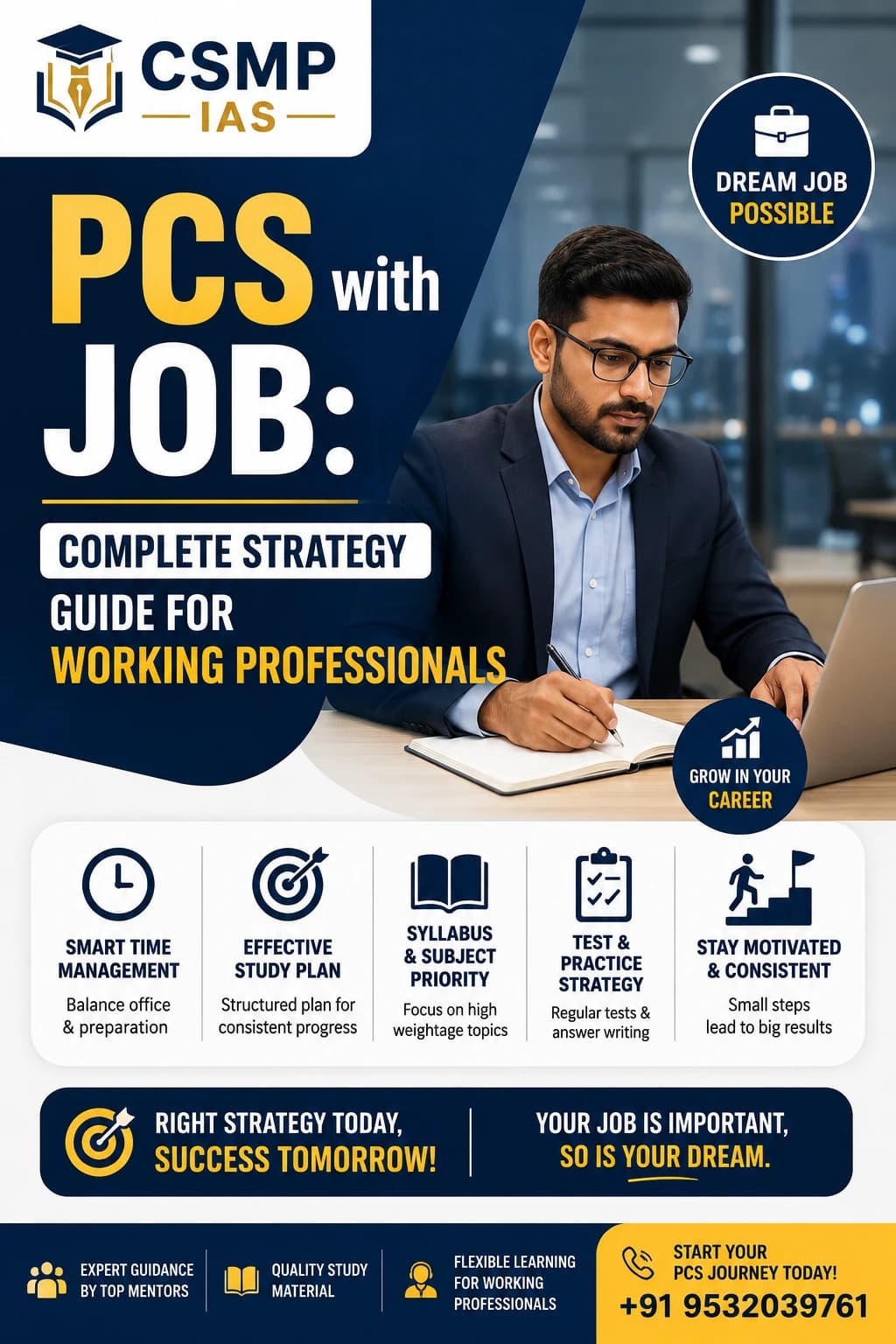
PCS with Job: Complete Strategy Guide for Working Professionals | CSMP IAS 12-Month Roadmap
CSMP IAS • PCS Preparation Series
PCS with Job: How Working Professionals Can Crack PCS Without Quitting Their Career
A realistic, field-tested strategy for aspirants who want to clear UPPCS / State PCS examinations while continuing their government or private job — plus CSMP IAS’s structured 12-month roadmap.
- Complete Strategy Guide for Working Professionals
- 60%+ PCS aspirants are working professionals
- 3–4 hrsDaily study needed on average
- 12 Months in CSMP IAS roadmap
- 2 Stages: Prelims + Mains preparation tracks
Every year, lakhs of candidates appear for the Provincial Civil Services (PCS) examination conducted by state Public Service Commissions such as UPPSC, BPSC, MPPSC, and others. What most coaching advertisements don’t tell you is a simple truth: a large share of successful PCS candidates were not full-time students sitting in a library for twelve hours a day. They were teachers, bank employees, government clerks, private-sector professionals, and even those managing family businesses — people who cracked PCS while holding a job.
If you are one of these working aspirants, this guide is written specifically for you. We will walk through why PCS-with-job is absolutely achievable, how to structure your limited hours for maximum output, which mistakes derail working aspirants most often, and finally, we’ll lay out the CSMP IAS 12-month roadmap — a month-by-month plan designed around the reality of a working professional’s schedule rather than the fantasy of unlimited study time.
The Core Truth
PCS is not won by the person who studies the most hours. It is won by the person who studies the right material, revises it enough times, and stays consistent for the full 10–12 months without burning out. A working aspirant with 3.5 focused hours daily will comfortably outperform a full-time aspirant who studies 8 distracted hours.
1. Is It Really Possible to Crack PCS with a Job?
Yes — and the exam’s own structure supports this. PCS Prelims is a screening-based objective test covering General Studies and (in most states) CSAT as qualifying. It rewards conceptual clarity, static-plus-current-affairs revision, and smart practice — not raw hours. Mains, similarly, rewards structured answer-writing and command over a manageable optional subject rather than encyclopedic knowledge. Complete Strategy Guide for Working Professionals The one liner answer is YES its completely possible for those who are working somewhere Working Professionals Can Crack PCS Without Quitting Their Career
The real challenge for a working aspirant is not intelligence or aptitude. It is time fragmentation — study happening in scattered 45-minute blocks around office hours, commute, and family responsibilities. The entire strategy below is built to solve exactly this problem.
- Who Typically Succeeds in the Job + PCS Combination
- 1
- Government employees
Clerks, teachers, and Group C/D staff already familiar with exam culture and syllabus overlap with other government exams.
- 2
- Private sector professionals
IT, banking, or corporate employees who bring strong time-management and analytical habits from their jobs.
- 3
- Teachers and tutors
Already engaged with GS-adjacent subjects; can integrate revision into their teaching schedule.
- 4
- Contractual/part-time workers
Often have more flexible hours, allowing longer uninterrupted study blocks on certain days.
2. Building a Realistic Daily Schedule
Forget the 10-hour study charts circulating on social media — they are written for full-time aspirants and will only generate guilt in a working professional. Instead, build a schedule around your actual job timings. Below is a sample structure assuming a standard 9-to-6 job.
- Time Slot
- Duration
- Activity
- 5:30 AM – 7:00 AM
- 1.5 hrs
Deep-focus study: static GS or optional subject (fresh mind, best for new concepts)
- Commute (to/from office)
- 45–60 min
- Current affairs audio notes, revision via mobile app, or MCQ practice
- Lunch break at office
- 20–30 min
- Quick revision of static notes or one editorial reading
- 9:00 PM – 11:00 PM
- 2 hrs
Answer writing (Mains phase) or MCQ practice + error analysis (Prelims phase)
- Weekly (Sat/Sun)
- 6–8 hrs/day
Full-length mock tests, weekly revision, current affairs compilation, doubt clearing
- This adds up to roughly
- 4–4.5 hours on weekdays and 6–8 hours on weekends
— a sustainable 30–35 hours per week, which is entirely sufficient if maintained consistently across 10–12 months.
Pro Tip
Protect your early morning slot fiercely. It is the only time of day a working aspirant has genuine control over — no meetings, no calls, no family demands. Whatever you study in that window should be the hardest, highest-priority material of the day.
3. Subject-Wise Prioritisation for Limited Time
With limited hours, you cannot treat every subject with equal depth. CSMP IAS recommends a tiered approach:
- Tier 1 — High Weightage, Must Master
- Indian Polity and Governance
- Modern Indian History and Freedom Struggle
State-specific History, Geography, and Culture (critical for state PCS)
- Current Affairs (last 12 months, integrated with static topics)
- Tier 2 — Moderate Weightage, Build Working Knowledge
- Indian and World Geography
- Economy and Government Schemes
- Environment and Ecology
- Science and Technology (application-based, not rote)
- Tier 3 — Selective Depth
- Ancient and Medieval History (focus on state-relevant portions)
- Art and Culture
- Ethics (for Mains, where applicable)
A working aspirant should spend roughly 60% of study time on Tier 1, 30% on Tier 2, and 10% on Tier 3 during the early months, gradually rebalancing toward full-syllabus revision as the exam approaches.
4. Prelims Strategy for Working Aspirants
Prelims is the biggest filter in PCS and demands speed, accuracy, and elimination technique — all trainable even in limited time.
One standard source per subject
— resist the temptation to collect multiple books. Multiplicity of sources is the single biggest time-waster for working aspirants.
Daily MCQ practice
— even 20–25 questions daily during commute builds pattern recognition over months.
Monthly current affairs compilation
— rather than daily newspaper reading (often unrealistic for working people), use a trusted monthly compilation supplemented by weekly headline scanning.
Weekend full-length mocks
— simulate exam-day conditions at least twice a month from month 6 onward.
Negative marking discipline
— analyse every mock to identify guesswork-driven errors versus knowledge gaps.
5. Mains Strategy: Answer Writing on a Tight Schedule
Mains is where most working aspirants lose ground — not due to lack of knowledge, but lack of practice writing structured answers under time pressure.
Start answer writing early
— ideally from month 4–5, not after Prelims results. Waiting until after Prelims leaves too little runway.
Two answers a day is enough
— quality and structured feedback matter more than volume.
Choose your optional subject strategically
— pick a scoring, well-resourced optional with syllabus overlap with GS wherever possible (Public Administration, Sociology, and Geography are common choices for working aspirants due to conceptual and current-affairs overlap).
Build a Mains value-addition register
— a running notebook of quotes, data points, committee reports, and diagrams to be sprinkled across answers.
Common Trap
Do not attempt to “finish the syllabus first, then start writing.” Syllabus completion and answer-writing practice must run in parallel from the mid-point of your preparation — otherwise you will face the syllabus in full only weeks before Mains, with no writing practice behind you.
6. Managing Current Affairs Without Burning Out
Current affairs is the most time-hungry component of PCS preparation and the easiest to over-invest in. For working aspirants, CSMP IAS recommends:
One reliable monthly magazine or compilation instead of daily newspaper cutting.
A weekly 45-minute “current affairs Sunday” session to consolidate the week’s static-current linkages.
State-specific current affairs given separate, dedicated attention — this is frequently under-prepared by candidates who over-focus on national news.
Integration technique: whenever you study a static topic (say, Panchayati Raj), immediately note any related current development, rather than treating the two as separate study streams.
- Home | UPPSC, Prayagraj
- 7. The Seven Mistakes That Derail Working Aspirants
- 1
- Over-ambitious daily targets
Planning 6 hours on weekdays and failing repeatedly, which erodes motivation faster than a modest, achievable plan.
- 2
- Source hopping
Switching books or coaching notes every few months instead of revising the same material multiple times.
- 3
- Delaying answer writing
Treating Mains preparation as a “later problem” until after the Prelims result is out.
- 4
- Ignoring revision cycles
Moving forward in the syllabus without scheduled revision, leading to forgetting what was studied months earlier.
- 5
- No mock test discipline
Skipping weekend mocks due to fatigue, which removes the only real exam-simulation practice available.
- 6
- Guilt-driven burnout
Comparing progress with full-time aspirants and overcompensating with unsustainable study binges.
- 7
- No leave planning near exam dates
Failing to plan office leave in advance for the final revision weeks before Prelims and Mains.
8. CSMP IAS 12-Month Roadmap for PCS Aspirants with a Job
This roadmap assumes a working aspirant starting from zero to moderate preparation level, targeting the next PCS cycle. Adjust the timeline slightly depending on your exact exam calendar and current stage of preparation.
Month 1 – Foundation & Syllabus Mapping
Understand the complete Prelims and Mains syllabus, state-specific exam pattern, and previous 5 years’ question trends. Select standard NCERT/state board books for Polity, History, and Geography. Set up your daily and weekend schedule. Begin Tier 1 subjects.
Month 2 – Polity & Modern History Core
Complete Indian Polity fundamentals (Constitution, governance structures, amendments) and Modern History (freedom struggle, key movements). Begin daily 20-question MCQ practice during commute.
Month 3 – Geography & State-Specific Content
Cover Indian and state geography in depth — this is disproportionately important for state PCS. Start building a state current affairs file alongside national current affairs.
Month 4 – Economy, Environment & Optional Subject Selection
Cover economy basics and government schemes, plus environment and ecology. Finalise your Mains optional subject based on interest, scoring history, and resource availability. Begin optional subject syllabus.
- Home | UPPSC, Prayagraj
- Month 5 – Answer Writing Begins
Start writing two GS answers daily alongside continued syllabus coverage. Begin first full revision cycle of Months 1–4 material on weekends.
Month 6 – Science, Tech & First Full-Length Prelims Mock
Cover Science and Technology (applied, current-affairs linked). Take your first full-length Prelims mock test and conduct detailed error analysis. Continue optional subject and answer writing.
Month 7 – Revision Cycle 2 + Current Affairs Consolidation
Second full revision of static syllabus. Consolidate 6 months of current affairs into a compact revision file. Increase weekend mock frequency to twice a month.
Month 8 – Optional Subject Depth + Ethics (if applicable)
Deepen optional subject preparation with past-year answer writing. Cover Ethics/Aptitude portions if part of your state’s Mains pattern. Continue mock test cycle.
Month 9 – Prelims Intensive Phase
Shift primary focus to Prelims: daily MCQ sets, weekly full mocks, and rapid revision of all static subjects using notes rather than original books. Reduce optional subject hours temporarily.
Month 10 – Final Prelims Push (Pre-Exam Month)
Plan office leave for the final 7–10 days before Prelims. Focus exclusively on revision, mock analysis, and current affairs recap. Avoid starting any new topic this month.
Month 11 – Prelims Exam & Mains Transition
Appear for Prelims. Immediately transition into Mains mode within a week regardless of expected result — resume optional subject depth and intensive answer writing practice, since the Mains window is typically short.
Month 12 – Mains Intensive & Final Revision
Full-length Mains mocks under timed conditions, value-addition register revision, and structured essay practice. Plan extended office leave for the final two weeks before Mains for uninterrupted preparation.
How CSMP IAS Supports This Roadmap
CSMP IAS structures its PCS batches specifically around this working-aspirant timeline — with recorded lectures for flexible viewing, weekend-focused doubt sessions, monthly current affairs compilations, and a dedicated answer-writing evaluation track so that Mains practice doesn’t get postponed.
9. Frequently Asked Questions
Q1. How many hours are really enough to crack PCS while working?
3.5 to 4.5 focused hours on weekdays, combined with 6–8 hours on weekends, is generally sufficient across a 10–12 month timeline — provided the study is structured and revision cycles are maintained.
Q2. Should I take a break from my job closer to the exam?
Most successful working aspirants take planned leave only for the final 7–10 days before Prelims and the final two weeks before Mains, rather than resigning or taking extended leave for the entire preparation period.
Q3. Which optional subject is best for working PCS aspirants?
Subjects with syllabus overlap with GS and easy availability of standard material — such as Public Administration, Sociology, or Geography — tend to work well since they reduce the total independent study burden.
Q4. Is coaching necessary for working aspirants?
Not mandatory, but structured guidance — through recorded lectures, test series, and answer evaluation — saves significant time by removing the need to independently curate sources and validate answer quality, which is especially valuable when study hours are limited.
Q5. What if I miss a day or fall behind the schedule?
Build a buffer day into your weekly plan (commonly Sunday evening) specifically to absorb missed targets, rather than trying to compress two days of material into one — this prevents the cascading burnout that ends many working aspirants’ attempts.
Conclusion
Cracking PCS while holding a job is not a compromise strategy — it is a legitimate, well-trodden path followed by a majority of successful candidates every year. The difference between those who succeed and those who don’t is rarely talent. It is structure, consistency, and realistic planning sustained over 10–12 months. With a disciplined daily schedule, tiered subject prioritisation, early answer-writing practice, and a clear roadmap like the one outlined above, a working professional is fully capable of clearing PCS without walking away from their career.
Start Your PCS Journey with CSMP IAS
Join CSMP IAS’s dedicated PCS-with-Job batch — structured around working professionals’ schedules, with recorded lectures, weekend doubt sessions, and evaluated answer writing.
- Explore CSMP IAS PCS Batch
- Election Commission of India: A Complete Guide for UPSC Aspirants 2026
© 2026 CSMP IAS. This article is for educational guidance purposes for PCS aspirants.