El Niño and La Niña: A Complete UPSC Guide
Relevance: GS Paper I (Geography), GS Paper III (Environment, Disaster Management, Agriculture) | Prelims and Mains
Introduction
Every year, when the monsoon forecast is released or when unusual weather makes headlines — a delayed monsoon, a harsh winter in North America, or floods in Peru — one term keeps surfacing: ENSO, the El Niño-Southern Oscillation. For UPSC aspirants, El Niño and La Niña are not just meteorological curiosities; they sit at the intersection of climatology, oceanography, agriculture, food security, and disaster management, making them a recurring favourite in both Prelims and Mains.
This blog breaks down the science, the impacts, and the exam-relevant angles of El Niño and La Niña in a structured, retainable format.
What is ENSO?
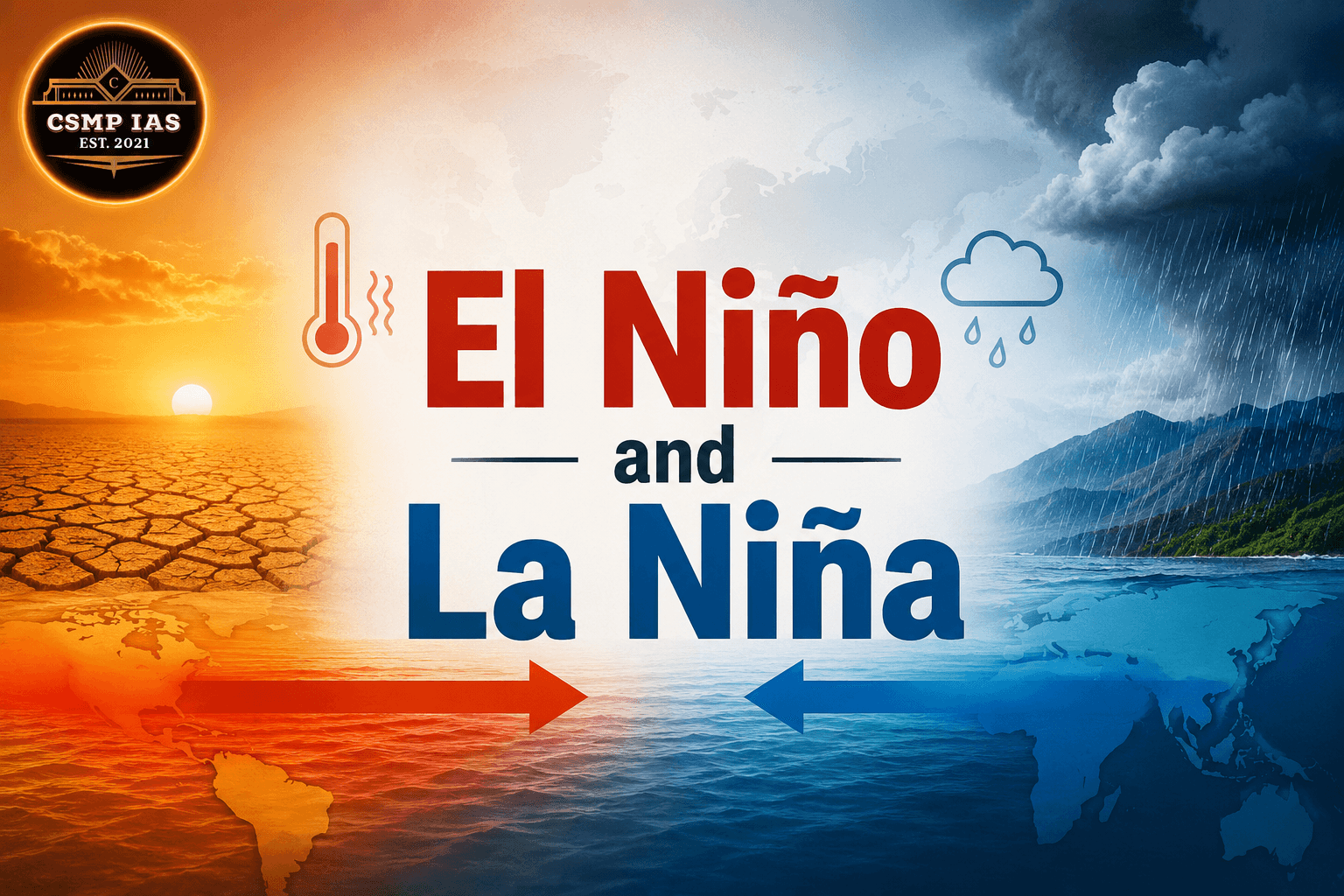
ENSO stands for El Niño-Southern Oscillation, a periodic fluctuation in sea surface temperature (ocean component) and air pressure (atmospheric component) across the tropical Pacific Ocean. It is the single most influential year-to-year climate phenomenon on Earth, affecting rainfall, temperature, and storm patterns across multiple continents.
ENSO has three phases:
El Niño — the warm phase
La Niña — the cool phase
ENSO-neutral — neither phase dominant
To understand these, we first need to understand the "normal" or baseline state of the tropical Pacific.
The Normal (Neutral) Pacific System
Under normal conditions:
Trade winds blow from east to west (from South America towards Australia/Indonesia) along the equator.
These winds push warm surface water westward, causing warm water to "pile up" near Indonesia and the western Pacific, while cold, nutrient-rich water rises (upwells) along the coast of Peru and Ecuador.
This creates the Walker Circulation — a loop of rising air over the warm western Pacific (leading to rainfall over Indonesia, Australia, and Southeast Asia) and sinking air over the cooler eastern Pacific (creating dry conditions over Peru).
The pressure difference between Tahiti (eastern Pacific) and Darwin, Australia (western Pacific) is called the Southern Oscillation Index (SOI), and it is this oscillation in pressure that gives ENSO its name.
El Niño: The Warm Phase
El Niño (Spanish for "the little boy" or "Christ child," originally named by Peruvian fishermen who noticed unusually warm coastal waters around Christmas time) occurs when the trade winds weaken or even reverse.
Mechanism
Weakened trade winds fail to push warm water westward effectively.
Warm water that would normally sit near Indonesia shifts eastward towards the coast of South America.
Upwelling of cold water off Peru weakens or stops, warming the eastern Pacific.
The Walker Circulation reverses or breaks down: rising air (and rainfall) shifts towards the central and eastern Pacific, while the western Pacific (Indonesia, Australia) experiences sinking air and drought-like conditions.
Key Indicators
Oceanic Niño Index (ONI): Measures sea surface temperature anomaly in the Niño 3.4 region (5°N-5°S, 170°W-120°W). A sustained anomaly of +0.5°C or more for five consecutive overlapping three-month periods signals El Niño.
Southern Oscillation Index (SOI): Turns negative during El Niño (pressure drops at Tahiti, rises at Darwin).
Global Impacts of El Niño
Drought in Indonesia, Australia, and parts of Southeast Asia and southern Africa.
Heavy rainfall and flooding along the coasts of Peru and Ecuador.
Weaker Indian monsoon in many (though not all) years — this is the linkage most relevant for India.
Warmer winters in northern parts of North America; wetter conditions in the southern United States.
Reduced Atlantic hurricane activity but can increase Pacific typhoon activity.
Coral bleaching due to elevated sea surface temperatures.
La Niña: The Cool Phase
La Niña ("the little girl") is essentially the mirror image of El Niño — an intensification, rather than a weakening, of normal conditions.
Mechanism
Trade winds strengthen beyond normal.
More warm water is pushed towards the western Pacific, intensifying convection and rainfall over Indonesia and Australia.
Upwelling off Peru intensifies, making the eastern Pacific unusually cold.
The pressure gradient (SOI) becomes strongly positive.
Global Impacts of La Niña
Enhanced rainfall over Indonesia, Australia, and Southeast Asia; sometimes leading to flooding.
Drought conditions intensify further in Peru and along the South American Pacific coast.
Generally favourable for the Indian monsoon — many of India's best monsoon and agricultural years have coincided with La Niña phases.
More active Atlantic hurricane seasons.
Colder winters in parts of North America and cooler, wetter conditions in parts of Africa.
ENSO and the Indian Monsoon: The Core UPSC Angle
For India, the most exam-relevant dimension of ENSO is its relationship with the Southwest Monsoon (June–September), which contributes roughly 70-80% of India's annual rainfall and remains central to agricultural output, reservoir levels, and rural incomes.
The General Correlation
El Niño years are statistically associated with below-normal or deficient monsoon rainfall in India. This happens because El Niño alters the Walker Circulation, weakening the low-pressure systems over the Indian subcontinent that normally draw in moist monsoon winds from the Indian Ocean.
La Niña years are statistically associated with normal to above-normal monsoon rainfall, as strengthened trade winds and an intact Walker Circulation support the low-pressure systems that pull the monsoon inland.
Important Caveats (Frequently Tested)
The correlation is statistical, not deterministic. Not every El Niño year has produced a drought in India (e.g., 1997 was a strong El Niño year but India still received near-normal rainfall), and not every La Niña year has produced a bumper monsoon.
Other factors modulate or even override the ENSO signal:
Indian Ocean Dipole (IOD): A difference in sea surface temperature between the western and eastern Indian Ocean. A positive IOD can offset the drought-inducing effect of El Niño by independently boosting monsoon moisture — this happened notably in 2023, when a strong positive IOD helped India avoid a severe monsoon deficit despite El Niño conditions.
Madden-Julian Oscillation (MJO): An eastward-moving pulse of cloud and rainfall activity in the tropics on a roughly 30–60 day cycle, which can boost or suppress monsoon activity within a season.
Local factors like Eurasian snow cover, Himalayan snow cover, and land surface temperatures over India also play a role.
Timing matters: an El Niño developing during the monsoon season tends to have a stronger dampening effect than one that develops afterward.
This is why the India Meteorological Department (IMD) and other forecasting agencies never rely on ENSO status alone — they use a basket of indicators including the IOD, MJO, and regional sea surface temperature patterns to issue monsoon forecasts.
Current ENSO Status (as of August 2026)
The Pacific has gone through a full cycle within a single year — a useful illustration of how quickly ENSO conditions can shift. Early 2026 saw weak La Niña conditions persist into January, before the tropical Pacific moved into ENSO-neutral territory through the spring. By June 2026, NOAA's Climate Prediction Center issued an official El Niño Advisory, as sea surface temperatures in the Niño 3.4 region warmed past the threshold and the atmosphere began coupling with the ocean — trade winds weakening, rainfall shifting eastward, and the Southern Oscillation Index turning negative. Forecasters expect this El Niño to strengthen through the remainder of 2026, with a high probability of a moderate-to-strong event persisting into early 2027. This rapid La Niña-to-El Niño flip in under a year underscores why ENSO monitoring is a continuous, month-to-month exercise rather than a once-a-year forecast.
(Note: ENSO status evolves monthly — aspirants should check the latest IMD, NOAA, or WMO bulletins closer to their exam date for the most current figures.)
Historical Context: Notable Events
1982-83 and 1997-98 El Niño: Among the strongest El Niño events on record, causing widespread global disruption, including droughts in India and Australia, and catastrophic flooding in Peru.
2015-16 El Niño: One of the strongest ever recorded, associated with global coral bleaching events and back-to-back drought years in India (2014-15 and 2015-16).
2020-2023 "Triple-dip" La Niña: A rare three-consecutive-year La Niña event, contributing to good monsoon performance in India during this period, alongside severe drought in the Horn of Africa and the western United States.
Broader Consequences Relevant for Mains
Agriculture and Food Security
Deficient monsoons linked to El Niño can depress kharif crop output (rice, pulses, oilseeds), affecting farm incomes, rural demand, and food inflation — a theme connecting Geography to Economy in GS III.
Disaster Management
ENSO phases are linked to specific hazards: El Niño with drought and forest fires (notably in Indonesia and Australia), La Niña with flooding and more intense cyclone/hurricane seasons in specific basins. This links to India's disaster preparedness architecture and early warning systems.
Global Climate Change Interaction
A key debate in climate science, and a useful analytical point for Mains answers, is whether anthropogenic climate change is intensifying ENSO extremes — making strong El Niño and La Niña events more frequent and their impacts more severe. While scientific consensus is still evolving, IPCC assessments suggest increasing confidence that extreme ENSO events may become more frequent under continued global warming, compounding existing climate stresses.
Fisheries and Marine Ecosystems
El Niño's suppression of the Peruvian upwelling devastates the anchoveta fishery, with cascading effects on global fishmeal markets. This is a good example of how a purely oceanographic phenomenon has direct economic consequences.
Quick Revision Table
Feature El Niño La Niña Trade winds Weaken Strengthen Eastern Pacific SST Warmer than normal Cooler than normal Peru upwelling Suppressed Enhanced Indonesia/Australia rainfall Below normal (drought) Above normal (floods) Peru/Ecuador rainfall Above normal (floods) Below normal (drought) Indian monsoon (general tendency) Weaker/deficient Normal to above normal SOI Negative Positive Atlantic hurricanes Suppressed Enhanced
Practice Questions for Self-Assessment
Prelims-style:
With reference to El Niño, consider the following statements: (1) It refers to warming of sea surface temperature in the eastern equatorial Pacific. (2) It is associated with a weakening of trade winds. (3) It always leads to a below-normal Indian monsoon. Which of the statements given above are correct?
Mains-style: 2. "The relationship between El Niño and the Indian monsoon is statistically significant but not deterministic." Discuss, with reference to the role of the Indian Ocean Dipole and other modulating factors. (250 words)
Conclusion
El Niño and La Niña exemplify how a single oceanic-atmospheric phenomenon in one part of the world can ripple across continents, shaping monsoons, harvests, fisheries, and disaster risks. For UPSC aspirants, mastering ENSO isn't just about memorising definitions — it's about understanding the causal chain from ocean temperature to atmospheric circulation to real-world consequences, and being able to nuance that understanding with modulating factors like the Indian Ocean Dipole. This interconnected, multi-disciplinary nature is precisely what makes ENSO a perennial favourite for both Prelims and Mains.