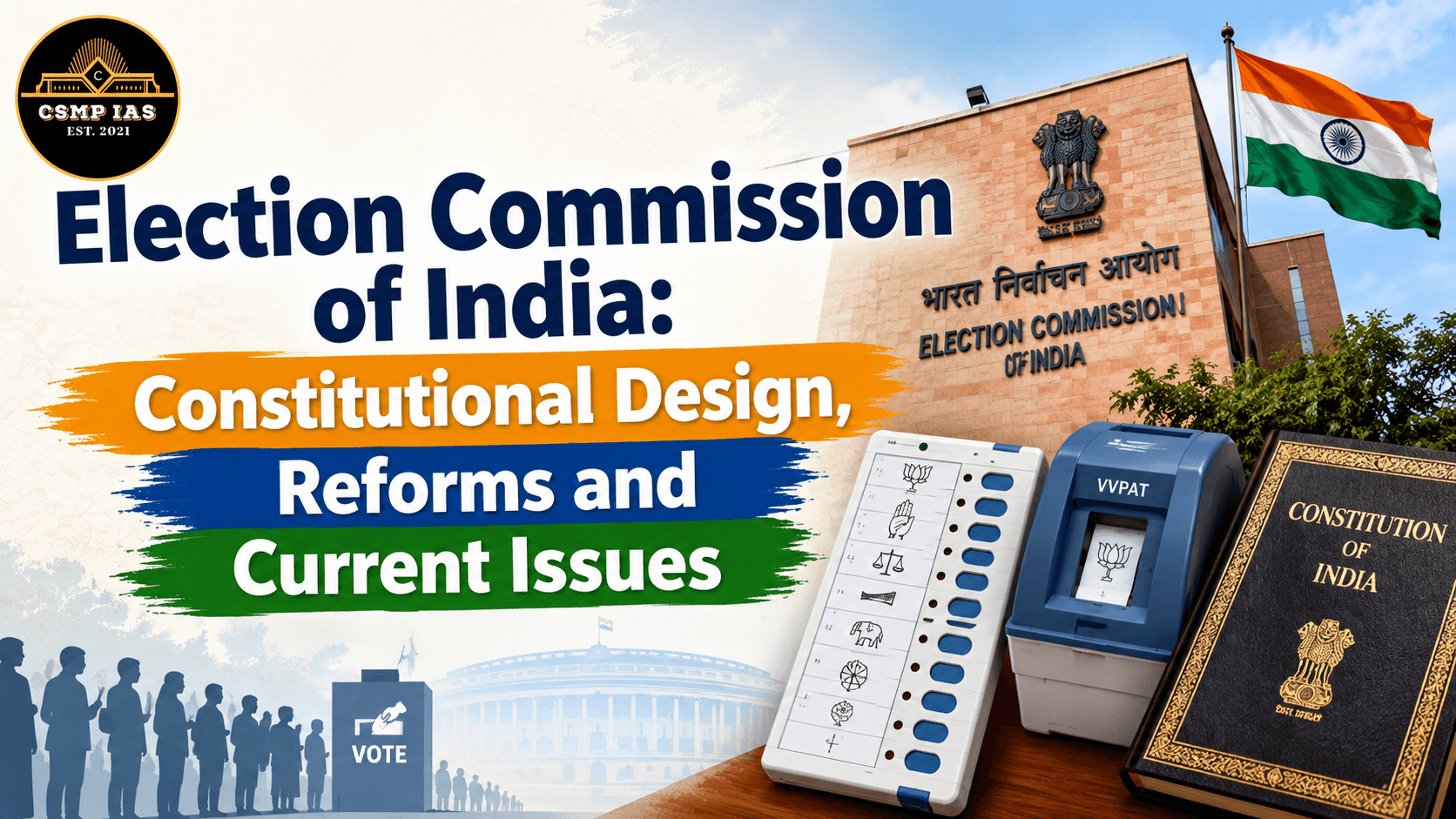
Election Commission of India: Constitutional Design, Reforms and Current Issues
A complete UPSC guide for Prelims, Mains (GS-II) and Essay | Updated to October 2026
Why this topic matters for UPSC
The Election Commission of India (ECI) sits at the centre of three things UPSC loves: constitutional bodies, electoral reforms and the health of democracy. It appears in Prelims as factual questions (articles, appointment, removal, powers), in Mains GS-II as analytical questions (autonomy, SIR, appointment law, ONOE), and in Essays on democracy and institutions. In 2026 the ECI has been in the news almost continuously, mainly because of the Special Intensive Revision (SIR) of electoral rolls and the legal fight over how the Commission is appointed and how it takes decisions.
Part 1: Static Background (Prelims Core)
Constitutional provisions (Part XV, Articles 324 to 329)
Article | Provision |
|---|---|
324 | Superintendence, direction and control of elections vested in the ECI; covers elections to Parliament, State Legislatures and offices of President and Vice-President |
325 | No person ineligible for the electoral roll on grounds of religion, race, caste or sex; one general roll |
326 | Adult suffrage; voting age 18 (61st Amendment, 1988) |
327 | Parliament’s power to make laws on elections to Legislatures |
328 | State Legislature’s power to make laws on elections to that Legislature |
329 | Bar on court interference in electoral matters; elections challenged only through an election petition (High Court) |
Note: Elections to Panchayats and Municipalities are conducted by the State Election Commissions (Articles 243K and 243ZA), not the ECI.
Composition and evolution
From 1950 to 1989 the ECI was a single-member body headed by the CEC.
In October 1989 two Election Commissioners were added briefly; the Commission became permanently multi-member in 1993 (CEC plus two ECs).
In T.N. Seshan v. Union of India (1995) the Supreme Court upheld the multi-member Commission and held that the CEC is not superior to the ECs; decisions are taken by majority, with equal say.
The ECI is a permanent body with no fixed term for the institution itself, but individual members have a tenure.
Appointment, tenure and removal
Before 2023: The President appointed the CEC and ECs on the advice of the Council of Ministers, in effect an executive choice.
Anoop Baranwal v. Union of India (March 2023): A Constitution Bench directed that, until Parliament legislates, appointments be made by a committee of the Prime Minister, the Leader of Opposition (or leader of the largest opposition party) and the Chief Justice of India.
CEC and Other ECs (Appointment, Conditions of Service and Term of Office) Act, 2023: Parliament replaced the CJI in the selection committee with a Union Cabinet Minister nominated by the Prime Minister. A Search Committee headed by the Cabinet Secretary prepares a panel of five names.
Tenure: Six years or until age 65, whichever is earlier.
Salary and service conditions: Equated with the Cabinet Secretary under the 2023 Act (earlier equated with Supreme Court judges), a point critics raise as a lowering of status.
Removal (Article 324(5)): The CEC can be removed only in the manner and on the grounds of a Supreme Court judge (a special majority impeachment-type process). Other ECs can be removed only on the recommendation of the CEC. This asymmetry is a favourite Mains point.
Powers and functions
Preparation and periodic revision of electoral rolls; registration of voters.
Announcing election schedules, supervising nomination, polling and counting.
Recognition of political parties and allotment of symbols (Symbols Order, 1968); resolving splits and disputes.
Enforcing the Model Code of Conduct (MCC), which is a set of guidelines and not a statute.
Advisory jurisdiction on post-election disqualification of legislators (Article 103 and 192) and quasi-judicial functions in certain disputes.
Postponing or countermanding polls where free and fair conditions are absent.
Residuary powers under Article 324, interpreted widely in Mohinder Singh Gill v. CEC (1978): where laws are silent, the Commission can act, but within constitutional limits and subject to judicial review and natural justice.
Landmark judgments to remember
Case | Takeaway |
|---|---|
Mohinder Singh Gill (1978) | Wide residuary power under Art. 324; must act fairly |
T.N. Seshan (1995) | Multi-member Commission valid; CEC not superior |
PUCL (2003), ADR (2002) | Voters’ right to know criminal, financial and educational background of candidates |
Lily Thomas (2013) | Disqualification on conviction with 2 years or more, with no 3-month protection |
Public Interest Foundation (2018) | Parties must publish criminal antecedents of candidates |
Anoop Baranwal (2023) | Independent appointment mechanism for CEC and ECs |
ADR v. Union of India (2024) | Electoral Bonds scheme struck down as violating the right to information |
Part 2: Current Issues (Mains Core)
1. Special Intensive Revision (SIR) of electoral rolls
What it is: A door-to-door, intensive re-verification of the electoral roll, in which electors are asked to fill enumeration forms and furnish documents, instead of the usual summary revision. It was first rolled out in Bihar in 2025 before the Assembly election and then extended to many States and UTs; reports indicate it was ordered in 23 States and UTs from April 2026.
ECI’s case:
Rolls carry duplicate, shifted and deceased voters; rapid urbanisation and migration make periodic cleaning essential.
Section 21(3) of the Representation of the People Act, 1950 lets the Commission order a special revision of rolls.
Clean rolls are the foundation of free and fair elections.
Critics’ concerns:
Risk of exclusion of genuine voters, especially migrants, the poor, women and marginalised groups who lack documents.
Burden of proof shifting from the State to the citizen.
Short timelines and doubts about due process.
Questions about whether the ECI is effectively judging citizenship, which is the Union Government’s domain under the Citizenship Act and Articles 5 to 11.
Opposition allegations of manipulation of rolls (the “vote chori” narrative), which the ECI rejects.
Judicial journey (as reported):
In the Bihar phase the Supreme Court allowed the exercise to continue while asking the ECI to accept Aadhaar as one of the documents and to publish details of deletions.
Reports say the Court, in January 2026, stressed that the ECI’s discretion under Section 21(3) must follow natural justice and the rules framed under the Act, rejecting “untrammelled” power.
On 27 May 2026 the Supreme Court upheld the SIR order, while imposing safeguards.
On 5 October 2026 a Bench led by CJI Surya Kant clarified that it had not approved any modified version of Form 6 used during SIR, even though it recognised the ECI’s residual authority to adapt documentation for such an exercise. The ECI maintains that its SIR decisions had the unanimous approval of the Commission.
UPSC angle: Link to Articles 324, 326 and 21, universal adult suffrage, proportionality, due process and the idea of “procedural fairness” in administrative law.
2. Internal functioning of the Commission and the “unilateral decision” petition
A petition before the Supreme Court questions whether the CEC can take decisions on behalf of the Commission without concurrence of the two other Election Commissioners. The plea, relying on media reports, claims that the two Election Commissioners recorded multiple objections (the plea speaks of at least 14) between October 2025 and August 2026. Reports say the Court refused an interim order restraining the CEC Gyanesh Kumar from discharging functions, but issued notice on the plea. The ECI’s position is that SIR decisions were unanimous.
Why it matters: The Seshan judgment settled that the CEC is primus inter pares and that the Commission works on collective decision-making. The case tests whether that principle is respected in practice. Note this is sub judice: in Mains answers, present both positions and avoid declaring a verdict.
3. Challenge to the 2023 appointment law
Petitions argue that removing the CJI from the selection committee lets the executive dominate appointments (the committee has a ruling-side majority), contradicting the spirit of Anoop Baranwal.
The government argues that Baranwal itself said the mechanism would operate until Parliament makes a law, and that Parliament is competent to legislate under Article 324(2).
Reports say that on 23 September 2026 two judges of a Supreme Court Bench differed on whether the matter should go to a Constitution Bench; the Court has not declared the Act unconstitutional.
Key concepts: separation of powers, legislative override of a judicial direction (can Parliament remove the “basis” of a judgment?), independence of constitutional bodies, and comparison with the CBI Director and Lokpal appointment committees.
4. Transparency, technology and EVM-VVPAT trust
In 2024 the Supreme Court declined to return to paper ballots and rejected 100 percent VVPAT slip counting, but allowed candidate-requested verification of burnt memory in a limited number of EVMs.
Demands persist for Form 17C data (polling-station-wise turnout) to be put in the public domain promptly.
Local-body polls held without VVPAT have drawn court questions (e.g., observations by the Bombay High Court).
The ECI’s digital push (the ECINET platform, cVIGIL, Voter Helpline, KYC apps) improves service delivery but raises data-protection and verification questions.
5. Model Code of Conduct and campaign regulation
The MCC has no statutory backing; the ECI enforces it through notices, censure and campaign bans.
Recurrent controversies: hate speech and communal appeals, freebies announced before polls, misuse of official machinery, and perceived asymmetry in action against ruling and opposition leaders.
Reform proposals: statutory backing for the MCC, faster action timelines, and a clearer penal framework.
6. Money in politics
The Electoral Bonds scheme was struck down in February 2024 as unconstitutional, and the Court ordered disclosure of donors.
Open questions remain on opaque donations, cash donations, expenditure ceilings and surrogate spending by parties and third-party actors.
Link: Representation of the People Act 1951 Sections 77 and 123, Companies Act amendments, Income Tax provisions for parties.
7. Criminalisation of politics
A significant share of legislators face criminal cases (ADR analyses regularly show this).
Court-directed disclosure norms exist, but disqualification on framing of charges needs Parliament; the ECI has repeatedly recommended it.
The Court has also pushed for fast-track courts for cases against legislators.
8. One Nation One Election (ONOE)
The Constitution (129th Amendment) Bill, 2024 and a companion Union Territories bill were referred to a Joint Parliamentary Committee for simultaneous Lok Sabha and Assembly polls.
Arguments for: lower cost, less MCC disruption, better governance continuity, higher turnout.
Arguments against: federal concerns, curtailing Assembly terms, logistical load on EVM/VVPAT and security forces, and the need for a constitutional amendment possibly requiring State ratification.
The ECI’s logistical readiness (EVM procurement, manpower) is central here.
9. Other reform threads UPSC may pick up
Remote voting for migrants (RVM prototype) and low urban and migrant turnout.
Women’s reservation (Nari Shakti Vandan Adhiniyam) and its link to delimitation and the census, which will need ECI and Delimitation Commission readiness.
Independent secretariat and budget charged on the Consolidated Fund (long-standing demand, as in the Law Commission’s 255th Report, 2015, which also urged wider consultation in appointments and equal removal protection for all ECs).
Internal party democracy and regulation of political parties; deregistration of inactive parties.
ECI’s international role: India has been associated with International IDEA leadership, projecting the Indian election model to the Global South.
Part 3: Analysis Framework
Strengths of the ECI
Conducts the world’s largest elections with high turnout and acceptance of results by most losers over decades.
Wide constitutional powers, judicial backing, and a record of innovation (EVMs, photo ID, SVEEP voter awareness).
Institutional confidence built during the Seshan era (1990s).
Weaknesses and risks
Appointment process tilted towards the executive; unequal removal protection for ECs.
Dependence on the Ministry of Law for budget and staff; borrowed state machinery during polls.
Perceived inconsistency in MCC enforcement; slow disposal of complaints.
Trust deficit when transparency is lacking (turnout data, roll deletions, VVPAT).
Way forward
A broad-based, balanced selection committee and equal removal protection for all members.
An independent secretariat and budget (as with the CAG and UPSC).
Statutory MCC, time-bound complaint redressal, and transparent reasoned orders.
SIR conducted with due process: adequate time, accepted documents including Aadhaar-based options where the Court has allowed, publicly available lists of deletions with reasons, and an easy appeal route.
Routine proactive disclosure (Form 17C, roll data) and independent audits of EVM/VVPAT.
Stronger party finance transparency and decriminalisation measures through Parliament.
Capacity building for migrant voting and inclusive enrolment.
Part 4: Exam Toolkit
Prelims quick facts
Article 324 gives the ECI power over Parliament, State Legislature, President and Vice-President elections.
Panchayat and municipal elections are with State Election Commissions.
Tenure of CEC and ECs: 6 years or 65 years.
CEC removal like a Supreme Court judge; ECs removed on CEC’s recommendation.
MCC is non-statutory.
Symbols are allotted under the Symbols Order, 1968.
Representation of the People Acts: 1950 (rolls, delimitation of seats) and 1951 (conduct of elections, disqualification, offences).
Present CEC: Gyanesh Kumar (took charge February 2025).
Likely Mains questions
“The independence of the Election Commission is central to democracy, yet recent developments raise concerns.” Discuss with reference to the 2023 appointment law. (250 words)
Examine the constitutional and legal basis of the Special Intensive Revision of electoral rolls. Does it strike a balance between roll purity and inclusion? (250 words)
Critically analyse the case for and against One Nation One Election. (250 words)
Why is the Model Code of Conduct often criticised as ineffective? Suggest reforms. (150 words)
Discuss the role of the Supreme Court in shaping electoral reforms in India. (250 words)
Answer-writing tips
Start with Article 324 and a one-line context (SIR or 2023 Act).
Present both sides on sub judice issues; use phrases like “critics argue” and “the ECI maintains”.
Add case laws (Seshan, Anoop Baranwal, Mohinder Singh Gill, ADR) as value-additions.
Close with a balanced, constitution-centred way forward.
Essay hooks
“Free and fair elections are the heartbeat of democracy.”
“Institutions are only as strong as the trust people place in them.”
“Ballot over bullet: can a democracy afford a referee who is doubted?”
Conclusion
The ECI’s journey from a single-member office to a powerful constitutional authority shows how Indian democracy has been built on institutional strengthening. In 2026, the Commission faces a defining test: it must complete large exercises like SIR with fairness, transparency and inclusion, ensure collegial decision-making, and retain public trust amid a pending debate on how its members are chosen. For aspirants, the safest approach is to learn the constitutional scheme thoroughly, track Supreme Court developments, and write balanced, evidence-based answers.
Disclaimer: Several of the issues above (the SIR proceedings, the plea on unilateral decisions, and the challenge to the 2023 Act) are ongoing in the Supreme Court. Please verify the latest status from the ECI website, PIB and The Hindu or Indian Express before your exam.