India's Sugar Crisis: A Complete Guide for UPSC Aspirants
Introduction
Sugar is more than a sweetener in India's economy — it is a political commodity, a rural livelihood issue, an energy security lever, and a recurring headache for policymakers. For UPSC aspirants, the "sugar crisis" is a goldmine of a topic because it sits at the intersection of GS Paper III (Agriculture, Food Processing, Infrastructure, Energy Security), GS Paper II (Government Policies, Federalism, Centre-State relations), and even Prelims (statutory bodies, schemes, terminology like FRP, SAP, and the Sugarcane Control Order).
Unlike a one-time event, the "sugar crisis" in India is really a cluster of recurring problems: a boom-bust production cycle, chronic cane payment arrears to farmers, volatile export-import policy, and now, a fresh twist — the diversion of sugarcane towards ethanol production, which in 2026 has, for the first time in a decade, pushed India to import sugar. This blog unpacks the structural roots of the crisis, the government's policy responses, and the way forward, all framed for exam relevance.
Why Sugar Matters: The Economic and Political Weight of an Industry
India is the world's largest consumer of sugar and its second-largest producer after Brazil. The sugar industry supports over 5 crore farmers and their families, along with lakhs of workers employed in nearly 500 sugar mills spread mainly across Uttar Pradesh, Maharashtra, and Karnataka. Sugarcane is also a politically sensitive crop — cane farmers form a powerful electoral bloc in western UP and western Maharashtra, which explains why cane pricing decisions are rarely made on economic logic alone.
This dual identity — as an agro-industrial commodity and a vote-bank crop — is central to understanding why India's sugar policy oscillates so sharply between surplus-management (export pushes, stock limits) and shortage-management (import duty cuts, export bans) almost every few years.
Anatomy of the Crisis: Four Recurring Problems
1. The Boom-Bust Production Cycle
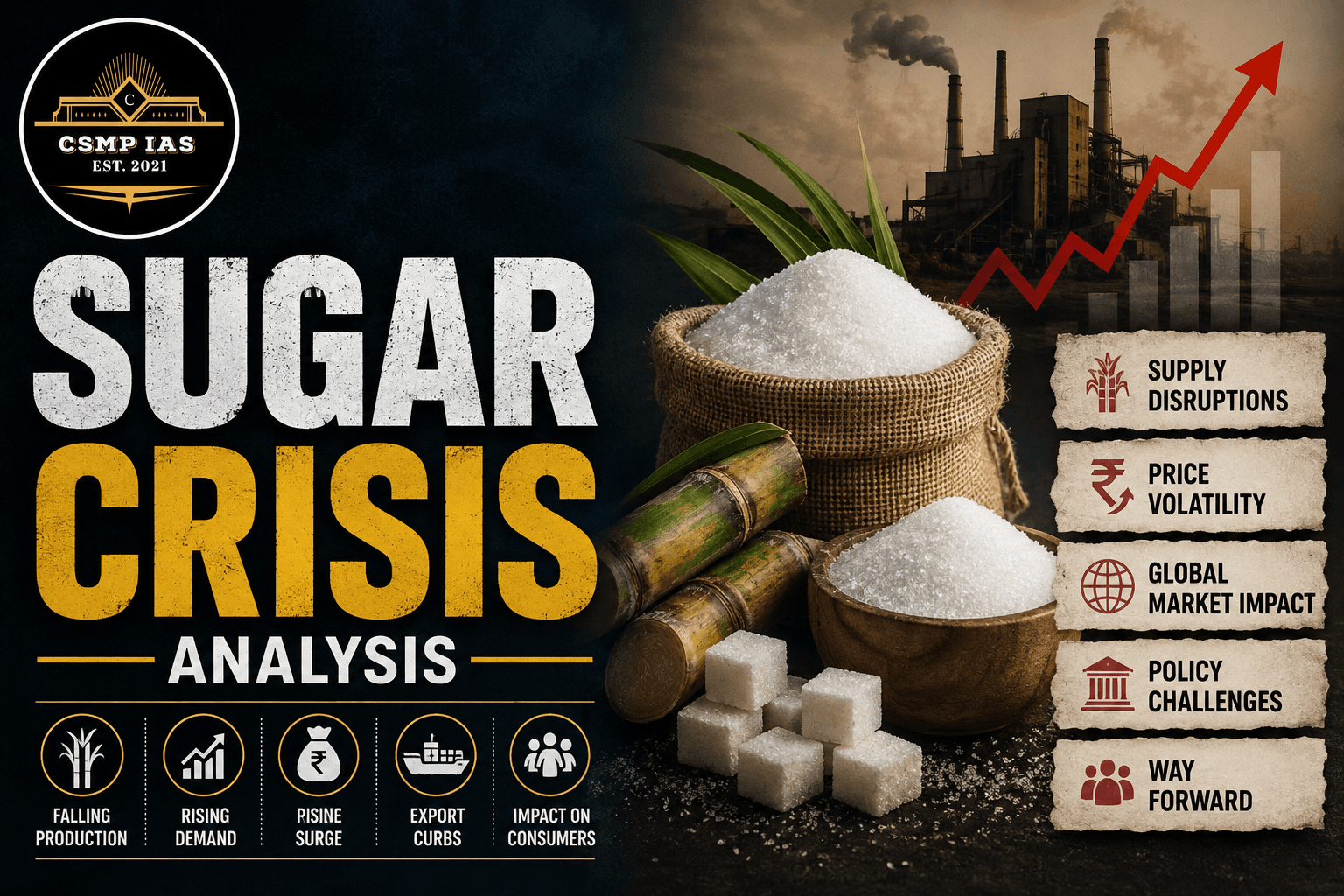
Sugarcane is a long-duration, water-intensive crop grown predominantly in areas that are not naturally rain-abundant enough to sustain it (western Maharashtra, parts of Karnataka). This creates a structural mismatch: a good monsoon leads to overproduction and crashing mill-gate prices, while a poor monsoon triggers shortages and price spikes. The most dramatic recent instance of this was the 2025-26 sugar season, which produced significantly less sugar than domestic consumption required. This forced the government, in mid-2026, to use four different policy instruments in as many months — an export ban (May), stock limits on dealers and bulk buyers (through August), and finally a duty-free import quota of one million tonnes of raw sugar opened in August 2026 — India's first import for domestic use since 2017-18.
2. The Cane Arrears Problem
Perhaps the most persistent irritant in the sugar economy is the delay in payment of cane dues by mills to farmers. Mills are legally required to pay farmers within 14 days of cane purchase, failing which 15% annual interest becomes payable — a rule retained even in the draft Sugarcane (Control) Order, 2026. Yet arrears routinely run into billions of dollars nationally. Industry data for the current season shows mills have disbursed about 80% of nearly $8.87 billion in total cane arrears, leaving close to $1.79 billion still outstanding, with Uttar Pradesh and Maharashtra among the worst affected states, and Karnataka posting a sharp reversal from having zero arrears in the previous two years to becoming a major defaulter. These arrears occur because sugar prices are market-determined while cane prices are administratively fixed (see below), so when sugar prices fall or working capital gets tight, mills simply delay payments — a burden that falls entirely on farmers.
3. The Dual Pricing Mechanism: FRP vs SAP
This is a favourite Prelims trap and deserves careful understanding:
Fair and Remunerative Price (FRP): Announced by the Central Government (on the recommendation of the Commission for Agricultural Costs and Prices, CACP) under the Sugarcane (Control) Order, 1966 (soon to be replaced by the draft 2026 Order). It is the minimum price mills must legally pay farmers for cane, linked to a base sugar recovery rate, with a premium for higher recovery.
State Advised Price (SAP): Certain states — most notably Uttar Pradesh, Punjab, and Haryana — announce their own cane price, which is typically higher than the FRP. This is not mandated by the Centre but is a political commitment states make to their cane-growing constituencies.
The gap between FRP and SAP is a major source of the crisis: SAP often ignores the underlying economics of what mills can recover from sugar and by-product (ethanol, bagasse, molasses) sales, forcing mills into losses that eventually surface as arrears. Even repeated adjustments to the FRP — currently around ₹31,000 per tonne in some benchmarks — have not kept pace with rising production costs or matched SAP levels in key states, keeping this tension alive.
4. Volatile Trade Policy
Because domestic prices are politically sensitive (sugar is a component of the WPI/CPI food basket) and cane payments depend on mills' export earnings, India's sugar trade policy swings unpredictably: export subsidies and incentives during surplus years, followed by abrupt export bans and stock-holding limits during shortages, as witnessed in 2023-24 and again through 2025-26. This unpredictability has repeatedly invited criticism — and formal disputes — at the WTO.
The Ethanol Twist: A New Layer to the Old Crisis
The most important recent development for aspirants to track is how India's ethanol blending programme has reshaped the sugar crisis. India achieved 20% ethanol blending in petrol (the E20 target) during the 2025-26 supply year — five years ahead of the original 2030 deadline (itself earlier advanced from 2030 to 2025) — and E20 became mandatory nationwide from April 2026. This is a genuine energy-security and farmer-income success story: ethanol blending helps India cut its crude oil import bill, reduces foreign exchange outflow, cuts vehicular pollution, and gives sugarcane growers/mills an assured, less volatile revenue stream compared to relying solely on sugar sales.
However, the 2025-26 season also exposed a structural flaw: diversion targets for cane towards ethanol are fixed administratively before the crushing season begins, based on expected production. When the actual cane crop underperforms — as it did in 2025-26 — the volume of sucrose already committed to ethanol does not adjust downward, directly squeezing the sugar available for human consumption. About 3.5 million tonnes of sugar-equivalent went into ethanol production in 2025-26 even as the country ended up short of sugar for its own festive-season demand, contributing directly to the imports and export ban described above. Notably, maize has now overtaken cane as the source of nearly half of India's ethanol, partially decoupling the blending programme from sugarcane availability going forward — a trend worth watching for how it might ease sugar-versus-fuel competition in future seasons.
The government has tried to make the system more responsive: from November 2025, it permitted all forms of sugarcane-derived feedstock — juice, syrup, B-heavy and C-heavy molasses — to be used for ethanol (reversing an earlier 2023-24 restriction that had been imposed specifically to protect sugar stocks). This flip-flop itself illustrates the underlying policy dilemma: promoting ethanol and protecting sugar-consumers' interests can pull in opposite directions when the cane harvest is uncertain.
Institutional and Policy Framework: What Aspirants Must Know
Sugarcane (Control) Order, 1966 / Draft Sugarcane (Control) Order, 2026: The 2026 draft update prioritises ethanol production (linking 600 litres of ethanol to one tonne of sugar for quota purposes), formally brings khandsari (traditional, informal sugar) production under the FRP regime for the first time — covering roughly 13.5 million tonnes of cane annually that was earlier outside formal regulation — mandates a 25-km radius rule for new sugar factories to prevent cane-sourcing conflicts between mills, and retains the 14-day payment window with 15% penal interest for delays.
Rangarajan Committee (2012): Recommended decontrolling the sugar sector — abolishing the levy sugar obligation (mills earlier had to sell a portion of production to the government at below-market rates for the Public Distribution System) and the regulated release mechanism that controlled how much sugar mills could sell each month. Most of these recommendations were implemented in 2013, though cane pricing itself was left outside full decontrol, which many economists argue is the unfinished half of the reform.
Ethanol Blending Programme (EBP) and NITI Aayog's Roadmap for Ethanol Blending in India by 2025: Provides the roadmap for the E20 target and the broader ambition of E85-capable flex-fuel vehicles.
Ethanol Supply Year (ESY): Runs November to October, distinct from the sugar season (October–September), which occasionally causes reporting and comparison confusion — a subtle point worth remembering for Mains answers.
WTO Dispute (DS579/DS580/DS581): Australia, Brazil, and Guatemala challenged India's sugar subsidies (including the Minimum Indicative Export Quota and production/export subsidies) as violating WTO Agreement on Subsidies and Countervailing Measures commitments. A WTO panel ruled against India in 2021; India appealed, but with the WTO's Appellate Body largely non-functional, the case remains in limbo — a good example of the broader crisis in multilateral trade dispute settlement that aspirants can cross-link to GS Paper II/III trade governance questions.
Why Does This Keep Happening? A Structural Diagnosis
Price signals are broken. Cane price (FRP/SAP) is fixed administratively and de-linked from sugar market prices, unlike in Brazil, where cane payment is directly linked to a revenue-sharing formula tied to sugar and ethanol realisation. This misalignment is the root cause of chronic arrears.
Water-intensive cropping in water-stressed regions. Cane cultivation in Maharashtra and parts of Karnataka strains groundwater and competes with other crops, worsening agrarian distress during droughts and creating supply volatility.
Reactive, not anticipatory, policymaking. Export bans, stock limits, and import duty changes are typically announced only after a crisis has visibly emerged, rather than through early-warning production forecasting — despite India having reasonably good crop-estimation capacity.
Competing policy objectives. Energy security (ethanol) versus food/sugar security versus farmer income support versus consumer price stability are all legitimate goals, but current instruments are not designed to optimise across all four simultaneously.
Fragmented mill ownership and financial fragility. Many cooperative sugar mills, especially in Maharashtra, are politically controlled and financially weak, making them structurally prone to delaying farmer payments during downturns.
The Way Forward
Link cane pricing to a revenue-sharing formula (as recommended by the Rangarajan Committee) so that cane price automatically reflects actual sugar/ethanol/by-product realisation, reducing arrears risk.
Dynamic, data-driven ethanol diversion targets that adjust in real time as crushing-season production estimates firm up, rather than being locked in administratively before the season starts.
Diversify ethanol feedstock further towards maize and grain-based sources, as is already happening, to reduce the sugar sector's exposure to fuel-blending demand shocks.
Encourage micro-irrigation and crop diversification in water-stressed cane belts to stabilise yields and reduce the boom-bust cycle.
Predictable, rules-based trade policy — for example, a transparent stock-to-consumption-ratio trigger for export/import decisions — instead of discretionary, reactive bans and quotas, which would also strengthen India's position in ongoing WTO-related disputes.
Formalisation of khandsari and other informal cane-processing units under the FRP regime, as the draft 2026 Order attempts, to bring farmer protections to a wider base.
Conclusion
The Indian sugar sector illustrates a classic policy trilemma: balancing farmer remuneration, consumer price stability, and now energy-security ambitions through ethanol, all within a crop that is inherently vulnerable to monsoon variability. The events of 2025-26 — a production shortfall, an export ban, stock limits, and finally sugar imports after a decade — are not an isolated crisis but the latest episode in a long-running structural story. For UPSC aspirants, the sugar crisis offers rich material to demonstrate an integrated understanding of agriculture, industry, trade, and energy policy — exactly the kind of interlinked analysis that Mains answers reward. Rather than memorising isolated facts, aspirants should focus on the underlying causal chain: administered cane prices → mill financial stress → payment arrears → volatile trade policy → and now, an added layer of ethanol-driven demand competing directly with sugar for the same raw material.
This piece is intended as a conceptual and current-affairs primer. Aspirants should supplement it with the latest Economic Survey chapter on agriculture, PIB releases on the Sugarcane (Control) Order 2026, and recent PRS/press coverage for the most current statistics before Mains answer writing.