India–UK Vision 2035 and CETA: What Every PCS Aspirant Must Know
A full-length breakdown of the Comprehensive Economic and Trade Agreement, the Vision 2035 roadmap, and why this bilateral moment matters for UPPSC, BPSC, MPPSC and every state PCS Mains answer on India's foreign policy.
Tags: GS Paper II · International Relations · India–UK Relations · Free Trade Agreements Reading time: 15 min · Relevance: Prelims & Mains · Syllabus: Effect of Policies of Developed & Developing Countries on India's Interests
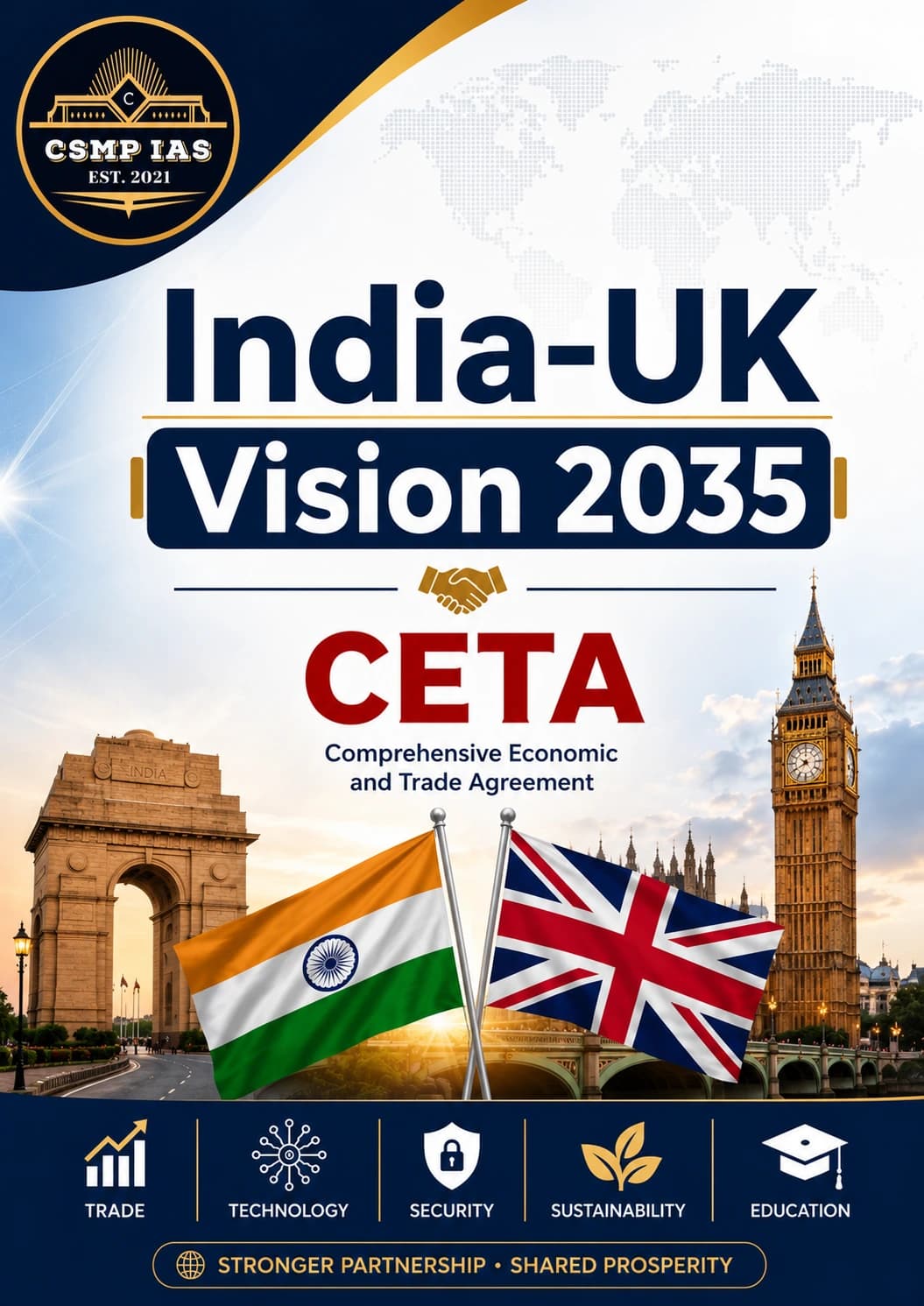
On the last week of July 2025, London became the venue for one of the more consequential turns in India's post-Brexit foreign policy: the unveiling of the India–UK Vision 2035 roadmap alongside the signing of the Comprehensive Economic and Trade Agreement (CETA). For a PCS aspirant, this is not just another current affairs headline to skim past — it sits squarely inside "Effect of policies and politics of developed and developing countries on India's interests," a theme that shows up in prelims facts, mains answers, and even essay papers with predictable regularity. This piece walks through the agreement, its architecture, its history, its friction points, and — most importantly — how to convert all of this into exam-ready material.
01. Why Is This in the News?
During the Indian Prime Minister's visit to the United Kingdom, the two governments formally unveiled the India–UK Vision 2035 roadmap and signed the CETA — a free trade agreement years in the making. The headline ambition attached to the deal is unambiguous: to push bilateral trade beyond USD 100 billion by 2030, nearly doubling the current trade volume between the two economies. The agreement's implementation will be overseen by a body called the Joint Economic and Trade Committee (JETCO), and both sides have also flagged plans to advance a separate Bilateral Investment Treaty (BIT) in parallel — a reminder that trade and investment liberalisation, while related, are negotiated as distinct legal instruments.
Quick Context CETA is the free trade agreement; Vision 2035 is the broader strategic roadmap that CETA sits inside. Aspirants often conflate the two in Mains answers — keep the distinction clean. CETA governs tariffs, services, and market access. Vision 2035 governs the full sweep of the relationship: trade, technology, defence, climate, education, and diaspora.
02. Inside India–UK Vision 2035: The Six Pillars
Vision 2035 is best understood not as a single agreement but as a strategic architecture built on six connected pillars. Each pillar carries its own institutional mechanism, and examiners tend to test the specific body or initiative tied to each pillar rather than the pillar's name alone — so pay attention to the nouns below.
Trade & Economic Cooperation — CETA sits at the centre of this pillar. Implementation runs through JETCO, with a Bilateral Investment Treaty planned as the next step to protect cross-border capital flows.
Technology & Innovation — Anchored by the Technology Security Initiative, targeting next-generation domains: artificial intelligence, quantum computing, telecom, and critical minerals.
Defence — A ten-year defence industrial roadmap covering joint research and manufacturing in jet engine technology, maritime security, and directed energy weapons.
Climate & Sustainability — Joint mobilisation of green finance, cooperation on offshore wind and nuclear technology, and shared supply chains for green goods.
Education & Skills — UK university campuses in India, Mutual Recognition of Qualifications, and a Green Skills Partnership tied to climate-linked job creation.
Global Governance — A shared push for reform at the UN, WTO, IMF, and World Bank — positioning the partnership within India's broader multilateral diplomacy.
Defence: The Details That Matter
The defence pillar deserves special attention because it moves beyond symbolic cooperation into hardware and doctrine. Beyond the ten-year industrial roadmap, the UK has indicated it will lean on India for logistics support in the Indian Ocean Region — a notable acknowledgment of India's growing maritime centrality. The two countries will also work together under the Indo-Pacific Oceans' Initiative (IPOI) to establish a Regional Maritime Security Centre of Excellence (RMSCE), aimed at tackling non-traditional maritime threats such as piracy, trafficking, and illegal fishing rather than conventional state-on-state conflict.
Climate: Institutions to Remember
On climate, the roadmap does not invent new institutions from scratch but routes cooperation through existing platforms India already anchors — principally the International Solar Alliance and the Coalition for Disaster Resilient Infrastructure (CDRI). This is a useful exam point: it shows how India uses its own multilateral creations as delivery vehicles for bilateral partnerships, reinforcing India's positioning as a rule-shaper rather than a rule-taker in the climate space.
03. CETA: The Trade Agreement, Clause by Clause
If Vision 2035 is the umbrella, CETA is the load-bearing structure underneath it. This is the part most likely to be tested with specific numbers, so treat the table below as a revision anchor.
CETA — Key Provisions at a Glance
Area Provision Market access for India 99% duty-free access to the UK market, benefiting textiles, leather, marine products, and electric/hybrid vehicles and components Market access for UK India to cut or eliminate duties on 90% of tariff lines, covering 92% of UK imports, including cars and alcohol Electric vehicles India to eliminate tariffs on UK EVs in the agreement's sixth year; no duties on EVs priced below GBP 40,000 Services Expanded access for Indian professionals and firms in IT, financial services, and education; simplified visas for engineering, architecture, and hospitality Social security Double Contribution Convention exempts Indian professionals and employers from UK social security contributions for three years Inclusion mandate Provisions supporting participation of women, youth, MSMEs, farmers, and innovators in global value chains Agriculture Tariff reductions on processed foods, edible oils, and seafood exports to the UK
Why the Double Contribution Convention Matters
Of all the CETA provisions, the Double Contribution Convention is arguably the most consequential for India's services economy, even though it rarely gets headline attention. Indian IT and consulting firms have long argued that mandatory UK social security contributions on short-term deputed staff made Indian talent more expensive than it needed to be, without those workers ever drawing UK social security benefits. A three-year exemption directly improves cost competitiveness for Indian professionals on secondment — this is the kind of granular provision that separates a well-informed Mains answer from a generic one.
Reading the Tariff Numbers Correctly
A common examiner trap is to test whether aspirants understand that India's 99% duty-free access and the UK's 90% tariff-line reduction are not mirror images — they are asymmetric commitments reflecting different economic structures. India's offer covers more tariff lines but on select high-sensitivity goods like automobiles and Scotch whisky, liberalisation is staggered over years rather than immediate, precisely to protect domestic industry during the transition.
Impact Snapshot
CETA aims to double bilateral trade by 2030, targeting nearly USD 112 billion in combined goods and services trade.
UK exports to India are projected to rise by 60% by 2040.
Job creation is expected across manufacturing, services, and agriculture in both economies.
MSME- and startup-friendly provisions are designed to encourage fresh investment flows.
04. Whose Interests Does CETA Actually Serve?
Every FTA is a negotiated trade-off, and CETA is no exception. Reading the agreement only through the lens of "India gains X, UK gains Y" misses the more useful exam question: which domestic constituencies inside each country stand to gain the most, and which stand to face adjustment pressure? This is the kind of analytical layer that turns a factual answer into an evaluative one.
What India Gains
India's labour-intensive export sectors are the clearest beneficiaries. Textiles, leather, and marine products have long faced tariff disadvantages against competitors like Bangladesh and Vietnam in the UK market; near-total duty-free access closes that gap and could meaningfully shift export volumes over the medium term. The services concessions matter just as much, even if they attract less public attention — Indian IT services, financial services, and education-linked mobility all gain from simplified visa routes, and the Double Contribution Convention directly lowers the cost of deploying Indian talent in the UK. For India's policymakers, there is also a diplomatic dividend: CETA is India's most significant FTA with a G7 economy since the country largely stepped back from mega-regional trade blocs such as the Regional Comprehensive Economic Partnership (RCEP) in 2019, and it signals that India can conclude ambitious bilateral deals even while remaining cautious about multilateral ones.
What the UK Gains
For the UK, still recalibrating its trade architecture after Brexit, CETA offers access to one of the world's fastest-growing large economies at a moment when traditional European markets offer limited additional upside. British automobile manufacturers, Scotch whisky producers, and financial services firms are the most visible winners, gaining phased access to India's large and increasingly affluent consumer base. Politically, the deal also lets the UK government point to a tangible, high-profile trade achievement independent of the European Union — a narrative that carries weight in domestic British politics regardless of which party is in office.
Who Faces Adjustment Pressure
No FTA is cost-free for domestic industry, and honest analysis has to acknowledge this. In India, sectors like automobiles and spirits will see gradually rising import competition as tariffs phase down, even though the staggered timelines — such as the six-year runway before EV tariffs fall — are specifically designed to give domestic manufacturers time to adjust. On the UK side, some domestic services providers may face new competitive pressure from Indian professionals entering under liberalised visa categories, a point that has featured in UK domestic political debate around the agreement. Recognising these adjustment costs, rather than presenting CETA as a purely win-win outcome, is what separates a nuanced Mains answer from a promotional one.
05. How India–UK Relations Got Here
No Mains answer on this topic is complete without situating CETA inside the longer arc of the relationship. Trade, technology, defence, health, and diaspora ties have all deepened steadily over the past decade, and each has its own thread worth tracing.
Trade & Investment Bilateral trade reached USD 21.34 billion in 2023–24. India's exports to the UK rose 12.6% to USD 14.5 billion in 2024–25, while imports from the UK grew 2.3% to USD 8.6 billion — a trend suggesting India has been running a growing trade surplus with the UK even before CETA's tariff cuts take effect.
Technology & Research The India–UK Technology Security Initiative, launched in 2024, focuses on AI, semiconductors, and cybersecurity. The UK is now India's second-largest research partner after the United States, and the two countries jointly run a "NET Zero" Innovation Virtual Centre focused on green hydrogen and decarbonisation. The UK has also named India a partner in its International Science Partnership Fund.
Defence & Security Joint military exercises — Konkan (naval), Cobra Warrior (air), and Ajeya Warrior (army) — have steadily built interoperability, with an increasing focus on Indo-Pacific cooperation and shared defence technology.
Health Cooperation The Covid-19 pandemic produced one of the relationship's most visible collaborations — the AstraZeneca-Serum Institute vaccine partnership. Beyond the pandemic, over 60,000 Indians work in the UK's National Health Service, forming a quiet but substantial pillar of the bilateral relationship.
The Diaspora Factor The UK is home to 1.86 million people of Indian origin — a community with outsized influence in British science, arts, business, and politics, and a natural constituency for deepening ties on both sides.
06. The Friction Points Examiners Love to Test
A mature Mains answer never presents a bilateral relationship as friction-free. India–UK ties carry real points of disagreement, and these are precisely the details that distinguish a balanced, examiner-friendly answer from a one-sided summary of achievements.
Extradition Disputes — India has repeatedly accused the UK of sheltering economic fugitives — the Vijay Mallya case being the most cited example — and the UK's reluctance to expedite extradition continues to strain legal and diplomatic trust between the two sides.
Divergence on Russia-Ukraine — India's studied neutrality on the Russia-Ukraine war sits uneasily alongside the UK's strong, explicit support for Ukraine, producing periodic strategic discomfort even as both sides try to compartmentalise the disagreement.
Carbon Border Adjustment Mechanism (CBAM) — The UK's planned carbon border tax risks raising costs for carbon-intensive Indian exports such as steel. India views such mechanisms with suspicion, framing them as a form of climate protectionism rather than genuine environmental policy.
Khalistani Activity in the UK — Pro-Khalistani protests and activity on British soil remain a recurring irritant, with India pressing for firmer UK action against groups it views as extremist and a threat to Indian diplomatic missions and personnel.
Intellectual Property Rights — The UK's push for stringent IP protection standards runs up against India's need to preserve flexibility for affordable generic medicines — a familiar fault line in nearly every India-developed country trade negotiation, from the EU to the US.
07. The Way Forward: What India Can Do
Every well-rounded Mains answer on a bilateral relationship should close with a forward-looking dimension rather than stopping at description. On India–UK ties specifically, four directions stand out as the most exam-relevant:
Deepen security engagement by leveraging platforms such as AUKUS-adjacent cooperation and expanding joint work on Indo-Pacific strategy, counterterrorism, and cyber defence.
Scale up joint climate action through shared research platforms on clean energy, sustainable agriculture, and green innovation, building on the NET Zero Innovation Virtual Centre model.
Use trade diplomacy to attract investment, positioning India more assertively as a hub for Global Capability Centres (GCCs) that multinational firms are increasingly relocating to India.
Mobilise the diaspora — the 1.86 million-strong Indian community in the UK remains an underused lever for political, cultural, and economic outreach, and a more structured diaspora engagement strategy could pay long-term dividends.
Conclusion, in One Paragraph India–UK Vision 2035 and CETA together deepen a strategic, economic, and technological relationship across trade, innovation, defence, and climate. The genuine friction points — extradition, Ukraine, CBAM, Khalistani activity, and IP — have not disappeared, and how both sides manage them will determine whether this becomes a template for India's other developed-economy partnerships or simply a well-signed document. Careful diplomacy on the unresolved issues, alongside disciplined implementation of CETA's tariff schedule, will decide how "future-ready" this partnership actually turns out to be.
08. Placing CETA in India's Wider FTA Strategy
CETA does not exist in isolation — it is the latest entry in a deliberate pattern of bilateral deal-making that India has pursued since stepping back from RCEP. Understanding this pattern helps aspirants answer comparative questions that examiners are increasingly fond of setting.
India signed a Comprehensive Economic Partnership Agreement (CEPA) with the UAE in 2022, followed by an Economic Cooperation and Trade Agreement (ECTA) with Australia the same year, and more recently a trade agreement with the European Free Trade Association (EFTA) bloc. CETA with the UK fits this same template: rather than negotiating inside large multilateral groupings where consensus is difficult and concessions get diluted, India has chosen to pursue narrower, deeper bilateral agreements with individual trade partners or smaller blocs where the terms can be tailored more precisely to Indian sensitivities — protecting agriculture and dairy in particular, sectors India has kept largely insulated across all these deals.
What sets CETA apart from the UAE and Australia agreements is the sheer weight of the services and mobility provisions. The Double Contribution Convention has no real precedent in India's other FTAs, and the ten-year defence industrial roadmap attached to Vision 2035 gives this partnership a strategic depth that a purely commercial agreement like ECTA with Australia does not carry. For essay and Mains answers on India's trade diplomacy, CETA is best framed as the point where India's FTA strategy matured from primarily tariff-focused deals into agreements that bundle trade, mobility, technology, and defence into a single strategic package.
Comparative Note for Mains If asked to compare India's recent FTAs, structure your answer along three axes: depth (tariff lines covered), breadth (services, mobility, investment, defence bundled in or not), and strategic weight (does the partner sit inside India's Indo-Pacific or technology-security calculus). CETA scores high on all three axes, which is precisely why it has been packaged inside a "Vision 2035" strategic roadmap rather than released as a standalone trade document.
Exam Corner: Converting This Into Marks
This topic maps directly onto GS Paper II — "Effect of policies and politics of developed and developing countries on India's interests" — and onto GS Paper III for the trade and economic dimensions. It is also a natural fit for the optional Public Administration and International Relations papers offered in several state PCS Mains examinations, where questions on bilateral economic diplomacy are a recurring feature. Below is how it has already been tested, and how it is likely to appear again.
Prelims PYQ — 2016 The term 'Regional Comprehensive Economic Partnership' often appears in the news in the context of the affairs of a group of countries known as: (a) G20 (b) ASEAN (c) SCO (d) SAARC — Answer: (b)
Prelims PYQ — 2021 A statement-based question on how India's parliamentary democracy differs from the British model, testing the limits of Parliament's amending power versus British parliamentary sovereignty — Answer: Both statements correct
Mains PYQ — 2020 "The judicial systems in India and the UK seem to be converging as well as diverging in recent times." Aspirants are asked to identify points of convergence and divergence — a useful reminder that India–UK comparisons extend well beyond trade into governance and institutions.
Likely Mains Framing Examine the strategic significance of the India–UK Vision 2035 roadmap and assess how it redefines bilateral relations in a post-Brexit world. Structure your answer around: (i) the CETA's economic weight, (ii) the technology and defence pillars, (iii) unresolved friction points, and (iv) a forward-looking recommendation.
Prelims facts worth memorising verbatim: 99% duty-free access for India; 90% tariff lines / 92% imports cut by India; EV tariff elimination in year six, threshold GBP 40,000; three-year Double Contribution Convention exemption; USD 100 billion trade target by 2030; USD 112 billion combined trade projection; 60% rise in UK exports to India by 2040; 1.86 million Indian-origin population in the UK; JETCO as the implementation body. Keep these numbers in a single revision card — prelims setters routinely lift such figures directly into option choices.
A Note From the CSMP IAS Desk Treat CETA the way you would treat any major FTA in your revision notes: one clean table for tariff numbers, one timeline for how the relationship evolved, and one honest list of frictions. Examiners reward aspirants who can hold both the achievement and the tension in the same answer — this piece is structured to help you do exactly that.