Jet Streams: A Complete Guide for UPSC Aspirants
. They link atmospheric circulation, Indian monsoon dynamics, weather phenomena, and climate change, so they can appear in Prelims, Mains (GS-1), and even the Optional paper. This guide covers everything you need.
What Are Jet Streams?
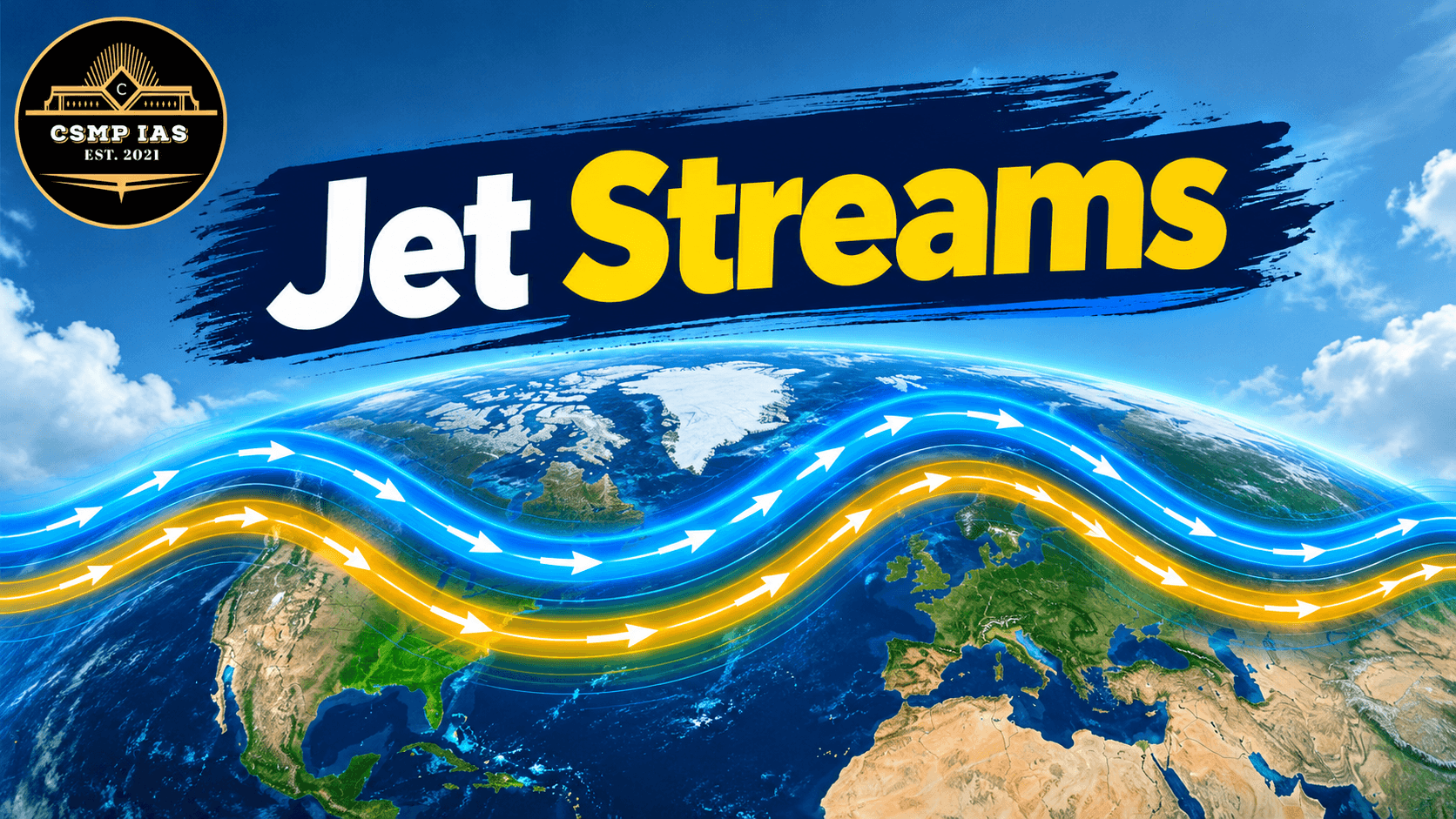
Jet streams are narrow, fast-moving bands of strong westerly winds in the upper troposphere and lower stratosphere. They flow in a meandering, wave-like pattern around the globe.
Key characteristics:
Located at an altitude of 9 to 14 km (near the tropopause)
Wind speed is typically 110 km/h or more, and can exceed 400 km/h in winter
Width is a few hundred km, and depth is 2 to 3 km
Flow is mostly west to east (except the Tropical Easterly Jet)
Stronger in winter because of a sharper temperature contrast between the poles and the equator
How Do Jet Streams Form?
Jet streams arise from two main factors:
Temperature gradient: Where cold polar air meets warm tropical air, the sharp contrast creates a steep pressure gradient at upper levels. This drives fast winds.
Coriolis effect: Earth’s rotation deflects these winds to the right in the Northern Hemisphere and to the left in the Southern Hemisphere, turning them into strong westerlies (in line with the geostrophic wind concept).
The jet is strongest where the temperature contrast is greatest, which is why it intensifies in winter.
Major Types of Jet Streams
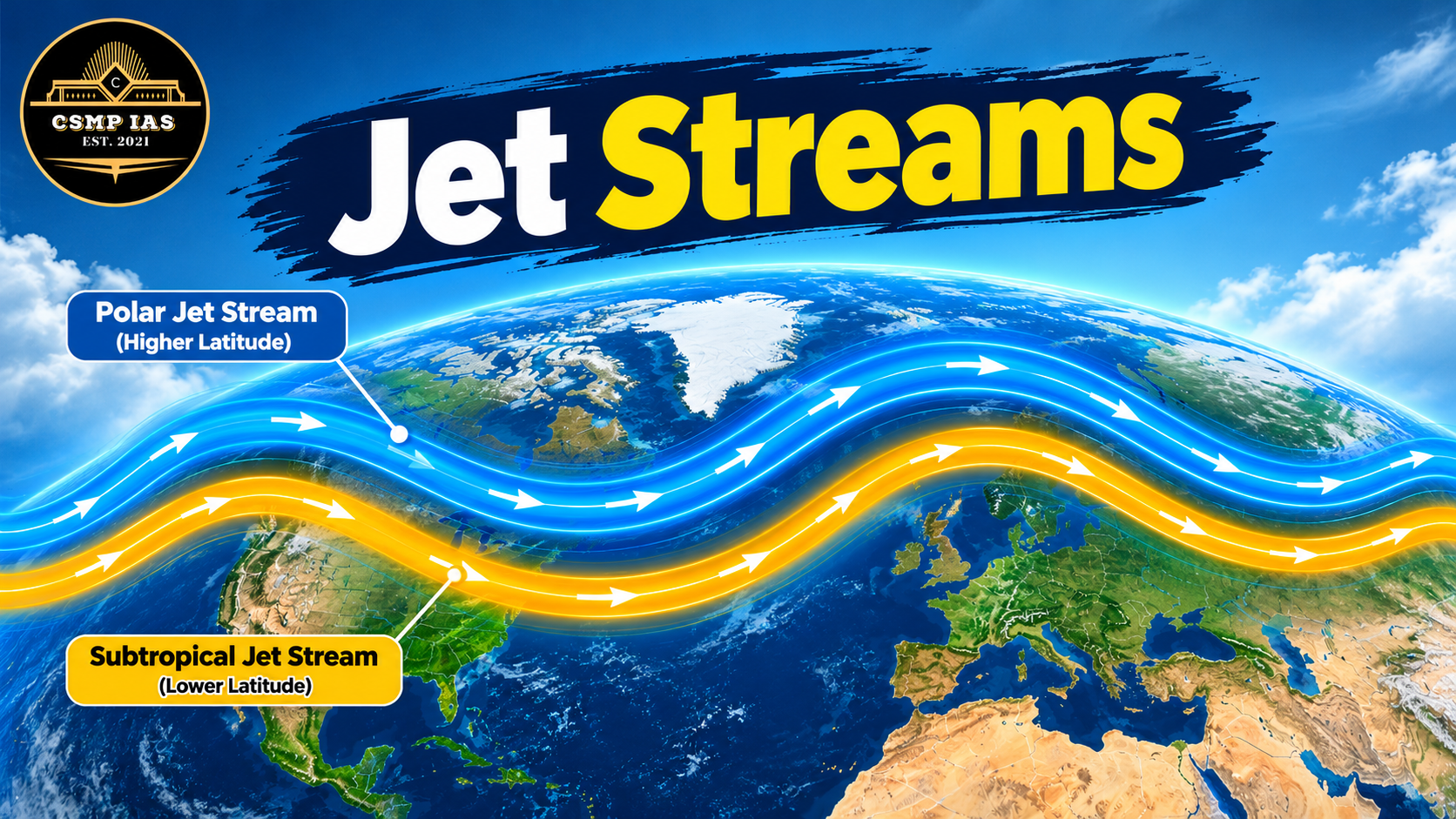
1. Polar Front Jet Stream
Found at 40° to 60° latitude in both hemispheres
Forms at the boundary of cold polar air and warmer mid-latitude air
Height: about 9 to 12 km
Strongly linked to mid-latitude cyclones (temperate cyclones)
Highly variable, and meanders significantly
2. Subtropical Westerly Jet Stream (STJ)
Located at about 20° to 35° latitude
Height: about 12 to 14 km
Forms where the Hadley cell meets the Ferrel cell
More stable and consistent than the polar jet
Most important for India
3. Tropical Easterly Jet Stream (TEJ)
Found at about 8° to 15° N latitude over the Indian region
Height: about 14 to 16 km
Blows east to west, the only major easterly jet
Develops in summer because of intense heating of the Tibetan Plateau
Plays a crucial role in the onset and strength of the Indian summer monsoon
4. Polar Night Jet Stream
Occurs in the stratosphere at about 60° latitude during polar winters
Associated with the polar vortex
Height: about 20 to 30 km
Rossby Waves and Meandering
The polar jet doesn’t flow in a straight line. It moves in large, wavy loops called Rossby waves (or planetary waves).
Troughs bring cold polar air equatorward.
Ridges carry warm tropical air poleward.
When these waves become highly amplified or “blocked,” they cause extreme weather such as cold waves, heat waves, and prolonged floods or droughts.
Jet Streams and the Indian Monsoon
This is the most important section for UPSC.
Winter (Subtropical Westerly Jet)
The STJ splits into two branches around the Tibetan Plateau.
The northern branch flows north of Tibet. The southern branch flows south of the Himalayas, over northern India.
The southern branch brings Western Disturbances (extratropical cyclones from the Mediterranean region). These cause winter rainfall and snowfall in northwest India, which benefits rabi crops like wheat.
Summer Onset
As the sun moves northward, the STJ shifts north of the Himalayas by early June.
This withdrawal of the westerly jet from India is linked to the “burst” or onset of the southwest monsoon.
The Tropical Easterly Jet then sets in, drawing air upward and supporting monsoon circulation.
Monsoon Strength
A strong TEJ is generally associated with a good monsoon.
A weak or delayed TEJ is associated with monsoon deficiency and drought years.
El Niño years tend to weaken the TEJ, while La Niña years strengthen it.
Other Significant Impacts
1. Aviation: Flights flying west to east ride the jet stream, saving time and fuel. Westbound flights take longer. Jet streams also cause Clear Air Turbulence (CAT).
2. Weather systems: Polar jets steer mid-latitude cyclones and storm tracks. The position of the jet influences where rain, snow, or dry spells occur.
3. Western Disturbances: The STJ is responsible for steering these across northern India.
4. Climate change: Arctic amplification (the Arctic warming faster than the rest of the globe) reduces the temperature gradient. This is thought to weaken and slow the polar jet, making it wavier and increasing the persistence of extreme weather events. This remains an active research area, and scientists debate the strength of the link.
Jet Streams vs. Other Winds: Quick Comparison
Feature | Jet Streams | Normal Westerlies |
|---|---|---|
Altitude | Upper troposphere | Surface level |
Speed | Very high | Moderate |
Shape | Narrow, meandering | Broad |
Cause | Temperature gradient + Coriolis | Pressure belts |
Quick Revision Points
Jet streams are located near the tropopause.
They blow west to east, except the Tropical Easterly Jet.
The STJ has a major influence on India’s winter and monsoon onset.
The TEJ is exclusive to the summer monsoon region (Indian Ocean and Africa).
Rossby waves are the meanders in the polar jet.
The jet is stronger in the winter hemisphere.
Likely UPSC Question Angles
Prelims: Statement-based questions on jet stream altitude, direction, types, and their relation to monsoons or Western Disturbances.
Mains:
“Discuss the role of jet streams in the Indian monsoon.”
“Explain how jet streams influence weather and climate.”
“Examine the impact of climate change on jet stream patterns.”
Answer tip: Draw a simple diagram showing the STJ splitting around the Tibetan Plateau in winter and shifting north in summer. Diagrams earn marks and save words.
Conclusion
Jet streams are far more than a physical geography topic. They connect the dots between global atmospheric circulation, Indian monsoon behavior, agriculture, aviation, and climate change. For UPSC, focus on their types, formation mechanism, and above all their relationship with the Indian monsoon and Western Disturbances. Combine factual clarity with diagrams and current climate links, and this topic can become a reliable scoring area.