Parliament of India: A Complete Guide for UPSC Aspirants
Parliament is one of the highest-yield topics for both Prelims and Mains, and it feeds into GS-II, Polity, and even Essay answers. Here is everything you need, in one place.
1. Constitutional Basis and Composition
Parliament is covered in Part V (Articles 79-122). Under Article 79, it consists of the President, Lok Sabha, and Rajya Sabha. The President is an integral part even though he or she doesn’t sit in either House.
2. Lok Sabha vs Rajya Sabha
Feature | Lok Sabha | Rajya Sabha |
|---|---|---|
Nature | Lower House, directly elected | Upper House, indirectly elected |
Max strength | 550 (530 states + 20 UTs) | 250 (238 elected + 12 nominated) |
Current strength | 543 | 245 |
Term | 5 years (can be dissolved) | Permanent; one-third retire every 2 years |
Member’s term | 5 years | 6 years |
Minimum age | 25 | 30 |
Presiding officer | Speaker | Chairman (Vice-President, ex officio) |
Key points:
Rajya Sabha members are elected by state legislative assemblies through proportional representation by single transferable vote.
The President nominates 12 members with special knowledge in literature, science, art, and social service.
The Anglo-Indian nomination was abolished by the 104th Amendment (2019).
Lok Sabha’s term can be extended by one year at a time during a National Emergency.
Quorum is one-tenth of total members (Article 100).
3. Sessions and Procedural Terms
Parliament holds three sessions: Budget, Monsoon, and Winter. The gap between two sessions cannot exceed six months (Article 85). The President summons the Houses.
Adjournment: temporarily suspends a sitting.
Prorogation: ends a session, ordered by the President.
Dissolution: ends the life of the Lok Sabha only. Rajya Sabha cannot be dissolved.
4. Types of Bills
Ordinary Bill: can start in either House. Rajya Sabha can delay it but cannot ultimately block it.
Money Bill (Article 110): introduced only in Lok Sabha, and only on the President’s recommendation. The Speaker certifies whether a bill is a Money Bill, and this decision is final. Rajya Sabha can only recommend changes, within 14 days, which Lok Sabha may accept or reject.
Financial Bill: contains financial provisions but is not purely a Money Bill.
Constitutional Amendment Bill (Article 368): requires a special majority, meaning a majority of the House’s total membership plus two-thirds of members present and voting. Amendments affecting federal features also need ratification by half the states.
Joint sitting (Article 108) resolves deadlock over ordinary and financial bills, but not Money Bills or Constitutional Amendments. The Speaker presides. It has happened only three times: the Dowry Prohibition Bill (1961), the Banking Service Commission Repeal Bill (1978), and the POTA Bill (2002).
5. Financial Control
Article 112: Annual Financial Statement (the Budget).
Article 266: Consolidated Fund of India. Nothing can be withdrawn without parliamentary approval.
Article 267: Contingency Fund, placed at the President’s disposal for unforeseen expenditure.
Cut motions (policy cut, economy cut, token cut) let members express disapproval of demands for grants.
A Vote on Account allows spending for part of the year until the full Budget passes.
6. Parliamentary Devices
Question Hour: includes starred (oral) and unstarred (written) questions.
Zero Hour: an Indian innovation, not mentioned in the rules of procedure.
Adjournment Motion: Lok Sabha only, to discuss a matter of urgent public importance.
No-Confidence Motion: Lok Sabha only, reflecting the collective responsibility of the Council of Ministers (Article 75).
Calling Attention Motion: draws a minister’s attention to an urgent matter.
7. Parliamentary Committees
Public Accounts Committee (PAC): 22 members (15 LS + 7 RS). It examines CAG audit reports, and by convention an opposition member chairs it.
Estimates Committee: 30 members, all from Lok Sabha.
Committee on Public Undertakings: 22 members (15 LS + 7 RS).
Departmental Related Standing Committees (DRSCs): created in 1993, now 24 in number, each with 31 members (21 LS + 10 RS).
8. Presiding Officers
The Speaker is elected by Lok Sabha from among its members. The Speaker decides disqualification under the Tenth Schedule, certifies Money Bills, and presides over joint sittings. The Speaker can be removed by a resolution passed by an effective majority (majority of all the then members), with 14 days’ notice (Article 94).
The Vice-President is the Rajya Sabha Chairman but doesn’t vote except to break a tie. The Vice-President can be removed by a Rajya Sabha resolution passed by an effective majority and agreed to by Lok Sabha.
9. Anti-Defection Law
The 52nd Amendment (1985) added the Tenth Schedule. The 91st Amendment (2003) removed the “one-third split” exception and capped the Council of Ministers at 15% of the House’s strength. In Kihoto Hollohan v. Zachillhu (1992), the Supreme Court upheld the law but held that the Speaker’s decisions are subject to judicial review.
10. Privileges and Powers
Article 105: freedom of speech in Parliament and immunity from court proceedings for statements made there.
Article 122: courts cannot question the validity of parliamentary proceedings on grounds of procedural irregularity.
Article 123: the President can promulgate ordinances when Parliament is not in session. They lapse six weeks after Parliament reassembles unless approved sooner.
Parliament also has the power to impeach the President (Article 61), requiring a two-thirds majority of total membership, and to remove judges (Article 124).
11. Recent Developments
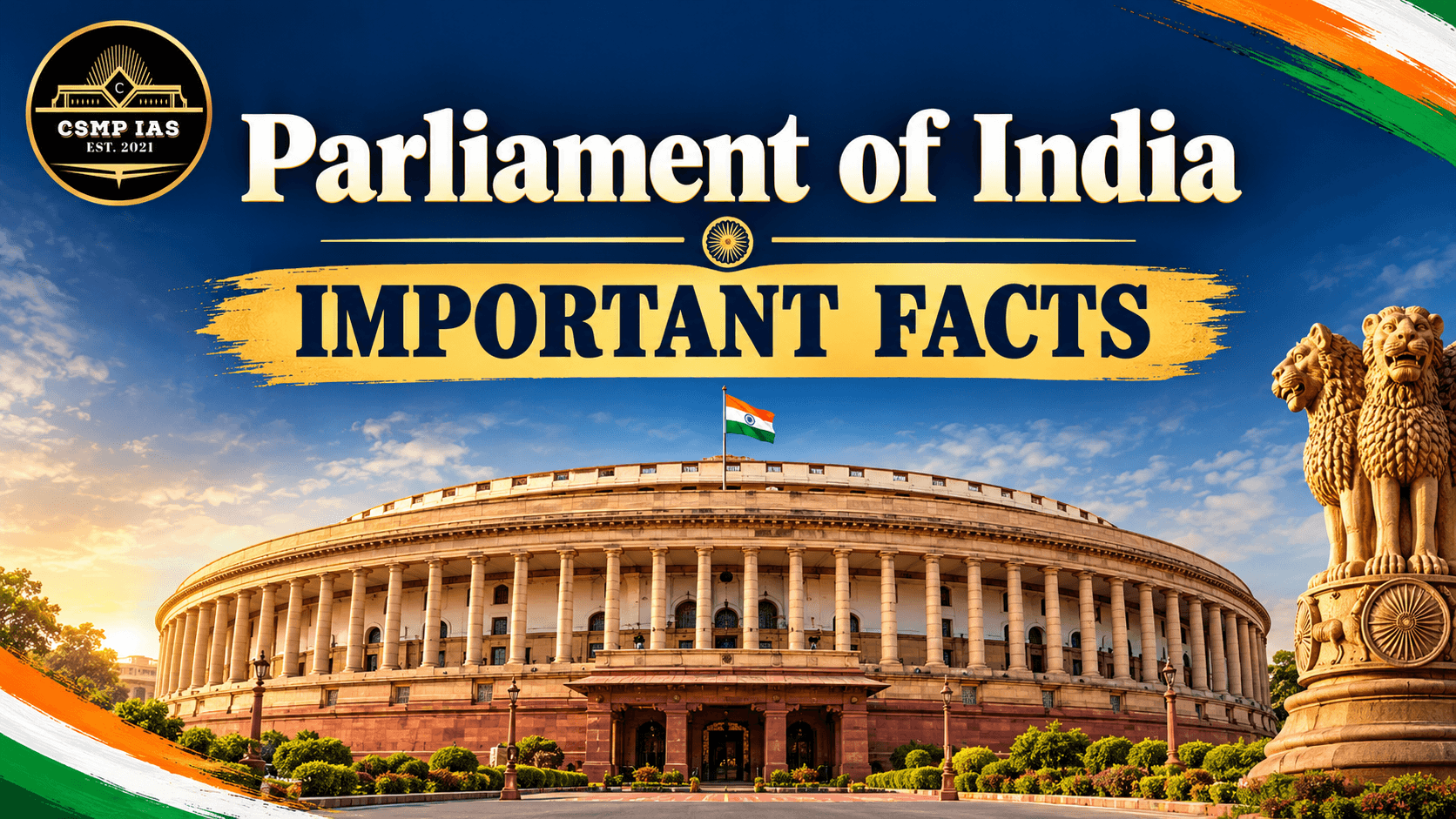
New Parliament building inaugurated on 28 May 2023, with seating for 888 in Lok Sabha and 384 in Rajya Sabha.
Nari Shakti Vandan Adhiniyam (106th Amendment, 2023): reserves one-third of seats for women in Lok Sabha and state assemblies. It takes effect after the next census and delimitation.
Constituency delimitation is frozen until the first census after 2026 (84th Amendment).
Quick Revision Tips
Memorise article numbers: 79, 85, 100, 105, 108, 110, 112, 123, 368.
Know what is Lok Sabha exclusive (Money Bill, no-confidence, adjournment motion).
Practise Mains angles: declining parliamentary productivity, the role of committees, and the Money Bill controversy.