Lucknow Fire Tragedy 2026 | Reforming Fire Safety in Indian Cities | UPSC & PCS
- Current Affairs | June 2026 | UPSC ·
- लखनऊ अग्निकांड 2026
- Reforming Fire Safety in Indian Cities
Aliganj Coaching Centre Tragedy — 15 lives lost. What went wrong, and what must change.
UPSC PrelimsGS-II GovernanceC Legal ReasoningCurrent Affairs Lucknow Fire Tragedy 2026
- What Happened? — घटना का सार
- Date:
- 22 June 2026 (Monday) |
- Location:
- Aliganj, Lucknow, Uttar Pradesh
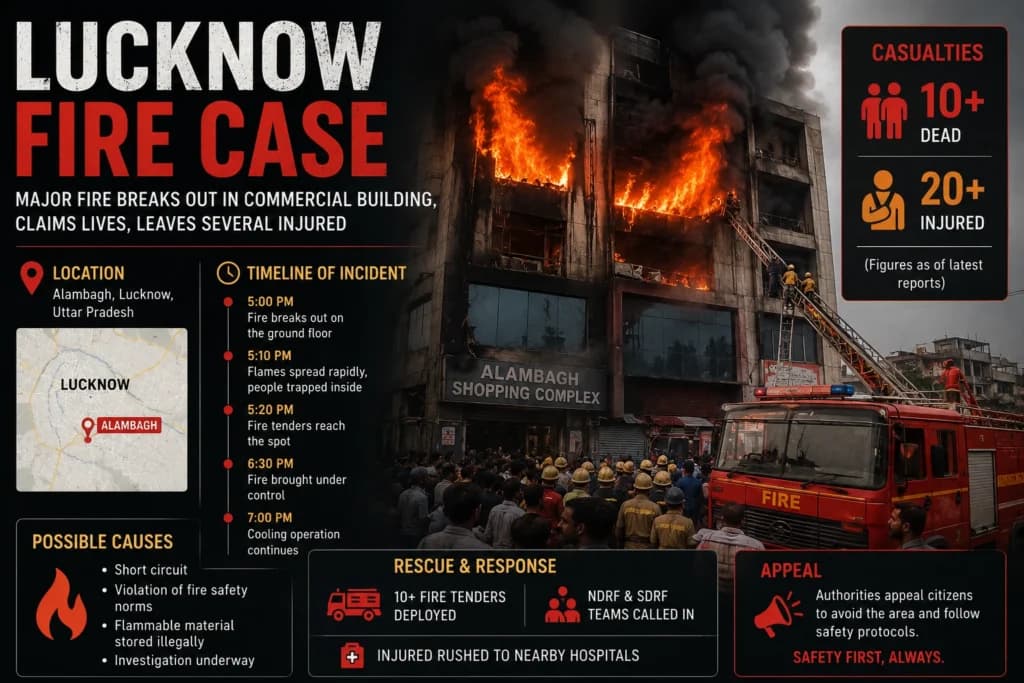
A massive fire broke out in a three-storey commercial complex in the Puraniya area of Aliganj, Lucknow. The building housed a library, an animation coaching centre, a game zone, and multiple showrooms. The blaze erupted while students had just returned from lunch, trapping dozens inside.
Thick smoke rapidly filled rooms and passageways, cutting off escape routes. Firefighters were forced to break through a wall after dense smoke blocked entry. Exhaust fans were deployed to clear smoke during rescue operations. Social media videos showed people climbing out of broken windows; one person fell from an upper floor while attempting to escape.
- 15
- Deaths (mostly students)
- 6
- Injured (admitted KGMC)
- 16–25
- Age range of victims (years)
- 1
- Exit in the entire building
- 🔎 Cause & Key Findings
The fire is believed to have originated from an electrical short circuit, the most common cause of building fires across India. The FIR registered at Aliganj police station revealed a catalogue of violations that turned a fire into a mass casualty event.
The Uttar Pradesh Fire Prevention and Fire Safety ACT 2005 uppolice.gov.inhttps://uppolice.gov.in › Site-Content › Web_Page
- Violation
- Detail
- Single Entry/Exit
The entire multi-use building had only ONE entry and exit point — no emergency escapes
No Fire Safety Arrangements
Building lacked mandatory fire extinguishers, sprinklers, and smoke detectors
Illegal Commercial Use
Premises operated commercially without valid fire NOC or occupancy certificate
Smoke Accumulation
No ventilation design — smoke filled corridors within minutes, causing suffocation
Mixed-Use Hazard
Coaching centre, game zone, and showrooms packed into one non-compliant structure
Electrical Wiring
Suspected poorly maintained wiring — the leading cause of fire in India
Cause of death:
Most victims died of suffocation rather than burns — a direct result of having no means of escape and no smoke extraction system.
⚖️ Legal & Administrative Response
The UP government swiftly ordered a high-level probe. A Special Investigation Team (SIT) led by Additional Director General of Police (Lucknow Zone) IPS Praveen Kumar was formed. Deputy CM Brijesh Pathak confirmed a committee comprising the DGP and Additional Chief Secretary would investigate.
- FIR Sections Invoked
- ASSURED PRELIMS PROGRAMME – UPPCS 2026
- Section 105, BNS:
- Culpable homicide not amounting to murder
- Section 110, BNS:
- Attempt to commit culpable homicide
- Section 125, BNS:
- Rash or negligent act endangering human life
- UP Fire and Emergency Services Act:
- Provisions relating to fire safety non-compliance
The FIR explicitly names illegal commercial operation without fire safety measures, emergency exits, and anti-smoke measures as the basis of charges — making this a landmark case for accountability in building safety law enforcement.
- ⚖️ Legal Reasoning Angle
- Tort of Negligence:
Building owner owed a duty of care to occupants. Clear breach — foreseeable harm — damage resulted → classic negligence claim.
Strict Liability vs Negligence:
Storing fire-prone materials in a commercial space with no NOC may attract strict liability (Rylands v Fletcher principle, applied in Indian courts).
Consumer Protection Angle:
Students paid fees to a coaching centre. Failure to provide basic safety = deficiency of service under Consumer Protection Act, 2019.
Criminal vs Civil Liability:
BNS Section 105 (culpable homicide) — distinguishing from IPC Section 304A (rash/negligent act causing death). Understand the intent threshold.
Locus Standi:
Families of victims can approach NHRC, NCDRC, and also file writ petitions under Article 21 (Right to Life) before High Court.
🏗️ Systemic Issues & Needed Reforms
The Lucknow tragedy is not an isolated event. It is part of a long pattern of fire tragedies in Indian cities — from Uphaar (Delhi, 1997) to Surat (2019) to Mundka (Delhi, 2022). Each time, the same governance failures repeat.
- 🧯
- Mandatory Fire NOC Enforcement
Commercial establishments must obtain Fire NOC before operation. Surprise audits needed quarterly, not just at inauguration.
- 🚪
- Multiple Emergency Exits
National Building Code mandates at least two exits. Single-exit buildings should face immediate closure orders.
- 🏛️
- Independent Fire Safety Authority
India lacks a national statutory body for fire safety. A dedicated Fire Safety Regulatory Authority (on lines of TRAI/SEBI) is overdue.
- 📲
- Digital NOC Tracking
Real-time public portal showing fire NOC status of all commercial buildings — transparency as a tool of enforcement.
- 👩🏫
- Fire Drill Mandate for Institutions
Coaching centres, schools, and offices must conduct mandatory fire drills twice a year with documentation.
- ⚖️
- Stricter Penal Liability
Building owners must face minimum imprisonment, not just fines, for operating without fire clearance when deaths occur.
- 📘 UPSC Syllabus Connect
- Paper
- Topic Mapping
- GS Paper II
Urban Governance; Welfare Schemes; Role of State in Public Safety; Regulatory Bodies
- GS Paper III
- Disaster Management; Infrastructure; Urban Planning and Building Codes
- GS Paper IV
Ethics in Administration; Accountability of public officials; Duty of Care
- Prelims
- National Building Code; BNS Sections; NDMA mandate; fire statistics
- 📝 Practice MCQs — Test Yourself
Q1. The Lucknow Aliganj fire (June 2026) primarily killed most victims due to:
- (A) Direct burns from the fire
- (B) Suffocation due to smoke accumulation ✓
- (C) Building collapse
- (D) Electrocution
Explanation: The building had no ventilation or smoke extraction system and only one exit — causing mass suffocation before flames reached victims.
Q2. Which section of the Bharatiya Nyaya Sanhita (BNS) was invoked for “culpable homicide not amounting to murder” in the Lucknow fire FIR?
- (A) Section 100
- (B) Section 110
- (C) Section 105 ✓
- (D) Section 125
Explanation: BNS Section 105 covers culpable homicide not amounting to murder. Section 125 covers rash/negligent acts endangering human life — both were invoked.
Q3. Which document certifies that a commercial building meets fire safety norms before it begins operation?
- (A) Occupancy Certificate
- (B) Building Permit
- (C) Fire NOC (No Objection Certificate) ✓
- (D) Environmental Clearance
Explanation: Fire NOC is issued by the State Fire Department and is mandatory for commercial establishments. Its absence was a central allegation in the Lucknow FIR.
Q4. What is the leading cause of building fire incidents in India as per fire safety data?
- (A) Gas cylinder explosions
- (B) Electrical short circuits due to faulty wiring ✓
- (C) Arson
- (D) Chemical spills
Explanation: Electrical short circuits from poorly maintained wiring remain the leading cause of fire incidents across India.
Q5. The “Uphaar Cinema Fire” tragedy (1997) is associated with which city and is often cited in discussions on fire safety accountability in India?
- (A) Mumbai
- (B) Kolkata
- (C) New Delhi ✓
- (D) Chennai
Explanation: The Uphaar Cinema fire (June 1997, Delhi) killed 59 people and led to a landmark Supreme Court case on liability of cinema owners and regulatory failure.
UPSC Mains — Model Answer Framework
“Recurring fire tragedies in Indian cities expose a crisis of urban governance rather than mere regulatory gaps.” Critically examine with reference to the Lucknow Aliganj fire (2026). (250 words)
Introduction:
The Lucknow Aliganj fire (June 22, 2026), which claimed 15 lives — mostly students — in a building without emergency exits or fire clearance, is symptomatic of a deeper failure in India’s urban governance ecosystem.
Governance Failure, Not Just Regulatory Gap:
India possesses adequate legal frameworks — the National Building Code (2016), the Model Building Bye-Laws, and State Fire Services Acts. The Lucknow building’s operation without a Fire NOC, with a single exit and no smoke management, was not a legal vacuum but a failure of enforcement. Municipal bodies, fire departments, and local administration all failed to detect or act on these violations over months of operation.
Systemic Issues:
(i) Absence of a statutory national fire safety authority with enforcement powers; (ii) Conflict of interest — local urban bodies issue building permits and are also responsible for compliance inspections; (iii) Inadequate fire station density in Indian cities (one station per 1–2 lakh population vs. global norms of one per 50,000); (iv) No digitised, publicly accessible Fire NOC registry; (v) Coaching centre boom in India outpacing regulatory oversight.
Way Forward:
Creation of an independent Fire Safety Regulatory Authority; digital real-time NOC portals; mandatory fire drills for educational institutions; strict criminal liability for building owners; and periodic third-party safety audits.
Conclusion:
Law exists; accountability does not. Unless India transitions from reactive regulation (post-tragedy FIRs) to proactive governance (pre-emptive inspection regimes), urban fire tragedies will remain cyclical.
- 📌 Quick Revision — Key Facts
- Date:
- 22 June 2026 |
- Place:
- Aliganj, Lucknow, UP
- Toll:
- 15 dead (mostly students aged 16–25), 6 injured
- Building:
3-storey commercial complex — animation studio, library, game zone, showrooms
- Primary cause of deaths:
- Suffocation (not burns)
- Probable fire cause:
- Electrical short circuit
- Key violation:
- Single exit, no Fire NOC, no emergency escape, no smoke management
- FIR under:
- BNS Sections 105, 110, 125 + UP Fire Act
- Probe:
- SIT headed by ADGP IPS Praveen Kumar
- Key BNS concept:
- Culpable homicide not amounting to murder (S.105)
- Urban Fires in India:
- Risk Factors & Legal Framework
A comprehensive study of why Indian cities are increasingly vulnerable to devastating fires — and the legal architecture meant to prevent them.
- #NBC 2016#NDMA#FireSafety#UrbanPlanning#NCRB Data#GS3
- 5,888 Fire-related deaths in India (NCRB 2024)
- 7,435 Deaths in 7,500+ fire accidents (2022)
- 600 MProjected urban population by 2031
- <40%Fire stations vs actual need (FICCI-Pinkerton)
- Introduction
- Why Urban Fires are a Growing Crisis
Urban fires are no longer freak accidents — they are symptoms of a deeper systemic failure. From the Uphaar Cinema tragedy (1997) that killed 59 people, to the Anaj Mandi fire (2019), the Rajkot TRP Game Zone fire (2024), and the Delhi Malviya Nagar Hotel fire (2026), India’s cities continue to burn — and continue to forget.
These disasters are the result of multiple interconnected factors: climate change, unplanned urbanisation, ageing infrastructure, weak regulatory enforcement, and human negligence. Yet the legal and institutional framework meant to prevent them remains fragmented, largely recommendatory, and poorly enforced.
📌 Exam Relevance
This topic is relevant to GS-1 (Urbanisation, Disasters), GS-3 (Disaster Management, Urban Infrastructure), and GS-2 (Governance, Policy Implementation). It also has CLAT relevance for Legal Reasoning questions on negligence, NOC violations, and public safety law.
- Part I — Risk Factors
- Factors Responsible for Increased Fire Risk in Urban Areas
Urban fire vulnerability is multi-causal. The following are the key structural, environmental, and governance-related drivers:
- ⚡
- Faulty Electrical Infrastructure
Electrical short circuits are the single leading cause of urban fires. Faulty wiring, overloaded circuits, substandard electrical components, and outdated systems in ageing buildings — unable to handle modern power loads — are a persistent hazard. Improper installations and lack of maintenance compound the risk significantly.
- 🏙️
- Unplanned Urbanisation & Congestion
Rapid and unplanned urban growth has created densely packed settlements where buildings stand wall-to-wall. Narrow lanes and congested layouts delay fire engines and hinder rescue operations. Mixed land-use violations — factories operating next to residential buildings — dramatically amplify fire spread.
- 🧱
- Use of Flammable & Substandard Materials
Even approved buildings routinely use non-fire-resistant materials. Polyurethane foam, bamboo curtains, tarpaulin sheets, metal roofing, and cheap cladding are easily ignited. The Kamla Mills fire (Mumbai, 2017) spread catastrophically due to combustible bamboo and tarpaulin on the rooftop.
- 🌡️
- Climate Change & Rising Temperatures
India has witnessed unusually high temperatures, prolonged heat waves, erratic rainfall, and extended dry spells — all linked to global warming and recurring El Niño events. Higher temperatures dry out materials, reduce ambient moisture, and create conditions where fires ignite more easily and spread faster.
- 🏭
- Industrial Hazards & Gas Cylinder Explosions
Industrial accidents involving mishandled hazardous materials, malfunctioning machinery, and improper chemical storage are a major cause — especially in cities with dense industrial concentration. Gas cylinder explosions are particularly dangerous in residential areas and restaurants.
- 📋
- Regulatory Non-Compliance & Weak Enforcement
Establishments operate without valid Fire NOCs. The Rajkot TRP Game Zone (2024) operated without a fire NOC or structural stability certificate. Safety inspections are rare and irregular. NCRB data shows this pattern repeats across all major fire incidents, pointing to a systemic governance failure, not isolated negligence.
- 🚒
- Inadequate Fire Service Infrastructure
A 2020 FICCI-Pinkerton study found urban India has less than 40% of the fire stations it needs. Shortage of trained firefighters, outdated equipment, and poor emergency response coordination result in delayed action — turning containable fires into mass tragedies.
- 🌙
- Nighttime Vulnerability
High-fatality fire incidents increasingly occur at night or in early morning hours when occupants are asleep and reaction times are slow. Hotels, hospitals, and hostels — where people sleep in unfamiliar environments — face acute risk from fires that may go undetected for critical minutes.
- 🎆
- Fireworks & Festive Season Risks
Fireworks-related fires spike during Diwali and other festivals. Crowded urban settings with closely packed buildings make accidental ignition particularly dangerous. Improper storage and unregulated sale of firecrackers in residential areas remain a seasonal hazard.
- 🏗️
- Ageing & Poorly Maintained Infrastructure
Many Indian cities have a significant stock of buildings constructed decades ago — with electrical systems, staircases, and structural elements that have not been upgraded. These buildings were not designed to handle modern electrical loads or fire suppression requirements.
📊 Key Data Point (NCRB)
Over 57% of fire-related deaths occur in residential settings. However, casualties in commercial hubs — hospitals, factories, and markets — are rising sharply due to mixed-land-use violations. States with the highest fire deaths: Maharashtra, Gujarat, Delhi, and Madhya Pradesh together account for over 50% of all fire-related deaths nationally.
- Part II — Case Studies
- Major Urban Fire Incidents: A Decade of Tragedies
These incidents are not random — they reveal a consistent pattern of regulatory failure, negligence, and institutional apathy:
- 1997
- Uphaar Cinema Fire, Delhi — 59 Dead
Fire caused by an electrical fault. Owners convicted for criminal negligence. This case shaped key legal precedents in fire safety liability and led to landmark changes in building safety law.
- 2017
- Kamla Mills Fire, Mumbai
Fire spread rapidly due to highly combustible bamboo curtains and tarpaulin sheets on rooftop restaurants. Rooftop extensions were illegal. Highlighted mixed-use dangers and building code violations in commercial areas.
- 2019
- Anaj Mandi Fire, Delhi — 43 Dead
A garment factory operating illegally in a residential building. Migrant workers — many asleep — had no chance of escape. Exposed the lethal combination of unregulated industry, poor housing, and zero fire safety compliance.
- 2024
- Rajkot TRP Game Zone Fire, Gujarat — 28+ Dead
Built using metal sheets without valid NOC or structural certificate. Gujarat High Court took suo motu notice. Triggered nationwide audit of gaming and entertainment zones regarding fire compliance.
- 2026
- Malviya Nagar Hotel Fire, Delhi
Night-time fire in an unregulated hotel. Exemplifies the persistent failure to enforce fire NOC renewals and conduct routine safety audits of commercial establishments in dense urban zones.
- Part III — Legal & Safety Provisions
- Fire Safety Legal Framework in India
India’s fire safety regulatory architecture operates at multiple levels — national, state, and local — but suffers from a critical structural flaw: the primary national code is recommendatory, not mandatory.
- Law / Provision
- Authority
- Key Provisions
- NBC 2016
- National Building Code (Part 4) — Fire & Life Safety
- Bureau of Indian Standards (BIS)
Central guideline on fire prevention, building design, safe egress, firefighting systems. Defines fire zones. Mandates non-combustible materials with minimum
120-minute fire resistance for staircase walls. Covers occupant load, exit width, travel distances.
Recommendatory in nature
— states must adopt through bye-laws.
- NBC 2025
- Updated National Building Code 2025
- BIS / MoHUA
Revised Part 4 (Fire & Life Safety) incorporating latest construction safety developments. Includes two-stage permits for high-rises, periodic renewal certificates for structural, fire, and electrical safety, and provisions for heritage structures.
- MBBL 2016
- Model Building Bye-Laws 2016
- Ministry of Housing & Urban Affairs
Guides States/UTs in uniformly updating local building regulations. Prescribes norms for fire protection and safety requirements. Provides the mechanism through which NBC becomes enforceable at local level.
- NDMA Guidelines
- National Disaster Management Authority
- NDMA (under DM Act 2005)
Fire safety guidelines for homes, schools, and hospitals. Specifies minimum open safety space, protected exit mechanisms, dedicated staircases, and mandatory evacuation drills. Sets special provisions for public buildings.
- State Fire Acts
- State Fire Prevention and Fire Safety Acts
- Respective State Legislatures
State-specific legislation for fire safety of buildings. Vary by state. Make NBC and local bye-laws enforceable at ground level. Example:
Gujarat Fire Prevention and Life Safety Measures Act 2013
— all buildings (even temporary) must comply with Fire Authority standards.
- Fire NOC
- No Objection Certificate
- State Fire Departments
Mandatory pre-requisite for operating commercial, industrial, and high-occupancy buildings. Requires compliance with firefighting equipment, exit provisions, and safety audits. Non-compliance is a criminal violation — yet widely ignored.
- DM Act 2005
- Disaster Management Act
- Central/State Governments
Provides the overarching legal framework for all disaster management in India including fires. Empowers NDMA and State DMAs to issue guidelines and enforce emergency preparedness standards.
- FEMS 2023–26
- Scheme for Expansion & Modernisation of Fire Services
- Ministry of Home Affairs
Centrally sponsored scheme (2023–2026) to strengthen State fire services through modern equipment, infrastructure upgrades, training capacity, and digital systems for faster response. Addresses the critical shortage of fire stations.
- IPC / BNS
- Criminal Law Provisions
- Courts (Criminal jurisdiction)
Building owners, managers, and licencing authorities can face charges of culpable homicide not amounting to murder (Section 304), rash/negligent acts (Section 304A IPC / BNS equivalents), and abetment in case of deaths from fire due to safety violations.
⚖️ Key Legal Principle
NBC 2016 defines nine occupancy categories for buildings (Group A to I — including educational, residential, assembly, industrial, etc.) and prescribes differentiated fire safety standards for each. Buildings in Fire Zone 1
(residential, educational, institutional) are prohibited from coexisting with industrial or hazardous structures.
- Part IV — Gaps & Challenges
- Why the Legal Framework Fails: Key Gaps
- Recommendatory Nature of NBC
NBC provisions are disregarded at local level without mandatory adoption through state bye-laws. Even where adopted, enforcement remains weak and patchy.
Built-in Exemption Clauses
NBC itself allows fire services to grant exemptions “to avoid unnecessary hardship.” This is routinely misused to regularise non-compliant buildings.
Underutilised Fire Safety Audits
Local bodies rarely conduct regular fire safety audits. Compliance checks are reactive (post-incident) rather than proactive and systematic.
Severe Infrastructure Deficit
Less than 40% of required fire stations exist in urban India (FICCI-Pinkerton). Rural and semi-urban areas are even more underserved.
No Uniform National Code
Absence of a single, mandatory national fire safety code binding on all states creates a patchwork of inconsistent local standards.
Institutional Apathy
NIDM’s 2020 report highlighted that “little has been learnt from previous fire outbreaks” — a damning indictment of institutional memory and accountability.
- Part V — Way Forward
- Recommendations & Path Ahead
- 01
- Mandatory National Fire Code
Enact a uniform, mandatory national fire safety code binding on all states, with strict penalties for non-compliance — ending the “recommendatory” loophole.
- 02
- Mandatory Periodic Fire Audits
Implement mandatory fire safety audits for all buildings as per NBC and NDMA norms — not just at the time of construction but on a regular renewal cycle.
- 03
- Modernise Fire Services
State governments must urgently invest in upgrading firefighting equipment, increasing the number of fire stations to meet actual urban density, and intensive firefighter training.
- 04
- Urban Planning Reform
Enforce strict mixed-land-use regulations. Ensure all new urban layouts provide adequate road width for fire engines and mandatory open safety spaces.
- 05
- Community Resilience
Regular fire drills in residential colonies, schools, and workplaces. Fire safety education integrated into school curricula. Community-based fire risk management programs.
- 06
- Technology Integration
Mandate automatic fire detection and alarm systems, sprinkler installations, and smoke exhaust systems in all high-occupancy buildings. Promote smart fire monitoring.
🔑 Fire Safety Week
The Ministry of Home Affairs, NDMA, and State Fire Services collectively observe
Fire Safety Week from April 14–20 every year — promoting public awareness on fire prevention, evacuation procedures, and building code compliance.
- Exam Practice
- MCQ Practice — Prelims Level
Q1. The National Building Code (NBC) of India is published by which organisation?
- (a)National Disaster Management Authority (NDMA)
- (b)Bureau of Indian Standards (BIS)
- (c)Ministry of Home Affairs (MHA)
- (d)National Institute of Disaster Management (NIDM)
✅ Answer: (b) Bureau of Indian Standards (BIS) | NBC is a recommendatory document; states must adopt it through local bye-laws to make it mandatory.
Q2. The National Building Code (NBC) 2016, Part 4 mandates a minimum fire resistance rating of how many minutes for internal walls of staircase enclosures?
- (a)60 minutes
- (b)90 minutes
- (c)120 minutes
- (d)180 minutes
- ✅ Answer: (c) 120 minutes
Q3. According to NCRB data, what percentage of fire-related deaths in India occur in residential settings?
- (a)35%
- (b)47%
- (c)57%
- (d)67%
✅ Answer: (c) 57% — though casualties in commercial hubs are rising due to mixed-land-use violations.
Q4. The ‘Scheme for Expansion and Modernisation of Fire Services’ was launched for the period:
- (a)2020–2023
- (b)2021–2025
- (c)2023–2026
- (d)2025–2030
✅ Answer: (c) 2023–2026 — under the Ministry of Home Affairs to modernise state fire services.
Q5. Which of the following correctly describes the legal status of the National Building Code (NBC) in India?
(a)Mandatory document binding on all states directly
(b)Recommendatory document; states must adopt it through local bye-laws
- (c)Part of the Disaster Management Act 2005
- (d)Enforceable only in Union Territories
✅ Answer: (b) — This is the critical weakness in India’s fire safety framework. NBC is recommendatory, making enforcement inconsistent across states.
- Mains Practice
- Model Mains Answer (GS-3)
- Question (250 words)
“Urban fire disasters in India reflect a failure of governance, not merely an accident of circumstances.” Examine the statement in the context of risk factors and existing legal provisions. Suggest a way forward. (250 words)
Introduction
India recorded 5,888 fire-related deaths in 2024 (NCRB) and over 7,435 in 2022 — figures that reflect not random misfortune but a systemic failure of urban governance. From the Anaj Mandi tragedy (2019) to the Rajkot Game Zone fire (2024), recurring urban fires expose deep structural, regulatory, and administrative deficits.
Risk Factors
Urban fire vulnerability stems from: (i) faulty electrical infrastructure and ageing buildings unable to handle modern loads; (ii) unplanned, congested urbanisation where narrow lanes block fire engines; (iii) use of flammable, substandard construction materials; (iv) climate change-induced heat waves that create fire-prone conditions; (v) mixed-land-use violations placing industries next to residences; and (vi) nighttime vulnerability in hotels and hospitals.
Governance Failure
India’s fire safety framework — anchored by the National Building Code (NBC) 2016 and NDMA Guidelines — suffers from a foundational flaw: NBC is recommendatory, not mandatory. States must adopt it through local bye-laws, leading to patchy enforcement. Fire NOC compliance is widely ignored. Regular safety audits are rare. Urban India has less than 40% of required fire stations (FICCI-Pinkerton). The Rajkot facility lacked a valid NOC; the Delhi Hotel had no functioning safety systems — yet operated freely.
Way Forward
India needs: (i) a mandatory, uniform national fire code; (ii) mandatory periodic fire audits with penal consequences; (iii) modernisation of fire services under the FEMS 2023–26 scheme; (iv) strict enforcement of mixed-land-use regulations; and (v) community fire resilience programmes. Governance failure, not bad luck, kills people in urban fires. The solution must be institutional and structural — not merely reactive.
- Conclusion
- Key Takeaways
Urban fire risk in India is a product of rapid, unplanned urbanisation colliding with weak governance. The legal framework — from NBC 2016 to State Fire Acts and NDMA guidelines — is substantive on paper but porous in practice. The recommendatory nature of the NBC, exemption clauses, understaffed fire departments, and institutional apathy create a deadly gap between law and reality.
Addressing this requires treating fire safety as an urban governance priority — with mandatory codes, funded fire services, regular audits, and genuine political will to enforce what already exists. India cannot continue to grieve its fire victims while perpetuating the conditions that create them.