MSME Development (Amendment) Bill, 2026: A Complete UPSC Guide
Relevance: GS Paper II (Government Policies and Interventions) | GS Paper III (Indian Economy, Industrial Policy, Employment)
Introduction
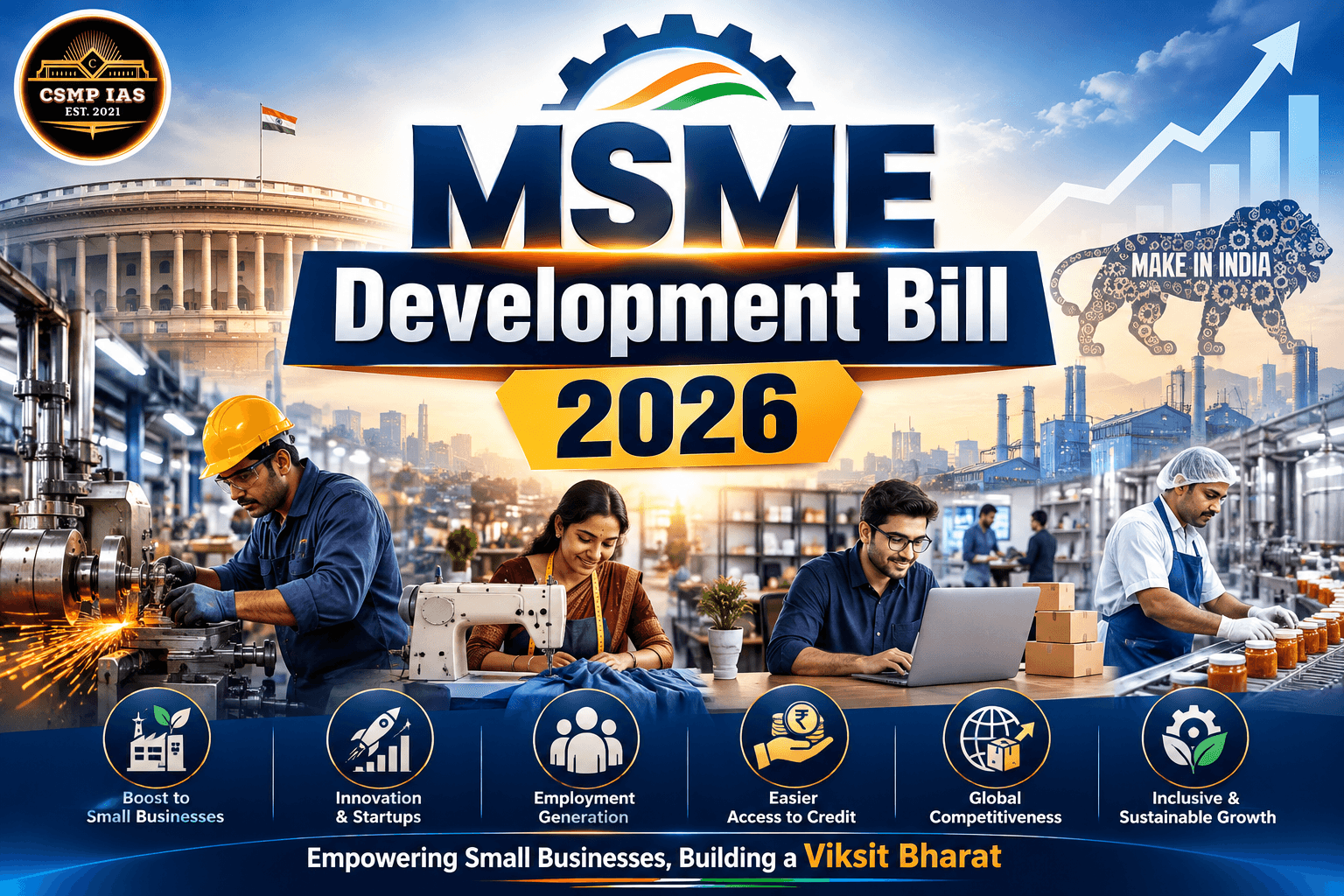
On 7 August 2026, the Lok Sabha passed the Micro, Small and Medium Enterprises Development (Amendment) Bill, 2026, four days after the Rajya Sabha cleared it on 3 August 2026. The Bill now awaits the President's assent before it becomes an Act. For UPSC aspirants, this is a high-value current affairs topic because it touches almost every dimension the Commission likes to test together: economic reform, ease of doing business, employment, digital governance, and the mechanics of dispute resolution and decriminalisation of minor offences.
The Bill amends the Micro, Small and Medium Enterprises Development Act, 2006 (MSMED Act), which completed twenty years since its notification this year. Two decades is a long time in a fast-digitising economy, and the government has framed this amendment as a modernisation exercise aligned with the vision of Viksit Bharat @2047. This blog breaks down the background, the key provisions, the significance, the criticisms, and probable exam angles.
Why MSMEs Matter: Setting the Context
Before getting into the Bill itself, it helps to recall why the MSME sector occupies such a central place in India's economic architecture.
The sector is often called the backbone of the Indian economy, and the numbers justify the label. MSMEs contribute roughly 30% of India's GDP and, according to recent government figures, nearly half of India's total exports. On the employment front, the sector is the second-largest employer in the country after agriculture, providing livelihoods to tens of crores of people across manufacturing, trade, and services. The scale of formal registration has also expanded dramatically: the number of enterprises registered on the Udyam portal rose from about 1.65 crore in April 2023 to over 9 crore today, a sign of rapid formalisation driven by digital registration and linked government incentives.
Yet MSMEs remain structurally vulnerable. They are typically thin on working capital, dependent on timely payments from larger buyers (including government departments and public sector enterprises), and disproportionately hurt by litigation delays, bureaucratic friction, and criminal liability for what are often minor or technical lapses. The 2006 Act, while path-breaking for its time, had begun to show its age: its classification criteria, registration process, and dispute-resolution mechanisms had not kept pace with digitisation, the rise of platforms like TReDS, or the government's broader push toward decriminalising minor business offences. This gap is precisely what the 2026 Amendment Bill seeks to close.
Legislative Journey of the Bill
28 July 2026: The MSME Development (Amendment) Bill, 2026 was introduced in the Rajya Sabha.
3 August 2026: Passed by the Rajya Sabha.
7 August 2026: Passed by the Lok Sabha.
Status: Awaiting Presidential assent, after which it will be notified as an Act.
The Bill falls under the administrative jurisdiction of the Ministry of Micro, Small and Medium Enterprises.
Key Provisions of the Bill
1. Redefining Classification of MSMEs
Under the existing 2006 Act, enterprises are classified as micro, small, or medium based on investment in plant and machinery (for manufacturing) or equipment (for services), with fixed monetary thresholds written into the law itself.
The 2026 Bill removes these hard-coded thresholds from the statute. Instead, it empowers the central government to classify enterprises based on a combination of (i) investment in plant and machinery or equipment, and (ii) turnover, with the actual threshold values to be specified through notification rather than through the Act. This shift from a rigid, legislated criterion to an executive, notification-based mechanism gives the government flexibility to revise classification limits in response to inflation, changing business scale, and sectoral realities, without having to return to Parliament each time. It mirrors the direction the government had already taken administratively in earlier revisions of MSME investment and turnover limits.
2. Voluntary and Fully Digital Registration
Currently, a person intending to set up a medium manufacturing enterprise is required to file a memorandum with a specified authority, while other categories of MSMEs may do so at their discretion. The Bill makes the filing of this memorandum entirely voluntary for all categories of MSMEs, regardless of size or sector.
Crucially, the Bill gives statutory permanence to the Udyam Registration Portal as a digital, free, and voluntary registration platform. The central government will notify a digital platform for registration, and state governments are also empowered to notify their own digital platforms for the same purpose. This formalises what had, until now, largely been an executive/administrative arrangement (the Udyam portal was launched via notification, not enshrined in the parent Act), and it reinforces the government's broader push toward paperless, self-certification-based ease of doing business.
3. Mandatory TReDS Settlement for CPSEs — Tackling Delayed Payments
Delayed payments to MSME suppliers by larger buyers, including government bodies, have long been recognised as one of the sector's most acute problems, choking working capital and pushing many small firms into distress. The Bill's most consequential intervention addresses this directly.
It inserts a new provision (widely reported as Section 15A) mandating that every Central Public Sector Enterprise (CPSE) must route settlement of all invoices for procurement of goods and services from MSMEs through the Trade Receivables Discounting System (TReDS) — an RBI-regulated electronic platform that allows MSMEs to auction their trade receivables to financiers and get paid quickly, rather than waiting out long payment cycles. The Bill also creates an enabling mechanism for the central and state governments to extend this mandatory TReDS-based settlement to other public sector enterprises, authorities, bodies, and entities beyond just CPSEs. This is a significant structural fix: it does not merely penalise delayed payment after the fact, it re-engineers the payment plumbing so that large, powerful buyers cannot easily sit on MSME dues.
4. Time-Bound Dispute Resolution: Mediation and Arbitration
The existing Act allows Micro and Small Enterprises Facilitation Councils (MSEFCs), or mediation service providers referred by them, to settle payment disputes through mediation, but without any statutory deadline — a gap that has historically allowed disputes to drag on for years.
The 2026 Bill fixes clear timelines:
Mediation must be completed within 90 days from the date fixed for first appearance.
If mediation fails, the matter must be referred to arbitration within 30 days of the mediation's termination.
The arbitral award itself must be made within 90 days from the date pleadings are completed.
The Bill also expands the territorial jurisdiction of MSEFCs, allowing them to entertain a dispute wherever the supplier (not just the buyer) is registered, regardless of where the buyer is located anywhere in India. This is a supplier-friendly change, since it lets small enterprises litigate closer to home rather than having to travel to the buyer's jurisdiction.
5. Strengthening Enforcement of Awards
Under the current Act, a buyer wishing to challenge a Council's order or arbitral award in court must first deposit 75% of the awarded amount, and the court may then release a "reasonable" percentage of that deposit to the MSME supplier while the case is pending — with no fixed floor. The 2026 Bill extends this deposit-and-set-aside mechanism to mediated settlement agreements as well (not just formal awards), closing a loophole where buyers could stall payment simply by dragging out proceedings around a mediated settlement.
More importantly, it introduces a statutory floor: if a case remains pending for more than six months, at least 50% of the awarded amount must be released to the supplier. This directly targets the practice of buyers using prolonged litigation as a delaying tactic to avoid paying MSMEs even after an award has been passed in the supplier's favour.
6. Decriminalisation and a Graded Civil Penalty Framework
In line with the government's larger Jan Vishwas-style decriminalisation agenda, the Bill replaces several conviction-based criminal fines under the MSMED Act with graded, escalating civil penalties, moving away from treating minor procedural lapses as criminal offences.
For example, wilful furnishing of false information for registration currently attracts a fine of up to Rs 1,000 on first conviction and between Rs 1,000–10,000 on subsequent conviction. Under the Bill, this becomes a warning on the first instance, followed by a civil penalty of Rs 1,000 to Rs 50,000 for subsequent contraventions — no conviction required. Similarly, failure to furnish information sought by officers attracts the same graded structure.
For buyers who fail to disclose unpaid dues to MSME suppliers in their annual accounts — currently a flat fine of at least Rs 10,000 — the Bill substitutes a graded scale: a warning on the first contravention, a penalty of Rs 10,000–50,000 on the second, and Rs 50,000–1,00,000 for subsequent contraventions. Notably, these penalty ranges are designed to stay relevant over time: the minimum penalty amounts will automatically increase by 10% every three years from the commencement of the Amendment Act.
7. New Adjudication and Appeal Structure
The Bill creates a more streamlined enforcement architecture: the central government will appoint the Development Commissioner as the adjudicating officer for penalties under the Act, and appeals against the Development Commissioner's decisions will lie before the MSME Secretary. This keeps adjudication within the administrative/executive domain rather than the criminal court system, consistent with the Bill's decriminalisation thrust, and is expected to speed up resolution considerably compared to routing every dispute through the regular judicial hierarchy.
Significance of the Bill
Addressing the delayed payments crisis structurally. Rather than relying solely on penalties after the fact, mandatory TReDS settlement for CPSEs attacks the problem at its source by digitising and standardising how the largest class of institutional buyers pay MSME suppliers.
Boosting ease of doing business. Decriminalisation of minor defaults, graded civil penalties instead of automatic prosecution, and time-bound mediation and arbitration collectively reduce the compliance burden and litigation risk that often deter entrepreneurs from formalising or scaling their businesses.
Deepening formalisation without coercion. By making Udyam registration a permanent, free, voluntary, and fully digital option — rather than tightening mandatory filing requirements — the Bill tries to nudge formalisation through convenience and access to benefits, rather than compulsion.
Modernising a 20-year-old law. Shifting classification criteria from rigid statutory thresholds to a flexible notification-based system allows the definition of "micro," "small," and "medium" to evolve with inflation and economic scale without requiring fresh legislation each time.
Aligning with employment and export goals. Given that the sector employs tens of crores of people and drives a substantial share of exports, faster liquidity and quicker dispute resolution directly support MSMEs' capacity to invest, hire, and compete internationally — feeding into the broader Viksit Bharat @2047 vision.
Concerns and Possible Criticisms
While the Bill has been broadly welcomed, aspirants should be aware of the debates and potential weak points, since UPSC often tests the "other side" of a reform:
Excessive delegation of legislative power. Shifting classification thresholds from the statute to executive notification raises the classic concern of "Henry VIII clauses" — Parliament ceding its law-making authority to the executive, with reduced legislative oversight over a decision (MSME classification) that has major fiscal and regulatory consequences for millions of businesses.
Voluntary registration and enforcement gaps. Making Udyam registration voluntary for all categories, including medium manufacturing enterprises that previously had mandatory filing, could reduce the government's visibility into the sector and potentially dilute targeted policy delivery, even though it lowers the compliance burden.
Implementation capacity. Time-bound mediation and arbitration timelines (90 days, 30 days, 90 days) are only as effective as the institutional capacity of MSEFCs and mediation service providers to actually meet them. Aspirants should track whether adequate staffing, digital infrastructure, and case-management systems are put in place to make these deadlines real rather than aspirational.
Scope of TReDS mandate. The mandatory TReDS provision currently binds only CPSEs directly, with private buyers and even many public bodies outside the CPSE umbrella brought in only through an "enabling" (not mandatory) mechanism. Critics may argue this leaves a significant share of MSME transactions — especially with large private corporates — outside the strongest safeguard in the Bill.
Adequacy of penalty amounts. Some observers may question whether penalty ranges, even with the built-in 10% triennial escalation, are steep enough to genuinely deter large, well-capitalised buyers from delaying payments, given the scale of working-capital advantage such delays can offer a big buyer.
Way Forward
For the reform to deliver on its promise, several complementary steps will matter:
Robust, well-funded expansion of TReDS platform access and financier participation so that MSMEs can actually monetise receivables quickly.
Capacity-building of MSEFCs and empanelled mediators to meet the new statutory timelines.
Regular, transparent revision of classification thresholds via notification, with adequate stakeholder consultation despite the removal of the legislative requirement.
Continued extension of the TReDS mandate, over time, to a wider set of public and eventually large private buyers.
Public awareness campaigns so that MSMEs, especially in tier-2 and tier-3 towns, are aware of their new rights under the amended framework.
Conclusion
The MSME Development (Amendment) Bill, 2026 represents one of the more significant course corrections to India's small-business regulatory architecture in two decades. By combining structural payment reform (mandatory TReDS for CPSEs), procedural reform (time-bound mediation and arbitration), and philosophical reform (decriminalisation and graded civil penalties), it attempts to modernise the MSMED Act, 2006 for a digitised, formalising economy. For UPSC aspirants, the Bill is a rich case study connecting economic reform, ease of doing business, federalism (through enabling provisions for states), and administrative law concerns around delegated legislation — themes that frequently reappear across Prelims and Mains.
Practice Questions for Self-Assessment
Prelims-style (Factual):
The MSME Development (Amendment) Bill, 2026 amends which parent Act? (Answer: The Micro, Small and Medium Enterprises Development Act, 2006)
Under the Bill, invoice settlement for procurement from MSMEs is made mandatory through which platform for CPSEs? (Answer: Trade Receivables Discounting System — TReDS)
Within how many days must mediation on an MSME payment dispute be completed under the amended Act? (Answer: 90 days from the date fixed for first appearance)
Mains-style (Analytical):
"The MSME Development (Amendment) Bill, 2026 reflects a shift from criminalisation to civil penalty-based regulation of small businesses." Discuss this shift and evaluate its implications for ease of doing business in India. (250 words)
Delayed payments have long been identified as a structural constraint on MSME growth in India. Critically examine how the 2026 Amendment Bill seeks to address this problem, and discuss the limitations of its approach. (250 words)
Analyse the implications of shifting MSME classification criteria from statutory thresholds to executive notification, in light of concerns around excessive delegation of legislative power. (150 words)
This blog is intended as a study resource for UPSC Civil Services Examination aspirants. Facts and figures are based on official government statements and legislative summaries as of August 2026; aspirants are advised to cross-check the final Act text once notified after Presidential assent.