PM Surya Ghar Muft Bijli Yojana: A Complete UPSC & State PSC Notes Guide
Relevant for: UPSC Civil Services (Prelims & Mains — GS Paper II & III), State PCS Exams, SSC, and other competitive exams
Introduction
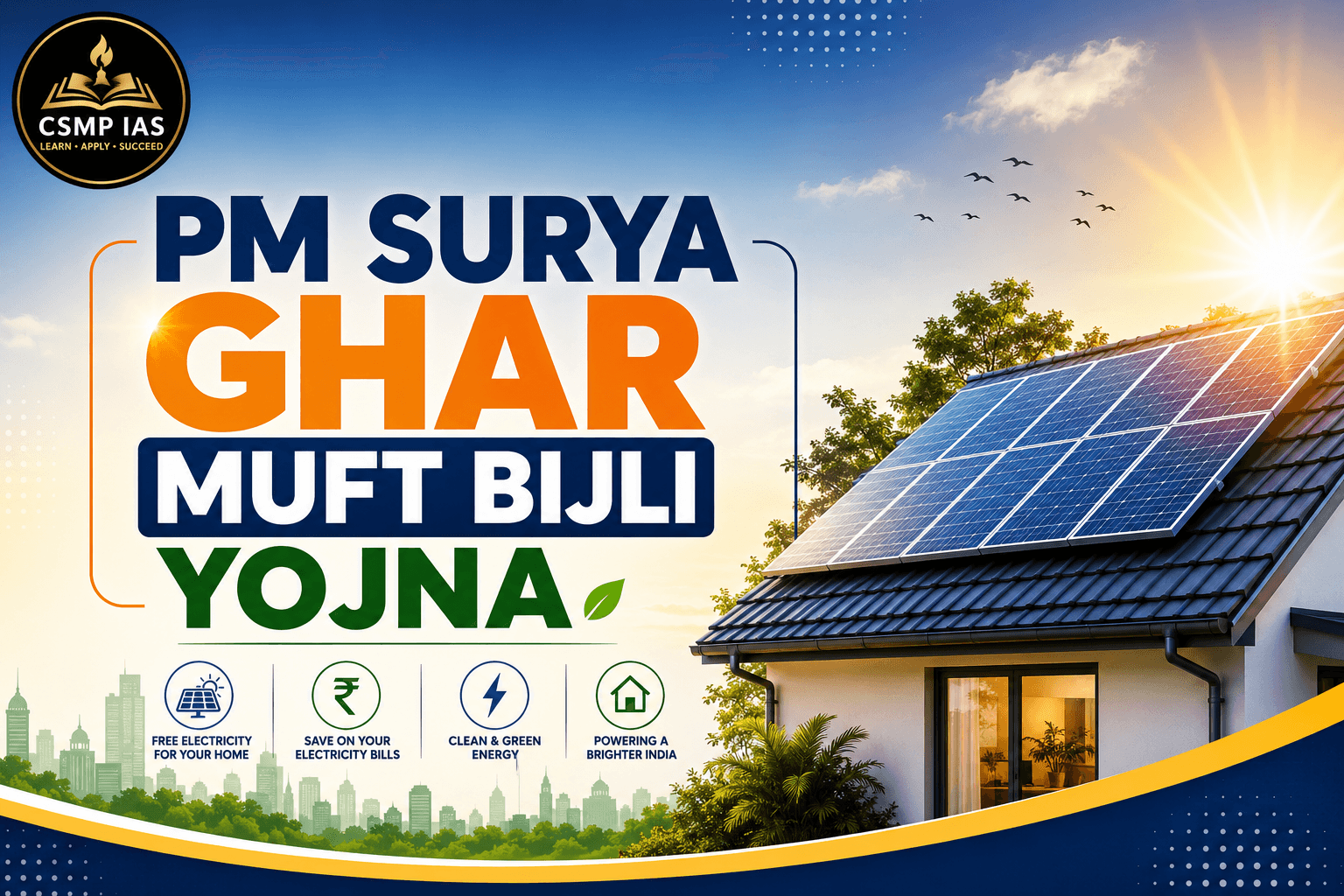
Energy security and clean energy transition have become recurring themes in UPSC and State PSC examinations over the last few years — from questions on renewable energy targets to India's climate commitments under the Paris Agreement. Among the flagship schemes that examiners love to test is the PM Surya Ghar: Muft Bijli Yojana, launched to make rooftop solar energy accessible to ordinary households across the country.
This scheme sits at the intersection of several important themes: renewable energy policy, energy federalism (Centre-State-DISCOM coordination), financial inclusion (subsidies and collateral-free loans), employment generation (solar technicians), and India's Nationally Determined Contributions (NDCs) under international climate agreements. For an aspirant, understanding this scheme in depth is not just about memorising numbers — it is about being able to connect it to the larger architecture of India's energy policy.
This article covers the scheme's background, objectives, key features, subsidy structure, implementation mechanism, significance, challenges, and its linkages with other government schemes — along with likely Prelims facts and Mains-style questions.
1. Background and Launch
The PM Surya Ghar: Muft Bijli Yojana was launched by Prime Minister Narendra Modi on 13 February 2024. It was subsequently approved by the Union Cabinet with a total outlay of approximately ₹75,021 crore, making it one of the largest household-level subsidy schemes for renewable energy anywhere in the world.
The scheme falls under the administrative control of the Ministry of New and Renewable Energy (MNRE), Government of India, and is implemented in coordination with state governments, State Nodal Agencies, and local electricity distribution companies (DISCOMs).
Why was the scheme needed?
India's residential electricity consumption has been rising steadily with urbanisation and increasing per-capita energy use.
Rooftop solar had remained a largely underutilised segment compared to utility-scale solar parks, mainly due to high upfront costs, lack of consumer awareness, and cumbersome approval processes.
India has committed to achieving 500 GW of non-fossil fuel-based installed electricity capacity by 2030 and reducing the carbon intensity of its economy by 45% (from 2005 levels) under its updated NDCs.
Rooftop solar, being decentralised, reduces transmission losses, eases pressure on the grid during peak hours, and empowers households to become "prosumers" — both producers and consumers of electricity.
This scheme is often seen as an evolution of the earlier Rooftop Solar Programme (Phase II), which had a more limited subsidy structure and slower uptake.
2. Objectives of the Scheme
The scheme has been designed with the following core objectives:
To install rooftop solar systems in one crore (10 million) households across India.
To provide up to 300 units of free electricity every month to beneficiary households.
To reduce the financial burden of high electricity bills on low- and middle-income families.
To promote decentralised renewable energy generation, thereby reducing transmission and distribution losses.
To generate direct and indirect employment, particularly for solar technicians, vendors, and manufacturers.
To boost domestic manufacturing of solar panels and inverters in line with the Atmanirbhar Bharat and Make in India initiatives.
To support India's broader commitment to net-zero emissions by 2070.
3. Key Features of the Scheme
a) Target and Timeline
The scheme aims to cover one crore households with rooftop solar installations by FY 2026-27 (i.e., by March 2027).
b) Central Financial Assistance (Subsidy)
This is the most examination-relevant part of the scheme. The subsidy is disbursed directly into the beneficiary's bank account (Direct Benefit Transfer/DBT) after installation and commissioning, and is structured on a per-kilowatt (kW) basis:
Up to 2 kW systems: ₹30,000 per kW
Additional capacity between 2 kW and 3 kW: ₹18,000 per kW
Systems above 3 kW: Subsidy is capped, regardless of system size
This works out to a maximum subsidy of ₹78,000 for a household installing a 3 kW (or larger) rooftop solar system. For a typical household requiring around 3 kW capacity, this can cover roughly 40–60% of the total installation cost, depending on local market prices.
c) Free Electricity Component
A correctly sized rooftop solar system (around 3 kW, depending on local sunlight conditions) can generate approximately 300 units of electricity per month, which — through net metering — effectively allows the household to consume this electricity free of cost, with any surplus fed back into the grid.
d) Collateral-Free Low-Interest Loans
To further ease the upfront cost burden, the scheme facilitates collateral-free loans for households wishing to install rooftop solar systems, at concessional interest rates, through participating banks and financial institutions.
e) National Online Portal
A dedicated national portal (pmsuryaghar.gov.in) was created to enable:
Online application and registration
Selection of a registered vendor/installer
Real-time tracking of application status
Subsidy disbursement tracking
A simplified and largely paperless process
f) Model Solar Villages
The scheme includes a provision to develop at least one Model Solar Village in every district of the country, to be a demonstration and awareness hub for solar adoption in rural India.
g) Skilling and Employment Generation
The scheme places emphasis on capacity building of youth as "Suryamitras" (trained solar technicians) to install, maintain, and repair rooftop solar systems — thereby linking the scheme to the Skill India Mission and generating grassroots-level green jobs.
h) Component-Level Manufacturing Push
To support domestic industry, the scheme requires solar panels and inverters used under it to comply with the Approved List of Models and Manufacturers (ALMM) issued by MNRE, thereby encouraging the use of domestically manufactured components over imports.
4. Eligibility Criteria
For an aspirant, it is useful to remember the broad eligibility conditions (exact documentation requirements are less important for exams than the underlying principle):
The applicant must be an Indian citizen.
The applicant must own a residential property with a roof suitable for solar panel installation (adequate space, structural strength, and sunlight exposure).
The household must have a valid electricity connection with the local DISCOM.
The applicant should not have already availed subsidy under any other solar subsidy scheme for the same property.
5. Application and Implementation Process
The process, simplified for conceptual understanding, involves the following broad steps:
Registration on the national portal using the electricity consumer number, mobile number, and email ID.
Feasibility approval from the concerned DISCOM based on roof suitability and sanctioned load.
Selection of a registered vendor and installation of the rooftop solar plant.
Submission of plant details and application for net metering.
Installation of the net meter by the DISCOM followed by inspection and commissioning certificate generation via the portal.
Submission of bank account details and a cancelled cheque to receive the subsidy directly through Direct Benefit Transfer.
The entire process has been designed to be largely online, reducing the discretionary role of intermediaries — a point relevant to governance and e-governance themes frequently tested in GS Paper II.
6. Progress So Far (Key Data Points for Prelims)
As per government replies in Parliament, as of late 2025:
Over 7,075 MW (approximately 7 GW) of rooftop solar capacity had been installed under the scheme in the residential sector.
Gujarat has emerged as the leading state in rooftop solar installation under the scheme, with capacity exceeding 1,800 MW.
The scheme's total financial outlay stands at approximately ₹75,021 crore.
(Note: Progress figures are updated periodically by the Ministry of New and Renewable Energy. Aspirants should verify the latest figures closer to their exam date via the PIB and MNRE websites, since installation numbers are updated frequently.)
7. Significance of the Scheme
a) Energy Security and Self-Reliance
By decentralising power generation to the household level, the scheme reduces dependence on centralised, often fossil-fuel-based, grid power — contributing to long-term energy security.
b) Climate Change Mitigation
The scheme directly supports India's international climate commitments, including:
The Paris Agreement (2015) goals
India's updated Nationally Determined Contributions (NDCs)
The Panchamrit targets announced at COP26 (Glasgow), including the 2070 net-zero pledge
India's role in the International Solar Alliance (ISA), which India co-founded
c) Reducing Transmission and Distribution (T&D) Losses
Since electricity is generated and consumed largely at the same location (rooftop), the scheme helps in reducing the technical losses associated with long-distance power transmission — a chronic issue for Indian DISCOMs.
d) Financial Relief to Households
By potentially bringing electricity bills close to zero for eligible households, the scheme has direct implications for household savings and disposable income, particularly relevant for lower-middle-income groups.
e) Employment Generation
The scheme is expected to create substantial employment across the solar value chain — manufacturing, installation, operation, and maintenance — aligning with the government's broader employment and skilling agenda.
f) Boost to Domestic Manufacturing
Through the ALMM requirement, the scheme indirectly supports India's push toward becoming a global hub for solar manufacturing, complementing the Production Linked Incentive (PLI) scheme for high-efficiency solar PV modules.
g) Cooperative and Competitive Federalism
The scheme requires close coordination between the Centre, State Nodal Agencies, and DISCOMs (many of which are state-owned or state-regulated), making it a good example for questions on Centre-State coordination in policy implementation.
8. Challenges and Criticisms
A balanced answer in Mains requires awareness of implementation challenges as well:
High upfront cost despite subsidy — even after subsidy, many low-income households find the residual cost difficult to bear without accessible financing.
DISCOM financial health — many DISCOMs are already financially stressed; large-scale net metering can affect their revenue models, since high-paying residential consumers moving to self-generation reduces DISCOM revenue from cross-subsidisation.
Awareness gaps, particularly in rural and semi-urban areas, about the application process and benefits.
Roof suitability issues — many urban households, particularly those in multi-storey apartments without clear roof rights, face practical difficulties in installation.
Vendor and installation quality concerns, including the use of non-ALMM-compliant or substandard components by unregistered vendors.
Grid integration challenges — a rapid increase in distributed rooftop solar can create technical challenges for grid stability and voltage management at the local (feeder) level.
State-level variation in implementation speed, net metering policies, and additional state subsidies, leading to uneven progress across states (as seen in Gujarat's disproportionately high share).
Time-bound nature of the scheme, which requires sustained administrative push to meet the FY 2026-27 target.
9. Related Schemes and Concepts (Important for Linkage-Based Questions)
Examiners often test a candidate's ability to distinguish between similar-sounding schemes. Aspirants should be clear on the following distinctions:
Scheme Focus Area PM Surya Ghar: Muft Bijli Yojana Rooftop solar for residential households PM-KUSUM Scheme Solar power for agricultural use — solarising irrigation pumps and setting up decentralised solar power plants on barren/fallow land for farmers National Solar Mission (Jawaharlal Nehru National Solar Mission) The original umbrella mission (launched 2010) under the National Action Plan on Climate Change (NAPCC), aiming to promote solar energy at a national scale Production Linked Incentive (PLI) Scheme for Solar PV Modules Boosting domestic manufacturing capacity for high-efficiency solar modules International Solar Alliance (ISA) An India-led international coalition of solar-resource-rich countries National Green Hydrogen Mission Focused on green hydrogen production, distinct from but complementary to renewable electricity generation
Key conceptual terms to know:
Net Metering: A billing mechanism that credits solar energy system owners for the electricity they add to the grid, allowing them to offset the cost of power drawn from the grid at other times.
DISCOM (Distribution Company): The utility responsible for the last-mile distribution of electricity to consumers.
ALMM (Approved List of Models and Manufacturers): A list maintained by MNRE specifying models/manufacturers of solar PV modules eligible for use in government schemes, to ensure quality and promote domestic manufacturing.
Suryamitra: Skilled solar technicians trained under associated skilling programmes to support installation and maintenance.
10. Possible Mains-Style Questions
To help aspirants practice application-based answer writing, here are a few sample questions in the UPSC Mains format:
"Discuss the significance of the PM Surya Ghar: Muft Bijli Yojana in achieving India's renewable energy targets. What are the key implementation challenges associated with it?" (GS Paper III, 15 marks)
"Rooftop solar schemes represent a shift from centralised to decentralised energy generation in India. Examine the implications of this shift for DISCOM finances and grid management." (GS Paper III, 10 marks)
"Critically analyse the role of Direct Benefit Transfer (DBT) in improving the efficiency of subsidy delivery, with reference to schemes like PM Surya Ghar: Muft Bijli Yojana." (GS Paper II, 10 marks)
"How does the promotion of rooftop solar energy align with India's international climate commitments? Discuss with suitable examples." (GS Paper III, 15 marks)
Sample answer approach for Q1:
Briefly introduce the scheme and its scale (1 crore households, ₹75,021 crore outlay).
Discuss significance under distinct heads: energy security, climate commitments, household savings, employment, domestic manufacturing.
Discuss challenges: DISCOM revenue concerns, awareness gaps, financing barriers, urban roof-rights issues.
Conclude with a brief "way forward" — strengthening last-mile awareness campaigns, DISCOM tariff reform, and expanding low-cost financing options.
11. Quick Revision Table (For Prelims)
Feature Detail Launch Date 13 February 2024 Launched By Prime Minister Narendra Modi Nodal Ministry Ministry of New and Renewable Energy (MNRE) Target 1 crore households Free Electricity Up to 300 units/month Maximum Subsidy ₹78,000 (for systems of 3 kW and above) Subsidy Rate ₹30,000/kW (up to 2 kW) + ₹18,000/kW (2–3 kW) Total Outlay Approx. ₹75,021 crore Deadline FY 2026-27 (March 2027) Portal pmsuryaghar.gov.in Related Personnel Category Suryamitras (trained solar technicians) Related Concept Net Metering, ALMM Leading State (installed capacity) Gujarat
12. Way Forward
For India to fully realise the scheme's potential, a few policy directions are frequently discussed:
Strengthening DISCOM reform to ensure their financial sustainability is not eroded by rising net-metered rooftop solar capacity.
Simplifying approval processes further at the state and municipal level, especially for apartment complexes and housing societies.
Expanding low-cost financing tie-ups with public sector banks and NBFCs to reduce the residual upfront cost burden on households.
District-level awareness campaigns, building on the Model Solar Village initiative, to improve last-mile penetration in rural and semi-urban India.
Strict enforcement of ALMM norms to protect consumers from substandard installations while supporting domestic manufacturers.
Integration with smart grid and battery storage initiatives to manage the technical challenges of rising distributed generation.
Conclusion
The PM Surya Ghar: Muft Bijli Yojana represents a significant policy attempt to democratise access to clean energy at the household level in India. For exam aspirants, the scheme offers a rich, multi-dimensional case study connecting governance (GS-II) — through its DBT-based, largely paperless implementation — with environment and energy security (GS-III) — through its contribution to renewable energy targets and climate commitments.
A well-rounded understanding of this scheme, along with its linkages to PM-KUSUM, the National Solar Mission, and India's broader climate diplomacy, will help aspirants tackle both factual Prelims questions and analytical Mains questions with confidence. As always, aspirants should track the PIB (Press Information Bureau) and the MNRE annual report for the latest updates on installation progress, subsidy revisions, and policy tweaks, since scheme-related data is frequently updated and tested in current affairs-based questions.
Disclaimer: Scheme parameters such as subsidy amounts, targets, and progress figures are subject to periodic government revision. Aspirants are advised to cross-verify the latest figures from official sources (pmsuryaghar.gov.in, mnre.gov.in, and PIB releases) closer to their examination date.