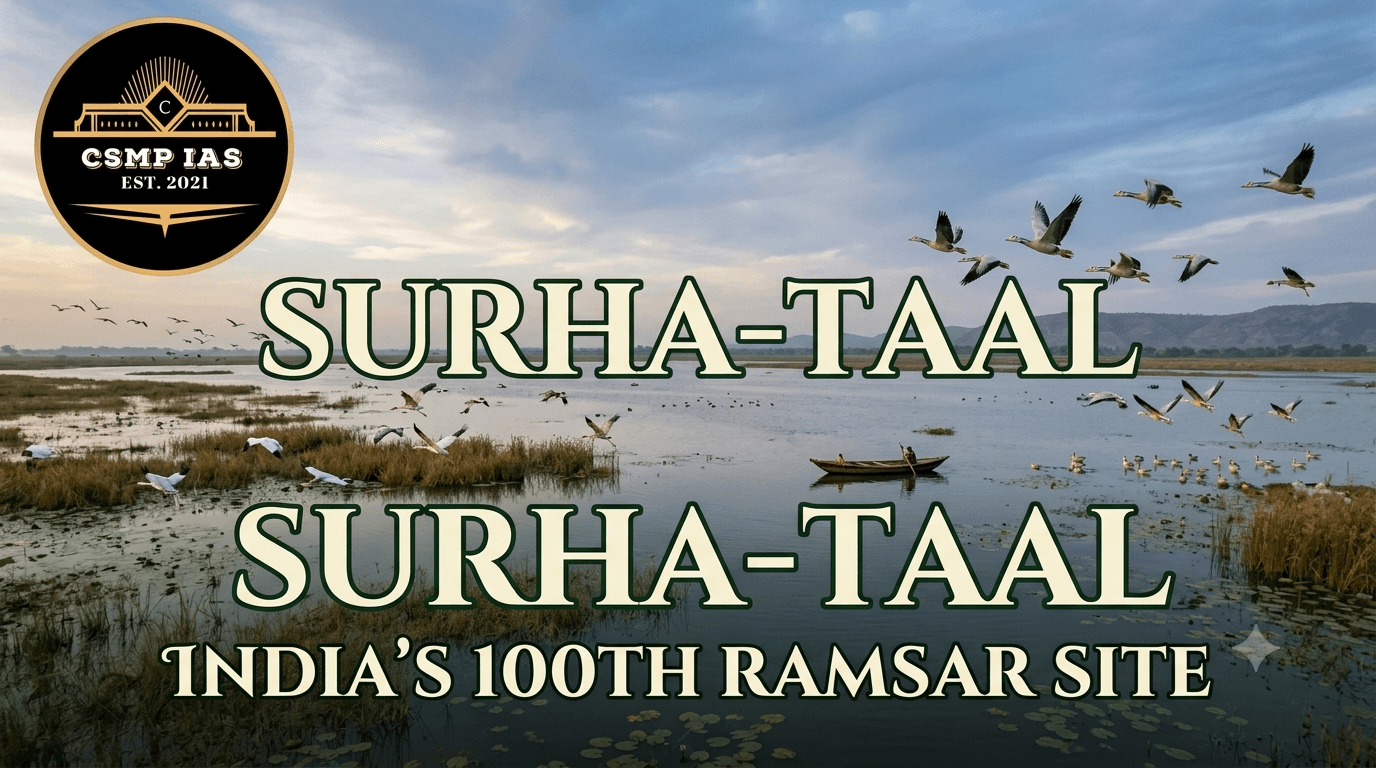
Surha Taal: India's 100th Ramsar Site
10 June 2026
Surha Taal: India’s 100th Ramsar Site
🌿
Environment & Ecology · June 2026 · UPSC Current Affairs
Surha Taal: India’s
100th Ramsar Site
and What It Signals for Wetland Conservation
A freshwater oxbow in Ballia, Uttar Pradesh, quietly becomes the centrepiece of India’s biggest environmental milestone in years.
📅 Designated: 5 June 2026📍 Ballia, Uttar Pradesh🦅 Jai Prakash Narayan Bird Sanctuary
100 India’s Ramsar Sites
3
rd
Global Rank
13 UP’s Ramsar Sites
34.32 Area (km²)
1991
Sanctuary Established
On World Environment Day — 5 June 2026 — India reached a landmark it had been quietly building toward for four decades: its 100th Ramsar-designated wetland. The honour went to a lake most of India had barely heard of: Surha Taal, a sprawling natural freshwater body in Ballia district of eastern Uttar Pradesh, officially recognised as the Jai Prakash Narayan Bird Sanctuary. A number like 100 carries a weight beyond arithmetic, and in the world of international environmental governance, this one matters enormously.
What is Surha Taal, how did it earn this recognition, and what does India crossing the century mark truly mean for its wetlands? This blog unpacks all of it — from the ecology of the lake itself to the bigger story of how India went from 26 Ramsar sites in 2014 to a hundred in a decade.
What Is Surha Tal ?
http://Wikipedia https://en.wikipedia.org › wiki › Surha_Tal Surha
Surha Taal is not a constructed reservoir or a picturesque tourist lake. It is something far more interesting geologically: a
large natural oxbow lake
, born from the restless meandering of the Ganga River. As the Ganga shifted its course over centuries, it left behind a curved water body that gradually became a self-sustaining freshwater ecosystem. This origin story — river abandons a loop, nature fills the void with life — is written into the very shape of the lake.
Located at coordinates 25°51′N, 84°11′E in the middle stretch of the Ganga basin, the sanctuary covers
3,432 hectares (34.32 km²)
. Three freshwater channels feed the lake year-round, and during the monsoon, the surrounding floodplains, marshes, and rice paddies merge with its waters, dramatically expanding the wetland’s footprint. This seasonal dynamism makes Surha Taal not just a lake but a breathing, fluctuating landscape.
Surha Taal — Quick Profile
UPPCS Mains Enrichment Program 2026
Full name: Jai Prakash Narayan Bird Sanctuary (renamed in 2002 from ‘Surha Taal Bird Sanctuary’)
Location: Ballia district, eastern Uttar Pradesh
Type: Natural oxbow/meander lake (freshwater); Ganga River basin
Area: 3,432.93 hectares across land consolidated from 45 villages of Baansdih, Ballia
Established as Bird Sanctuary: 1991, by the Government of Uttar Pradesh
Water inflow: Three primary freshwater channels from the Ganga
Governing body: Uttar Pradesh Forest Department
Ramsar designation: 5 June 2026 (World Environment Day)
The Ecology Within: Birds, Fish, and Floodplains
Surha Taal’s ecological value is best understood not just as a number of species, but as a function — what the wetland does for wildlife that depends on it. During the summer months, when smaller seasonal wetlands across the Gangetic plains dry up, Surha Taal becomes one of the last reliable refuges for waterbirds across the region. It is a lifeboat during ecological stress.
The resident avifauna includes iconic species like the
Sarus Crane
— the world’s tallest flying bird and a cultural symbol across rural UP — alongside herons and cormorants. During winter, migratory species fly in from Central Asia, Siberia, and the Himalayan foothills, using the lake as a critical staging ground on their flyways. The landscape surrounding the lake — floodplains, marshes, seasonally inundated areas and rice paddies — forms an integrated habitat mosaic that supports this diversity.
The lake is also a traditional and active
fisheries zone
. Several indigenous fish species thrive in its waters, making the wetland the economic backbone of surrounding fishing communities. This intersection of ecological richness and livelihood dependence is exactly why Surha Taal’s designation carries significance beyond environmentalism: it is a recognition of a socio-ecological system, not merely a geographic feature.
The Ramsar Convention: 54 Years of Wetland Diplomacy
The convention takes its name from the Iranian city of Ramsar on the Caspian Sea coast, where representatives from 18 nations gathered in February 1971 to sign a watershed agreement — literally, a treaty about water. The
Convention on Wetlands of International Importance
came into force in 1975 and has since grown into one of the most widely ratified environmental treaties in history, with over 170 contracting parties and nearly 2,600 designated sites worldwide covering 2.6 million square kilometres.
The logic of the Ramsar framework is elegant: rather than imposing regulations top-down, it asks nations to voluntarily nominate and commit to maintaining wetlands that meet specific ecological criteria. The “Ramsar tag” is not a land-use restriction but an internationally recognised status that obliges the host government to ensure the site’s ecological character is preserved. For India, every new Ramsar site is both an ecological recognition and a diplomatic statement about environmental governance.
India became a contracting party to the Ramsar Convention on 1 February 1982. Its first two designated sites — Chilika Lake in Odisha and Keoladeo National Park in Rajasthan — were nominated in 1981, still before formal ratification.— Ramsar Convention Records, India
India’s Journey: From 26 to 100 in a Decade
For much of the period from 1982 to 2014, India’s Ramsar network grew slowly. By 2014, the country had just 26 designated wetlands — a modest number for a country of India’s ecological diversity. The decade that followed was transformational.
1981
Chilika Lake (Odisha) and Keoladeo National Park (Rajasthan) become India’s first two Ramsar sites.
1982
India formally ratifies the Ramsar Convention (February 1).
2014
India has 26 Ramsar sites — relatively stagnant growth over three decades.
August 2024
Three new sites added — Nanjarayan Bird Sanctuary, Kazhuveli Bird Sanctuary (Tamil Nadu) and Tawa Reservoir (Madhya Pradesh) — taking the tally to 85.
February 2026
On World Wetlands Day, India’s count stands at 98. Udaipur and Indore are recognised as India’s first Ramsar-accredited Wetland Cities.
April 2026
Shekha Jheel Bird Sanctuary (Aligarh, UP) becomes India’s 99th Ramsar site.
5 June 2026
Surha Taal (Jai Prakash Narayan Bird Sanctuary), Ballia, UP — India’s
100th Ramsar Site
, announced on World Environment Day.
The pace itself is telling. Going from 85 to 100 sites between mid-2024 and mid-2026 reflects a deliberate policy push — a combination of systematic wetland survey, state-level advocacy, and political will to meet international benchmarks. Uttar Pradesh has been a particular standout, with its tally rising to 13 sites — the highest among Indian states — as wetlands like Patna Bird Sanctuary, Shekha Jheel, and now Surha Taal are brought under international recognition in quick succession.
India’s Wetland Ranking: A Century That Counts
With 100 Ramsar sites, India now holds a remarkable position on the global stage. It ranks
third in the world
by number of designated wetlands, behind the United Kingdom (176 sites) and Mexico (144 sites), and stands as the
country with the most Ramsar sites in all of Asia
. This matters not just as a statistic but as a signal in international negotiations over climate, biodiversity, and water security.
However, context is necessary. The United Kingdom’s 176 sites cover a country smaller than Gujarat. India’s 100 sites span a subcontinental landmass with extraordinary ecological variation — from the Himalayan wetlands of Ladakh to the mangrove deltas of the Sundarbans, from Rajasthan’s desert lakes to the backwaters of Kerala. The challenge India faces is not nomination but stewardship: ensuring that the Ramsar tag translates into genuine ecological protection on the ground.
India’s Ramsar Rankings at a Glance
3rd globally by number of Ramsar sites (after UK: 176, Mexico: 144)
1st in Asia by number of Ramsar-designated wetlands
First Indian Ramsar sites: Chilika Lake & Keoladeo National Park (1981)
Largest Ramsar site: Sundarbans, West Bengal
Smallest Ramsar site: Renuka Wetland, Himachal Pradesh (20 hectares)
Montreux Record (adverse change sites): Keoladeo NP (Rajasthan) and Loktak Lake (Manipur)
Leading state by Ramsar count: Uttar Pradesh (13 sites as of June 2026)
What the Ramsar Tag Actually Changes
It would be naïve to assume that a Ramsar designation automatically saves a wetland. Several Indian sites on the list face serious threats — encroachment, pollution, invasive species, groundwater extraction, and climate change-driven changes in rainfall patterns. The Montreux Record — a Ramsar sub-list of sites experiencing adverse change — includes two Indian wetlands: Keoladeo National Park and Loktak Lake in Manipur.
At Surha Taal itself, the history is not without its challenges. Overpopulation in surrounding villages has put pressure on the lake’s catchment. Traditional rice cultivation and artisanal fishing have coexisted with the ecosystem for generations, but expanding agricultural demands and infrastructure pressures have tested the balance. The National Green Tribunal previously stayed construction within the sanctuary, an indicator of the tensions at play.
What the Ramsar designation does — when backed by political will — is provide international legitimacy to conservation arguments, unlock technical cooperation and funding, strengthen legal protections at the state level, and, crucially, raise the cost of ignoring the wetland. It creates accountability where there was previously only aspiration. For Surha Taal, the designation now ensures that India’s forests and environment ministry, the state government, and international bodies like the Ramsar Secretariat all have a stake in its future.
Conservation That Must Work for People Too
The fishing communities of Ballia have sustained themselves on Surha Taal for generations. The lake is not an abstract ecological asset to them — it is the source of protein, income, and cultural identity. Any conservation model that excludes these communities is not just socially unjust; it is also ecologically ineffective. PM Modi, while welcoming the designation, specifically highlighted
“community participation”
as central to the conservation story — and that emphasis is worth taking seriously.
Effective wetland governance at Surha Taal will require co-management models that involve local fishermen, farmers, and village councils in both decision-making and benefit-sharing. The Wetland Mitras programme — a community volunteer initiative honoured at the World Wetlands Day event in February 2026 — is one such instrument. Scaling such participatory approaches is now the real test of whether the 100th Ramsar designation becomes a living conservation success or a paper tiger.
The Bigger Picture: Wetlands, Climate, and Water Security
Wetlands globally are among the most threatened ecosystems on Earth. Over the past century, the world has lost roughly 35% of its wetland area — a rate three times faster than forest loss. In India, the story is similarly sobering: urban expansion, agricultural drainage, and industrial pollution have degraded wetlands across the Indo-Gangetic plain, the coastal belt, and the northeastern highlands.
Yet wetlands perform services that no engineered infrastructure can replicate at comparable cost. They act as natural flood buffers — when Surha Taal expands across floodplains during the monsoon, it absorbs water that might otherwise inundate Ballia’s homes and fields. They recharge groundwater, improving water availability during dry seasons. They filter pollutants, improving water quality downstream in the Ganga. And they sequester carbon in waterlogged soils at rates that rival tropical forests.
In a country facing simultaneous crises of groundwater depletion, river pollution, and climate-linked flood-drought cycles, protecting wetlands is not a luxury — it is adaptation infrastructure. India’s march to 100 Ramsar sites is thus inseparable from its broader commitments to the Paris Agreement, the Kunming-Montreal Global Biodiversity Framework, and the sustainable development of its river basins.
⚖️ Current Affairs — Key Takeaways
Surha Taal (Jai Prakash Narayan Bird Sanctuary), Ballia, UP → India’s 100th Ramsar Site; announced on World Environment Day (5 June 2026)
Ramsar Convention: Signed in Ramsar, Iran (1971); entered into force 1975; India joined 1982
India’s rank: 3rd globally (after UK-176, Mexico-144); 1st in Asia
UP now has 13 Ramsar sites — most of any Indian state
99th site: Shekha Jheel Bird Sanctuary, Aligarh (April 2026)
Surha Taal: Oxbow/meander lake formed by Ganga; 3,432 ha; established as sanctuary in 1991
Montreux Record: Indian sites currently listed — Keoladeo NP (Rajasthan) and Loktak Lake (Manipur)
India went from 26 Ramsar sites (2014) to 100 (2026) in just over a decade — a key policy achievement
Wetland Cities: Udaipur and Indore became India’s first Ramsar-accredited Wetland Cities (early 2026)
Smallest Indian Ramsar site: Renuka Wetland, HP (20 ha); Largest: Sundarbans, WB
Conclusion: The Lake That Made History
Surha Taal did not become India’s 100th Ramsar site by accident. It earned the designation through its ecological richness, its role as a refuge for both birds and people, and through the sustained advocacy of conservationists, communities, and state authorities who recognised what was at stake. That it received this recognition on World Environment Day adds to the symbolism.
The number 100 is significant — but numbers alone do not protect lakes. What follows is more important: whether the Ramsar tag at Surha Taal triggers the kind of investment in habitat management, community livelihoods, and ecological monitoring that the wetland needs. If it does, then India’s century of Ramsar sites becomes not just a diplomatic milestone, but a real, breathing network of protected waters that will outlast any government.
For now, a quiet oxbow lake in Ballia district — formed by the slow drift of the Ganga over centuries — stands as a symbol of what is possible when policy, ecology, and community converge. That is worth celebrating.
Facts sourced from Ramsar Convention records, Ministry of Environment press releases, and UP Forest Department.