Sustainable Development Goals (SDGs): Why They Were Introduced and What They Aim to Achieve
A UPSC-focused primer for General Studies Paper III (Environment & Sustainable Development) and Essay/Ethics linkages
Introduction
For any UPSC aspirant, the Sustainable Development Goals (SDGs) are not just another acronym to memorise — they form one of the most frequently tested and inter-linked topics across Prelims, Mains, and even the Essay paper. Questions on SDGs connect environment, economy, social justice, governance, and international relations, making this a high-yield topic if understood conceptually rather than by rote.
This blog breaks down why the SDGs were introduced and what they aim to achieve, along with pointers on how to frame this topic in your answers.
Why Were the SDGs Introduced?
1. The Legacy of the Millennium Development Goals (MDGs)
Before the SDGs, the world worked under the Millennium Development Goals (MDGs), adopted in 2000 with a 2015 deadline. The MDGs achieved notable success — reducing extreme poverty and child mortality, improving access to safe drinking water — but they had clear limitations:
They focused mainly on developing countries, treating developed nations as "donors" rather than co-participants.
They did not adequately address inequality, governance, peace, or environmental sustainability.
Targets were often narrow and lacked an integrated view of development.
2. The Need for a More Holistic Framework
By the early 2010s, it was evident that development challenges — climate change, inequality, unsustainable consumption, conflict, and weak institutions — were deeply interconnected. A country could not achieve poverty eradication while ignoring environmental degradation or gender inequality. This realisation led to the idea of a universal, integrated, and indivisible development agenda.
3. Formal Adoption
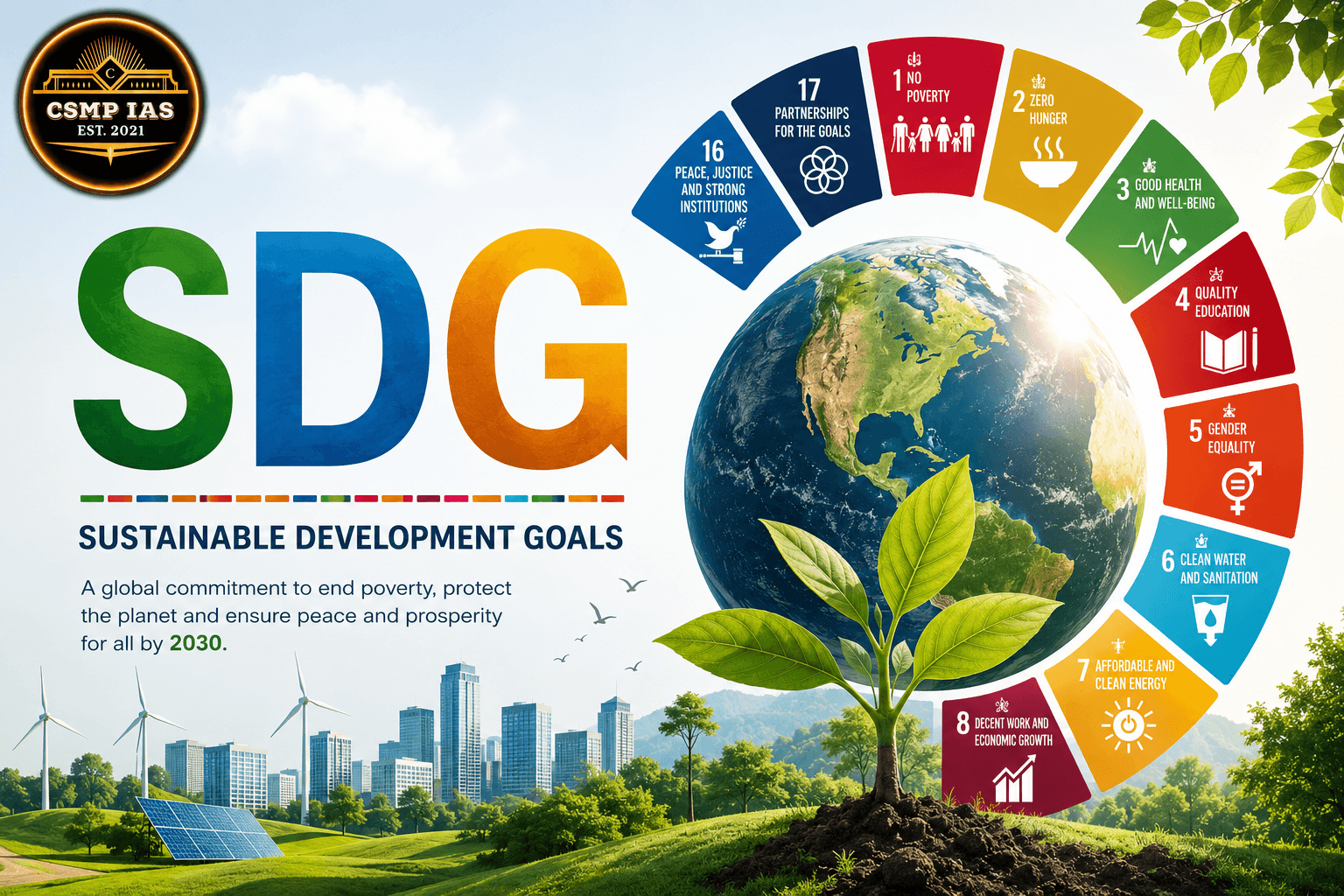
The SDGs were adopted by all 193 UN Member States at the UN Sustainable Development Summit in September 2015, as part of the document titled "Transforming Our World: The 2030 Agenda for Sustainable Development." They came into effect on 1 January 2016 and are meant to be achieved by 2030.
Key Reasons Summarised
Driver Explanation Gaps in MDGs Narrow scope, developing-country focus only Rising inequality Growth without equitable distribution Climate emergency Environmental degradation threatening long-term growth Universality Need for goals applicable to all countries, not just poor ones Integration Recognition that social, economic, and environmental goals are interlinked
What Are the SDGs Trying to Achieve?
The SDGs comprise 17 goals and 169 targets, built around what is often called the 5 Ps framework:
People — End poverty and hunger, ensure health and education for all
Planet — Protect the environment and combat climate change
Prosperity — Ensure economic growth that is inclusive and sustainable
Peace — Promote just, peaceful, and inclusive societies
Partnership — Strengthen global cooperation to implement the agenda
The 17 Goals at a Glance
No Poverty
Zero Hunger
Good Health and Well-being
Quality Education
Gender Equality
Clean Water and Sanitation
Affordable and Clean Energy
Decent Work and Economic Growth
Industry, Innovation and Infrastructure
Reduced Inequalities
Sustainable Cities and Communities
Responsible Consumption and Production
Climate Action
Life Below Water
Life on Land
Peace, Justice and Strong Institutions
Partnerships for the Goals
Core Principles Behind the SDGs
Universality — Applicable to all countries, developed and developing alike.
"Leave No One Behind" — A central pledge to reach the most vulnerable and marginalised first.
Integration — Goals are interconnected; progress on one often depends on progress on others.
Multi-stakeholder implementation — Governments, private sector, civil society, and citizens all have defined roles.
Relevance for UPSC Aspirants
Prelims: Expect factual questions on the number of goals/targets, year of adoption, related indices (SDG India Index by NITI Aayog), and India's ranking.
Mains (GS-III): Questions often ask you to evaluate India's progress, challenges in implementation (data availability, state-level disparities, financing gaps), and the role of local governance (Panchayati Raj institutions in SDG localisation).
Essay: SDGs work well as supporting examples in essays on sustainable development, inclusive growth, or global cooperation.
India-specific angle: NITI Aayog is the nodal agency for SDG implementation and monitoring in India; the SDG India Index tracks state and UT-level performance — this is a favourite source for Mains answer enrichment
(Goal) / (Target Year)
1 No Poverty 2030
2 Zero Hunger 2030
3 Good Health & Well-being 2030
4 Quality Education 2030
5 Gender Equality 2030
6 Clean Water & Sanitation 2030
7 Affordable & Clean Energy 2030
8 Decent Work & Economic Growth 2030 (some sub-target 2020)
9 Industry, Innovation & Infrastructure 2030
10 Reduced Inequalities 2030
11 Sustainable Cities & Communities 2030
12 Responsible Consumption & Production 2030 (some sub-target 2020)
13 Climate Action 2030
14 Life Below Water 2030 (some sub-target 2020)
15 Life on Land 2030 (some sub-target 2020)
16 Peace, Justice & Strong Institutions 2030
17 Partnerships for the Goals 2030
Conclusion
The SDGs represent a shift from a narrow, poverty-focused development model to a comprehensive vision balancing economic growth, social equity, and environmental sustainability. For a UPSC aspirant, understanding the "why" behind the SDGs is just as important as memorising the 17 goals — because most Mains questions test your ability to connect the rationale of a policy framework to real-world governance challenges. Build your notes around the MDG-to-SDG transition, the 5 Ps, and India's implementation mechanism, and you'll be well-equipped to handle this topic across all stages of the exam.
Tip: Pair this topic with related concepts like Agenda 21, the Paris Agreement, and the Human Development Index for stronger inter-linkage in your answers.