The Mecca Pact and the Rise of Strategic Hedging: A UPSC Perspective
Introduction
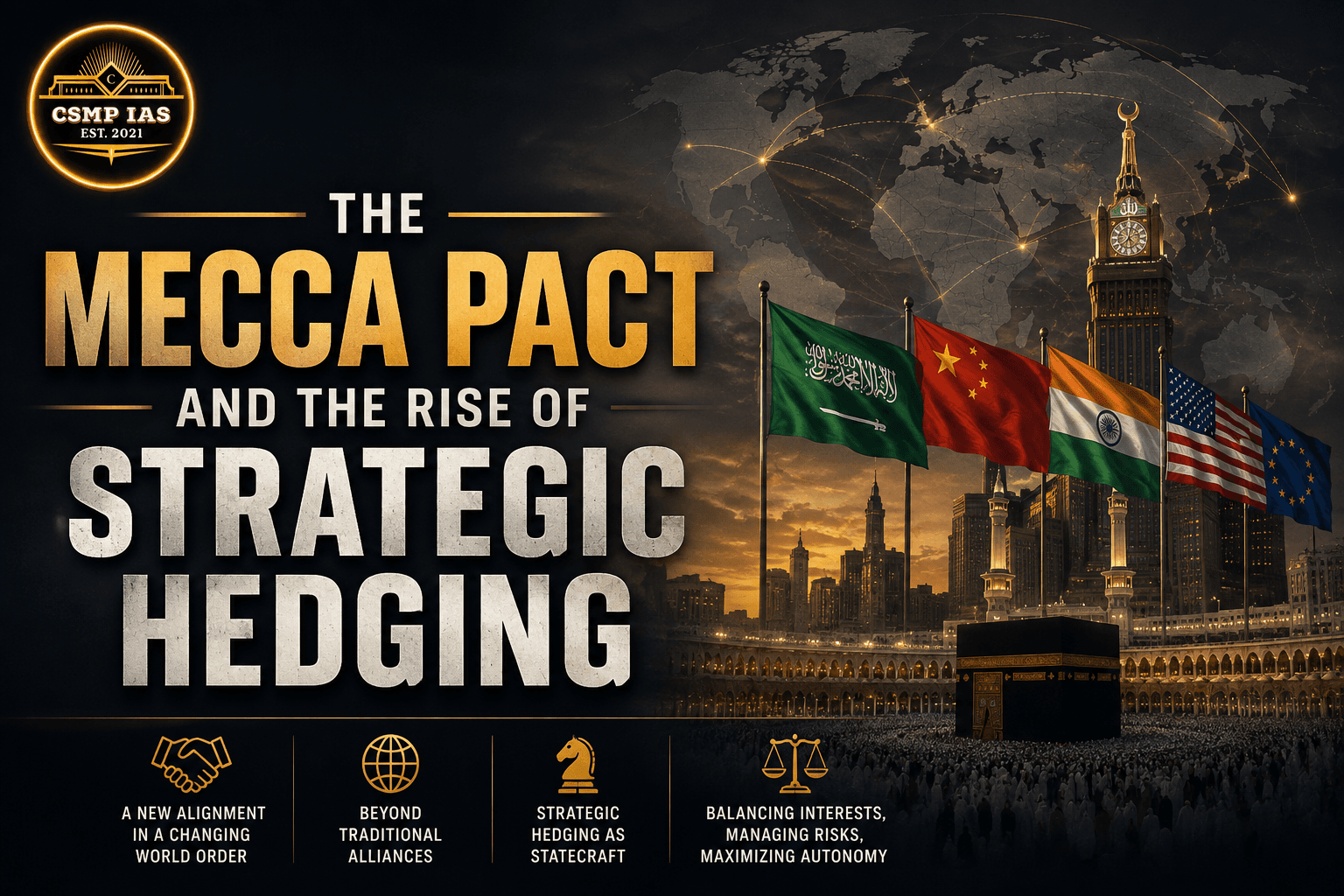
On 7 August 2026, Saudi Arabia, Türkiye, and Pakistan came together in the holy city of Mecca to sign what is now widely referred to as the Mecca Joint Defence Agreement (MJDA), or simply the "Mecca Pact." At first glance, the agreement looks like the birth of a new military alliance in the Islamic world — a trilateral compact built around a collective-defence clause reminiscent of Article 5 of the NATO Treaty. But a closer reading of the pact, its origins, and the incentives of its three signatories reveals something more nuanced: not the emergence of an "Islamic NATO," but an exercise in strategic hedging by regional middle powers navigating an increasingly unpredictable global order.
For UPSC aspirants, this development sits squarely within the GS Paper II framework of "Effect of Policies and Politics of Developed and Developing Countries on India's Interests" and "Bilateral, Regional and Global Groupings and Agreements involving India and/or affecting India's interests." It also touches GS Paper III themes of energy security and internal security, given the maritime, technological, and counter-terrorism dimensions involved. This blog unpacks the origins of the pact, the motivations of each signatory, why it falls short of a full-fledged alliance, and — most importantly for the exam — what it means for India and how New Delhi should respond.
Background: From a Bilateral Understanding to a Trilateral Framework
The Mecca Pact did not emerge overnight. It builds directly upon the Saudi–Pakistan Strategic Mutual Defence Agreement signed in September 2025, which had already established that an act of aggression against either country would be treated as aggression against both. That earlier arrangement was largely seen as a formalisation of a decades-old, informal security relationship — Pakistan has trained Saudi military personnel, provided advisory support, and at various points deployed troops to help safeguard the Saudi monarchy and its territorial integrity.
What changed in August 2026 was the inclusion of Türkiye, transforming a bilateral Gulf–South Asia security understanding into a broader transregional framework spanning the Gulf, Anatolia, and South Asia. This expansion is significant because it brings a NATO-experienced, militarily assertive middle power — one with a large conventional military and a sophisticated defence-industrial base — directly into a security arrangement anchored in the heart of the Islamic world.
Key Provisions of the Mecca Pact
While the full legal text of the agreement has not been made public in granular detail, several features have been consistently reported:
Collective Defence Clause: An armed attack on any one of the three members will be treated as an attack on all three — a provision that echoes, in political spirit, Article 5 of the North Atlantic Treaty, though without NATO's institutional depth.
Grounding in International Law: The pact explicitly locates itself within Article 51 of the UN Charter, which recognises the inherent right of individual and collective self-defence for UN member states facing armed attack. This is a deliberate legal framing intended to lend the pact international legitimacy rather than present it as an offensive coalition.
Defensive Orientation: Pakistani and Turkish officials have publicly described the pact as "purely defensive," insisting it is not targeted at any specific country, and have signalled openness to admitting additional members in the future.
Institutional Consultation Mechanism: The agreement provides for regular consultations among the foreign ministers, defence ministers, and military leadership of the three countries — a modest but meaningful step toward institutionalisation.
Flexible Response Options: Assistance triggered under the pact could range from intelligence-sharing and logistics to air and missile defence cooperation and, in extreme cases, military deployment. Crucially, the collective-defence clause does not mandate an automatic declaration of war by every member — each retains discretion over the nature of its response.
Openness to Expansion: Statements from the three governments suggest the pact could be widened to include other willing states, though no formal accession criteria or decision-making architecture has yet been disclosed.
Why Strategic Hedging, and Not Alliance-Building?
The central conceptual takeaway from this development — and the phrase that gives the original op-ed its title — is strategic hedging. In international relations theory, hedging refers to a strategy adopted by states that seek to avoid overcommitting to any single major power or bloc, instead cultivating multiple, sometimes overlapping partnerships to preserve maximum flexibility. It sits between the extremes of full alignment (bandwagoning) and outright confrontation (balancing).
None of the three Mecca Pact signatories is abandoning its existing relationships. Saudi Arabia remains deeply tied to the United States for weapons systems, intelligence, and security guarantees. Türkiye remains a NATO member. Pakistan continues to balance ties with the United States, China, and the Gulf states simultaneously. What the pact reflects, therefore, is not a wholesale realignment away from Washington, but each country's attempt to diversify its security options in a world where reliance on a single external guarantor increasingly feels risky.
Saudi Arabia's Calculus
Saudi Arabia's motivations are perhaps the most consequential for understanding why this pact has emerged now. Riyadh has grown increasingly uneasy about depending on the United States as its sole security guarantor. The 2019 drone and missile strikes on the Abqaiq and Khurais oil facilities — which temporarily knocked out roughly half of Saudi Arabia's oil production — exposed just how vulnerable the kingdom's critical infrastructure is to asymmetric attack, and how uncertain the American response to such an attack could be. Subsequent regional conflicts, including tensions and hostilities involving Iran through 2026, have only reinforced this anxiety.
Saudi Arabia's response has been to hedge rather than decouple. By deepening security ties with Türkiye (for drones, missiles, and electronic-warfare systems) and Pakistan (for training, manpower, and military expertise), Riyadh is building additional layers of insurance without abandoning its core relationship with Washington. There is also a religious-political dimension: hosting the signing ceremony in Mecca itself reinforces Saudi Arabia's claim to leadership of the Islamic world, at a moment when both Türkiye and Iran are also vying for greater regional influence.
Türkiye's Calculus
For Türkiye, the pact is part of a longer-term project of transforming the country from being merely NATO's southeastern flank into an autonomous Eurasian and West Asian power. Formal inclusion in a Gulf security framework gives Ankara a foothold that complements its existing military and political presence in Qatar, Libya, Syria, and the Horn of Africa.
There is also a strong commercial logic. Türkiye has built up considerable expertise in unmanned aerial systems, missiles, armoured vehicles, and electronic warfare — sectors where Saudi Arabia represents a lucrative market for both direct sales and joint production. This defence-industrial relationship is reinforced by wider economic cooperation; in February 2026, Saudi Arabia and Türkiye signed an agreement for Saudi-backed renewable-energy projects in Türkiye with a planned capacity of 5,000 MW, underlining how the security relationship sits atop a broader economic rapprochement. Finally, an expanded regional footprint strengthens Ankara's bargaining position within NATO itself, where Türkiye already fields the alliance's second-largest army.
Pakistan's Calculus
For Pakistan, the pact offers a route to convert its military manpower, geographic position, and nuclear status into diplomatic and economic leverage well beyond South Asia. It formalises — rather than creates — a security relationship with Saudi Arabia that has existed informally for decades, converting years of training missions and advisory deployments into a visible, structured commitment.
The economic incentives are significant too. Pakistan has repeatedly relied on Saudi financial deposits, oil facilities, and emergency assistance to shore up its external accounts, and deeper security cooperation is likely to translate into better access to investment and defence contracts. Politically, the pact allows Islamabad to project itself as a regional security provider rather than a country defined primarily by its rivalry with India — though it would be a mistake to assume Pakistan can convert this into automatic diplomatic backing from Riyadh on India-related issues, given how much Saudi Arabia values its own substantial and growing relationship with New Delhi.
Complementary Strengths: A Division of Labour
The three countries bring genuinely complementary capabilities to the arrangement, which is part of what makes the pact more than a symbolic gesture, even if it falls short of a true alliance:
Saudi Arabia contributes financial firepower, energy leverage, religious and diplomatic influence across the Islamic world, and access to modern (largely Western-origin) military hardware. According to SIPRI estimates, Saudi Arabia's 2025 military spending stood at roughly USD 83.2 billion, making it the eighth-largest military spender globally.
Türkiye brings a large conventional military, NATO-standard training and interoperability experience, an increasingly self-sufficient defence-industrial base (drones, missiles, naval platforms), and control over the strategically vital Turkish Straits.
Pakistan offers a large, combat-experienced professional military, missile capability, and a latent nuclear deterrent, along with decades of institutional familiarity with Saudi armed forces.
In principle, this is a natural division of labour — Saudi capital, Turkish technology, and Pakistani manpower and nuclear latency. In practice, translating this complementarity into a functioning, interoperable security architecture is far more difficult than signing a joint declaration.
Why the Mecca Pact Is Not Yet an "Islamic NATO"
Comparisons to NATO are tempting but misleading, and UPSC answers should be careful to draw out the distinctions clearly:
No integrated command structure: NATO possesses a permanent civilian and military command, including a Supreme Allied Commander. Nothing comparable has been announced for the Mecca Pact.
No common force structure: There are no permanently assigned joint forces, shared operational plans, or integrated air and missile defence systems among the three countries.
Ambiguous triggers: It remains unclear whether attacks by non-state actors, cyberattacks, maritime blockades, or conflicts arising from a member's own military actions elsewhere would actually activate the collective-defence clause.
No automatic military response: Even NATO's Article 5 only obliges members to take "such action as it deems necessary" — it does not mandate identical military responses. The Mecca Pact's collective-defence clause is, if anything, looser still.
Divergent threat perceptions: Saudi Arabia's principal security concerns centre on Iran and Gulf instability; Türkiye's priorities lie with Kurdish militancy, Syria, the Eastern Mediterranean, and its NATO obligations; Pakistan remains overwhelmingly focused on India and Afghanistan. Three very different threat maps make a genuinely unified strategic doctrine difficult to construct.
No declared nuclear umbrella: Although Pakistan is a nuclear-armed state, it has not formally extended any nuclear guarantee to Saudi Arabia or Türkiye. Describing the pact as establishing a Pakistani "nuclear umbrella" over the Gulf would be speculative and premature.
Structural Limitations That Could Constrain the Pact's Future
Several fault lines could limit how far the Mecca Pact evolves in practice:
Divergent relations with Iran: While Saudi–Iran relations remain uneasy despite periods of diplomatic accommodation, both Türkiye and Pakistan share borders with Iran and have pressing economic, security, and ethnic considerations that require sustained engagement with Tehran. Neither is likely to want to be drawn into an open-ended Saudi confrontation with Iran.
Saudi–Türkiye rivalry over Islamic leadership: The two countries have long competed over political Islam, the Muslim Brotherhood, and broader leadership of the Islamic world. Relations deteriorated sharply after the 2018 killing of journalist Jamal Khashoggi, and while ties have since improved considerably, underlying tensions have not fully disappeared.
Pakistan's economic constraints: Pakistan's considerable military capability sits uneasily alongside serious fiscal and external-sector vulnerabilities. Heavy dependence on Saudi financial support risks turning Pakistan into something closer to a contracted security provider than a fully autonomous strategic partner within the pact.
The Yemen precedent: When Saudi Arabia sought Pakistani troop participation in the Yemen conflict in 2015, Pakistan's Parliament unanimously voted for neutrality instead. This history is an important reminder that decades of defence cooperation do not guarantee automatic Pakistani participation in every Saudi military venture — a caution against overreading the pact's binding force.
Absence of operational clarity: Without clear rules on command-and-control, burden-sharing, intelligence classification, and responses to non-state actor attacks, the pact risks remaining more symbolic than enforceable.
Interoperability challenges: Saudi Arabia operates predominantly Western platforms, Türkiye uses a mix of NATO-standard and indigenous systems, and Pakistan relies on a blend of Chinese, American, and indigenous equipment. Harmonising communications, data links, and doctrine across these systems would require years of sustained investment.
Risk of regional polarisation: Even if the three members insist the pact is purely defensive, Iran and Israel may perceive it as directed against them, potentially triggering counter-alliances, accelerated arms build-ups, and pre-emptive military planning elsewhere in the region.
Implications for India
This is the section most relevant for UPSC Mains answer writing, since examiners consistently test the "effect on India's interests" dimension of any international grouping.
1. Maritime security in the western Indian Ocean. The pact effectively creates a more unified security front across the Arabian Sea and the Red Sea corridor. As Saudi Arabia and Pakistan deepen military interoperability, the Bab al-Mandeb Strait — a critical chokepoint for India's energy imports and trade — could increasingly fall within the sphere of influence of a bloc in which India has no formal participation. There is also a possibility of Turkish military hardware or personnel gaining a presence in the region, acting as a potential force multiplier for Pakistan and complicating India's own MAHASAGAR (Mutual and Holistic Advancement for Security and Growth Across Regions) vision for the Indian Ocean Region.
2. Defence-technology diffusion to Pakistan. Türkiye's entry brings NATO-standard aerospace and drone technology closer to Pakistan, potentially financed through Saudi capital. The integration of Turkish Bayraktar-class drone technology into Pakistan's operational doctrine would require India to recalibrate its air defence networks and electronic warfare capabilities along its western frontier.
3. Strain on India's "de-hyphenation" policy. India has long pursued strong, independent bilateral relationships with Riyadh, Ankara, and Tehran simultaneously — a policy sometimes called de-hyphenation. A more consolidated Saudi–Türkiye–Pakistan security bloc, potentially perceived as aligned against Iran, complicates this balancing act and demands more careful diplomatic navigation to preserve India's strategic autonomy.
4. Counter-terrorism and diplomatic optics. A more institutionalised trilateral security relationship could, in theory, give Pakistan additional diplomatic cover in international forums, making it harder for India to keep global attention focused on cross-border terrorism emanating from Pakistani soil.
5. Nuclear-shadow perception. Even though the pact does not formally extend Pakistan's nuclear deterrent to its partners, the existence of a collective-defence framework linking a nuclear-armed Pakistan with a resource-rich Saudi Arabia creates a persistent perception of a "nuclear shadow" over the region, requiring India to maintain heightened vigilance over Pakistan's nuclear posture and delivery systems, including any risk of technology transfer.
6. Energy security exposure. Saudi Arabia remains one of India's principal crude oil suppliers. Any instability, or any tendency for the MJDA bloc to align trade and pricing decisions with its own security priorities, could create fresh vulnerabilities for India's energy security and its broader energy-transition planning.
The Way Forward for India
Given these implications, India's response should be calibrated — avoiding both complacency and alarmism. Several elements should shape this response:
Seek explicit bilateral reassurances from Riyadh. India should use the existing India–Saudi Strategic Partnership Council to obtain clear, high-level clarity that the pact's collective-defence clause is not intended to extend into South Asian bilateral disputes, particularly any India–Pakistan confrontation.
Sustain de-hyphenated engagement. New Delhi should continue building its relationships with Saudi Arabia, the UAE, Qatar, and Oman on their own independent merits, resisting the temptation to read Gulf hedging behaviour as an anti-India posture.
Deepen alternative minilateral partnerships. Platforms such as I2U2 (India–Israel–UAE–USA) and expanded maritime cooperation with partners like France and the UAE can help India maintain a credible strategic presence in the western Indian Ocean without engaging in confrontational bloc politics.
Upgrade defence-technological preparedness. Given the likelihood of accelerated Turkish drone and aerospace technology transfers to Pakistan, India needs sustained investment in air defence, electronic warfare, and counter-drone capabilities.
Diversify energy sourcing and fast-track IMEC. Reducing over-dependence on any single supply corridor, while accelerating the India–Middle East–Europe Economic Corridor, would help insulate India's energy security from any future weaponisation of trade or transit routes.
Counter diplomatic co-option on terrorism. India must continue to build international coalitions — through the UN, FATF, and other forums — to ensure that Pakistan cannot leverage its elevated regional security status to obscure its record on cross-border terrorism.
Maintain independent channels with Iran and Israel. Because the pact alters the security calculus for non-signatory powers as well, India's continued engagement with both Tehran and Tel Aviv gives it a fuller, more balanced picture of the shifting regional order — and preserves its own room for manoeuvre.
Conclusion
The Mecca Pact is best understood not as the birth of a "Muslim NATO" but as a vivid illustration of strategic hedging by three middle powers seeking greater autonomy in an era of diminishing certainty about American security guarantees. Its long-term success will depend on whether Saudi capital, Turkish technology, and Pakistani military capability can be reconciled despite genuinely divergent threat perceptions on Iran, unresolved rivalries over leadership of the Islamic world, and Pakistan's own economic constraints.
For India, the pact is a reminder that the West Asian security order is becoming more multipolar and less predictable. The appropriate response is neither panic nor indifference, but a sustained, multi-pronged strategy: safeguarding the substantive Saudi partnership, closely monitoring Turkey–Pakistan military convergence, keeping diplomatic channels with Iran open, strengthening indigenous defence capabilities, and using India's economic weight to evolve from being a peripheral stakeholder into a genuinely credible security contributor in a multipolar West Asia.
Key Terms for Prelims
Mecca Joint Defence Agreement (MJDA)
Article 5 of the NATO Treaty
Article 51 of the UN Charter
Bab al-Mandeb Strait and the Red Sea corridor
I2U2 (India–Israel–UAE–USA)
India–Middle East–Europe Economic Corridor (IMEC)
FATF
Indian Ocean Rim Association (IORA)
MAHASAGAR initiative
Practice Mains Question
What is the Mecca Joint Defence Agreement (MJDA)? Critically analyse its strategic significance and examine its implications for India's energy security and regional diplomacy in West Asia. (250 words)
Related Previous Year Questions
Prelims (2023): A question testing understanding of Israel's diplomatic relations with Arab states and the Arab Peace Initiative — a reminder that West Asian diplomatic realignments are a recurring UPSC theme.
Prelims (2018): A question on the term "two-state solution" and its context — again underscoring the continued Prelims focus on West Asian geopolitics.
Mains (2018): A question on the depth and diversity of India–Israel relations, relevant background for understanding India's broader West Asia balancing act.
Mains (2017): A question on India's energy security and its policy cooperation with West Asian countries — directly relevant to the energy security dimension of the Mecca Pact's implications for India.
This article is intended as exam-oriented reading material for UPSC Civil Services aspirants, drawing on current developments in West Asian geopolitics as of August 2026.