Lost in Translation: Why India's Old Political Parties Can't Speak Gen Z
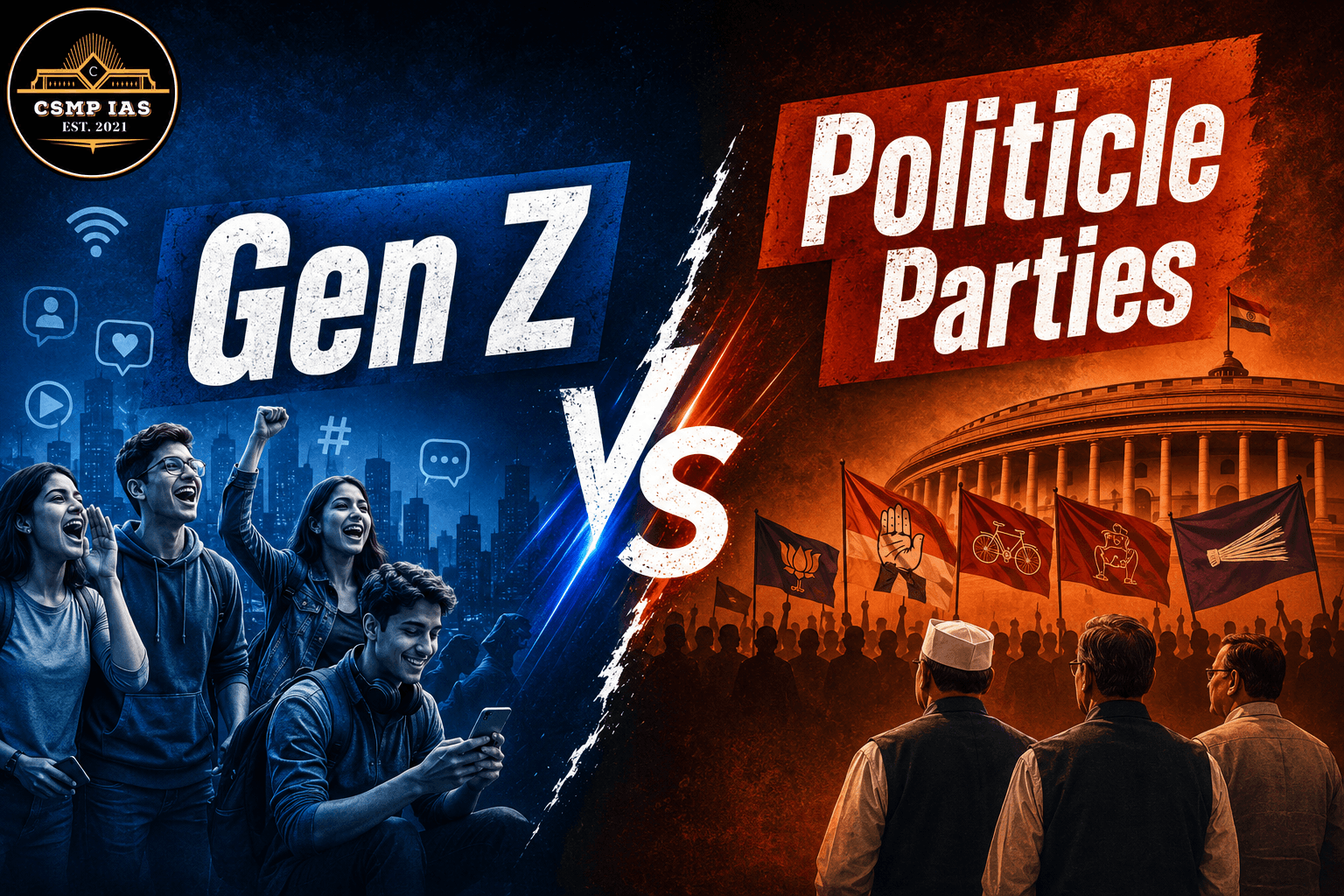
There's a particular kind of cringe that happens when a decades-old political party tries to talk like a 19-year-old. A stiff Instagram reel, a slang term used one meme-cycle too late, a hashtag that already feels dated by the time the press release goes out. It's become a recurring spectacle in Indian politics — and it points to something bigger than an awkward social media team. It suggests that many traditional parties don't just struggle to speak the language of Gen Z. They don't understand its grammar.
A New Political Dialect
Political communication in India used to run on a fairly predictable script: solemn speeches, ideological slogans, party symbols, and a chain of command that decided what got said and when. Gen Z politics runs on something else entirely — a fast, hybrid, irreverent dialect built from Hindi-English code-switching, meme formats, viral soundbites, and pop-culture references, all optimized for a phone screen rather than a podium.
This isn't just aesthetic. It's a different way of building trust and belonging. When young protesters or political newcomers use this language, it signals that they're insiders in a shared culture — not authority figures performing relatability from a distance.
The TVK Moment in Tamil Nadu
The clearest recent illustration came out of Tamil Nadu. Actor-turned-politician Vijay's Tamilaga Vettri Kazhagam built real momentum among young, first-time voters by treating them as participants rather than an audience — turning campaign moments into shareable reels and letting the online energy shape the ground campaign. The long-governing DMK responded by posting its own reels and borrowing Gen Z slang, but the imitation didn't land the same way. Copying the vocabulary of a subculture isn't the same as being fluent in it — and voters seemed to sense the difference.
The Numbers Back the Vibe
This isn't just anecdotal. A CVoter snap poll conducted after a wave of youth-led protests found that a clear majority of young respondents — across the political spectrum — believe parties simply don't understand their concerns. Interestingly, the skepticism was strongest among opposition-leaning youth but still substantial among ruling-party supporters, suggesting this isn't a partisan complaint so much as a generational one. When asked what actually matters to them, respondents pointed overwhelmingly to bread-and-butter issues — employment, education, and healthcare — with inflation and corruption trailing behind.
That's worth sitting with: the "grammar" gap isn't really about memes at all. The memes are just the surface layer of a deeper mismatch — parties optimizing for legacy loyalty and vote-bank arithmetic, while a generation raised on algorithmic feeds and gig-economy uncertainty wants direct answers to direct problems.
Why Borrowed Slang Doesn't Work
There's a pattern across several examples — leaders adopting terms like "delulu," "FOMO," or "MIA" mid-speech, often to describe opponents. It tends to read as try-hard rather than credible, because it treats Gen Z culture as a costume to put on for a news cycle instead of a genuine register to think and communicate in. Genuine fluency shows up in how a message is structured — quick, self-aware, comfortable with irony — not just in which words get borrowed.
What "Understanding the Grammar" Would Actually Require
If the language gap is a symptom, the cure isn't a better meme team. It's structural:
Direct, two-way channels instead of top-down messaging — Gen Z has grown up expecting to respond, remix, and talk back, not just receive.
Substance over slang — young voters are watching for real positions on jobs, education, and cost of living, not just cultural fluency.
Younger people in rooms where decisions are made, not just running the social media handle.
Comfort with irreverence — a willingness to be self-deprecating and quick rather than defensive and scripted.
here's why this topic matters for the exam:
Where it fits in the syllabus
GS Paper II (Polity & Governance): Political parties, their role, and challenges to representative democracy — this topic directly feeds "role of political parties," "effective institutions," and "citizens' charter"-type themes.
GS Paper I (Society): Social change and youth as a demographic force — relevant to "effects of globalisation on Indian society" and "role of women/youth in society."
Essay Paper: Excellent raw material for essays like "Democracy and Dissent," "Generation Gap in Politics," "Social Media and Political Communication," or "Changing Nature of Political Participation in India."
Prelims (current affairs): Recent Gen Z protest movements, CVoter survey data, and TVK's Tamil Nadu win are the kind of factual pegs prelims picks up (dates, data points, named movements).
Why it's a "high-value" editorial
It links a current event (TVK's rise, DMK's response, CVoter poll) to a conceptual argument (generational disconnect, communication vs. substance) — exactly the structure UPSC mains answers reward.
It's comparative and analytical rather than just descriptive, so it trains you to write answers that go beyond "what happened" into "why it matters" and "what should change" — useful for value-added/way-forward conclusions.
It connects to a global trend (Asia-wide Gen Z protests, shifting voter identities), which helps if you want to add an international comparison for extra marks.
The Bigger Picture
What's happening in India echoes a wider global pattern — from youth-led protest movements across Asia to shifting political identities among young voters elsewhere — where a generation shaped by economic precarity and digital-native habits is increasingly unwilling to inherit old party loyalties by default. Grammar, in this sense, is really shorthand for legitimacy. Parties that can't speak the language are usually also the ones that haven't fully grasped what this generation is actually asking for.
The parties that eventually crack this won't be the ones with the trendiest reels. They'll be the ones who stop treating Gen Z as an audience to be messaged and start treating them as a constituency to be answered.
Suggested title: "Lost in Translation: Why India's Old Political Parties Can't Speak Gen Z"