
CSMP IAS : India's Premier Coaching Institute for IAS / PCS
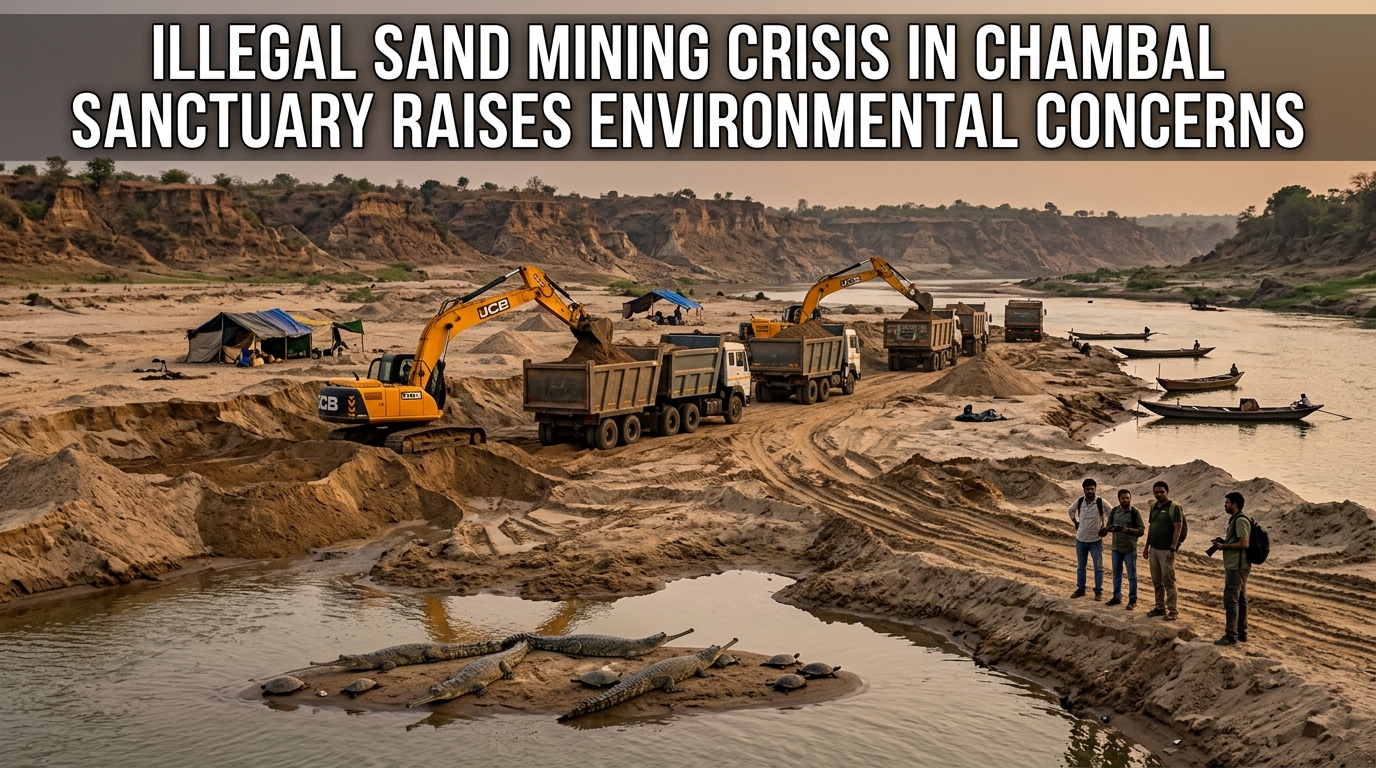
Illegal Sand Mining Crisis in Chambal Sanctuary Raises Environmental Concerns
Table of Contents
The Illegal Sand Mining Crisis in Chambal Sanctuary has come under national focus after the Supreme Court took suo motu cognisance of large-scale ecological damage. The issue highlights serious threats to the fragile river ecosystem, especially the critically endangered gharial, and exposes challenges in environmental governance, law enforcement, and inter-state coordination. This development is highly relevant for understanding biodiversity conservation and environmental protection in India.
Why in the News?
- The Supreme Court of India has taken suo motu cognisance of illegal sand mining in the National Chambal Sanctuary.
- Suo motu means that the court has taken action on its own without any formal complaint being filed.
- This power is used when the court finds an issue of serious public importance.
- The action was taken after media reports highlighted large-scale illegal sand mining in the Chambal River.
- Media reports act as an important source of information for courts in public interest matters.
- They help bring environmental and social issues to the attention of authorities.
- The court bench of Justice Vikram Nath and Justice Sandeep Mehta expressed concern about the damage to the ecosystem.
- The court emphasized that environmental protection is a constitutional duty under Article 21, which guarantees the right to life.
- A clean and healthy environment is considered part of the right to life.
- The issue is important because the sanctuary is a major habitat of the gharial, a critically endangered species.
- The gharial is a fish-eating crocodile with a long and narrow snout.
- It is listed as “Critically Endangered” by the International Union for Conservation of Nature (IUCN).
- The court intervened to prevent further ecological damage caused by illegal sand mining.
- The aim is to protect biodiversity and ensure sustainable use of natural resources.
What are the Key Highlights of Illegal Sand Mining?
Suo Motu Action by the Supreme Court
- The Supreme Court acted on its own initiative after reading media reports.
- This shows the proactive role of the judiciary in environmental protection.
- Courts in India often intervene in environmental matters through Public Interest Litigation (PIL).
- The court expressed deep concern about the ongoing destruction of the river ecosystem.
- It highlighted that unchecked sand mining can cause irreversible ecological damage.
Serious Threat to Gharial Habitat
- The Chambal River is one of the last safe breeding habitats for gharials.
- Gharials lay eggs in sandy riverbanks, which are essential for their reproduction.
- Sand mining destroys these nesting sites.
- Due to increasing mining activities, some gharials had to be relocated.
- Relocation means shifting animals from one place to another for their safety.
- However, relocation is not always successful because animals may not adapt easily.
Mining Even in Relocated Areas
- The areas where gharials were relocated were also affected by illegal mining.
- This shows that the problem is widespread and not limited to one location.
- It reflects poor enforcement of environmental laws.
Earlier Action by the National Green Tribunal (NGT)
- The National Green Tribunal had taken notice of the issue in March 2022.
- The NGT is a special court that deals with environmental cases in India.
- It was established under the National Green Tribunal Act, 2010.
- The tribunal acted after a report titled “Digging up the Chambal.”
- Reports like these provide scientific and factual evidence of environmental damage.
- The NGT identified sand mining as the biggest threat to the sanctuary.
- It warned about long-term ecological consequences if mining continues.
Sand Mining as the Biggest Threat
- Sand mining involves removing sand from riverbeds for construction purposes.
- Sand is used in building roads, houses, and infrastructure.
- Illegal sand mining causes multiple environmental problems.
- It changes the natural shape of the river, known as river morphology.
- It reduces the river’s ability to hold water, called water-retention capacity.
- For example, excessive sand removal can deepen the riverbed.
- This can lower groundwater levels and affect nearby agriculture.
Organised Sand Mining Mafia
- Illegal sand mining is often controlled by organised groups known as sand mafias.
- These groups operate in a structured and illegal manner.
- They aim to make profits by exploiting natural resources.
- Sand mafias often use force and intimidation.
- They may threaten or attack forest officials and police personnel.
- This creates law and order problems.
Mining Methods Used by Mafias
- Tractor-trolleys are used to remove sand from riverbeds.
- These vehicles can easily access shallow river areas.
- Sand is stored in nearby fields and later transported by trucks.
- This method helps avoid detection by authorities.
Use of Unregistered Vehicles
- Many vehicles used in illegal mining do not have registration numbers.
- This makes it difficult to identify and punish offenders.
- Lack of identification reduces accountability.
- It also encourages repeat offences.
Geographical Factors Help Illegal Mining
- The Chambal region has low rainfall and fewer floods.
- This keeps sandbanks exposed throughout the year.
- Exposed sandbanks make it easy to extract sand continuously.
- This increases the scale of illegal mining activities.
Location of the Sanctuary
- The National Chambal Sanctuary is located along the Chambal River.
- It spreads across three states: Rajasthan, Madhya Pradesh, and Uttar Pradesh.
- It covers around 600 km of the river stretch.
- The total length of the Chambal River is about 960 km.
- It is the only tri-state riverine protected area in India.
- Riverine means related to rivers.
Rich Biodiversity of the Sanctuary
- The sanctuary supports a wide range of species.
- It is an important hotspot for aquatic and semi-aquatic life.
- Important species include:
- Marsh crocodile, which is another crocodile species found in India.
- Red-crowned roof turtle, which is highly endangered.
- Smooth-coated otter, which depends on clean water ecosystems.
- Ganges river dolphin, which is India’s national aquatic animal.
- Indian skimmer, a rare bird that feeds by skimming water surfaces.
- Sarus crane, the tallest flying bird in the world.
- Black-necked stork, a large wetland bird.
What are the Significance of Illegal Sand Mining?
Protection of a Critically Endangered Species
- The sanctuary is one of the last strongholds of the gharial population.
- Without protection, the species may face extinction.
- Conservation efforts help increase the survival rate of hatchlings.
- Protecting nesting sites is essential for reproduction.
Conservation of River Ecosystems
- River ecosystems support a variety of plants and animals.
- They provide water, food, and habitat.
- Healthy rivers maintain ecological balance.
- They help regulate climate and support agriculture.
Safeguarding a Unique Tri-State Protected Area
- The sanctuary is shared by three states.
- This makes it unique and important.
- Protection requires cooperation between different state governments.
- Joint efforts can improve conservation outcomes.
Preservation of Biodiversity
- The sanctuary is home to many endangered species.
- Protecting it helps conserve genetic diversity.
- Biodiversity is important for ecosystem stability.
- It ensures resilience against environmental changes.
Strengthening Environmental Governance
- Judicial intervention ensures accountability.
- It forces authorities to take action.
- It highlights the importance of environmental laws.
- It promotes better governance and enforcement.
Challenges Associated with Illegal Sand Mining
Illegal Sand Mining Mafia
- Sand mafias operate in an organised and powerful manner.
- They often resist law enforcement actions.
- Their activities are driven by high demand for sand.
- Construction industries rely heavily on sand.
Weak Law Enforcement
- Forest departments often lack manpower and resources.
- They may not have adequate support from police.
- Corruption can also weaken enforcement.
- Illegal activities may continue due to lack of strict action.
Difficult Terrain and Geography
- The river terrain allows easy access to sandbanks.
- Open areas make monitoring difficult.
- Low floods keep sand exposed year-round.
- This encourages continuous mining.
Lack of Vehicle Identification
- Unregistered vehicles make tracking difficult.
- Offenders can escape without punishment.
- Lack of records reduces transparency.
- It weakens the legal process.
Environmental Damage
- Sand mining alters river flow patterns.
- It can lead to erosion of riverbanks.
- It destroys breeding grounds of aquatic species.
- It affects fish populations and bird habitats.
Way Forward
Strong Enforcement Against Illegal Mining
- Authorities should take strict action against offenders.
- Special task forces can be created.
- Regular patrolling should be increased.
- This can prevent illegal activities.
Use of Technology for Monitoring
- Drones and satellite imagery can be used for surveillance.
- GPS tracking can monitor vehicle movement.
- Technology improves efficiency and transparency.
- It helps in real-time detection of illegal activities.
Inter-State Coordination
- The three states should work together.
- Joint operations can improve enforcement.
- Sharing information can help track offenders.
- Coordination reduces gaps in governance.
Community Participation
- Local people should be involved in conservation.
- They can act as watchdogs.
- Awareness programmes can educate communities.
- People can report illegal activities.
Strengthening Legal Framework
- Laws should be strictly implemented.
- Penalties should be increased.
- Fast-track courts can handle environmental cases.
- This ensures timely justice.
Conclusion
Protecting river ecosystems requires a balance between development and conservation, where human activities must respect natural limits. Long-term sustainability can only be achieved when ecological protection becomes a shared responsibility among institutions, communities, and policymakers, ensuring that natural systems continue to support life and livelihoods in a stable manner.
Relevant Articles:
U.S. Forced Labour Probe Raises Concerns for Global Trade and India
India–Canada Relations Strengthen with Strategic Economic and Energy Partnership
Economic Stabilisation Fund Boosts India’s Crisis Preparedness and Fiscal Stability
Read More:
Peptide Therapies Risks and Benefits: Growing Popularity Raises Safety Concerns
India Labour Codes Reform: Opportunities and Challenges in India Labour Codes Reform
Western Media Double Standards: Bias in Global Politics
Supreme Court steps in to save the home of gharials at …