
CSMP IAS : India's Premier Coaching Institute for IAS / PCS
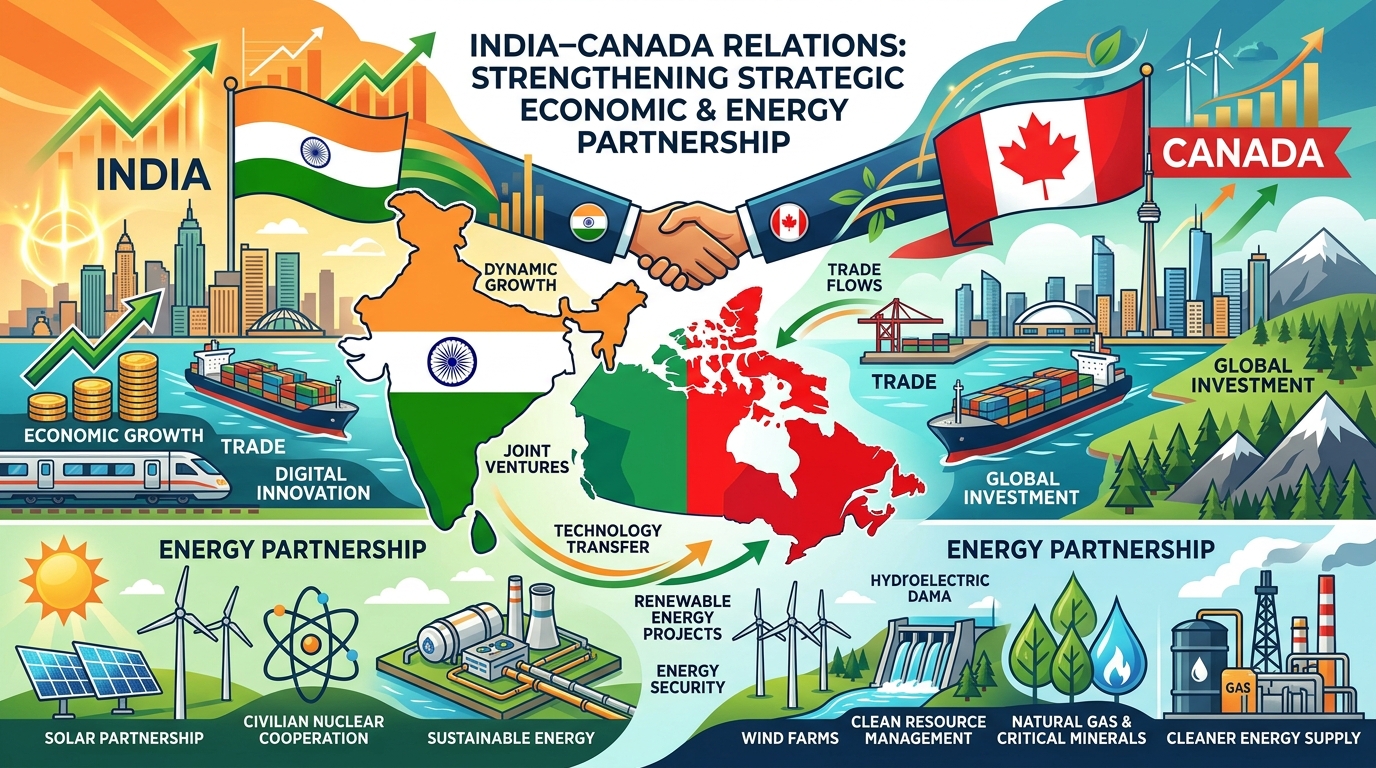
India–Canada Relations Strengthen with Strategic Economic and Energy Partnership
Table of Contents
India–Canada Relations have entered a positive and renewed phase following Canadian Prime Minister Mark Carney’s 2026 visit to India. The engagement focused on strengthening economic cooperation, securing critical mineral supply chains, enhancing energy security, and boosting technology partnerships. With progress on the Comprehensive Economic Partnership Agreement (CEPA) and new agreements in uranium supply and innovation, India–Canada Relations are poised to play a key role in global trade, clean energy transition, and strategic stability.
Why in the News?
- The Prime Minister of Canada, Mark Carney, visited India from February 27 to March 2, 2026.
- The visit marked an improvement in relations between India and Canada after tensions during the tenure of former Canadian Prime Minister Justin Trudeau.
- The visit focused mainly on economic cooperation, energy security, technology partnership, and critical minerals supply chains.
- Several agreements and memoranda of understanding (MoUs) were signed to strengthen the bilateral relationship between India and Canada.
- The visit also followed earlier diplomatic engagements between Narendra Modi and Canadian leaders in Kananaskis (June 2025) and Johannesburg (November 2025) to improve bilateral ties.
Key Highlights of India–Canada Relations
- Revival of India–Canada Relations
- The visit marked a major improvement in diplomatic relations between the two countries.
- Both sides avoided past political disputes and focused on practical cooperation.
- Focus on Economic Cooperation
- Economic issues were the main focus of the discussions.
- Both countries want to strengthen trade, investment, and supply chains.
- Comprehensive Economic Partnership Agreement (CEPA)
- India and Canada signed the terms of agreement for CEPA.
- This agreement will provide a road map for future trade negotiations.
- Technology and Innovation Partnership
- An MoU was signed under the Australia-Canada-India Technology and Innovation Partnership.
- The partnership aims to promote technology cooperation and innovation.
- Research, Cultural and Food Cooperation
- Agreements were signed to increase research collaboration.
- Cultural exchanges between the two countries will be strengthened.
- Cooperation in food and nutrition was also agreed.
- Uranium Supply Agreement
- India’s Department of Atomic Energy signed a commercial contract with Cameco.
- Canada will supply uranium ore concentrates for India’s nuclear power program.
- Critical Minerals Cooperation
- Both countries signed an MoU on critical minerals cooperation.
- This will help India secure minerals required for technology, electronics, and clean energy industries.
- Energy Cooperation
- Energy cooperation became the central theme of the visit.
- Both countries will work together in conventional and renewable energy sectors.
Significance of India–Canada Relations
Strengthening Bilateral Relations
- The visit helped restore trust and cooperation between India and Canada.
- It created a new positive phase in diplomatic relations.
Boost to Trade and Economic Growth
- The CEPA negotiations will increase trade and investment flows.
- Businesses in both countries will get better market access and opportunities.
Securing Critical Mineral Supply Chains
- Critical minerals are necessary for modern technology, semiconductors, and clean energy systems.
- Cooperation with Canada will help India reduce dependence on limited suppliers, especially China.
Enhancing Technology and Innovation Cooperation
- Technology partnerships will promote research, innovation, and industrial development.
- It will strengthen collaboration in advanced technologies.
Strengthening Energy Security
- Canada is a resource-rich country with large energy reserves.
- Uranium supply will help India maintain a stable fuel supply for nuclear power plants.
Supporting India’s Nuclear Energy Expansion
- India plans to increase nuclear power capacity to 100 GW by 2047.
- Uranium supply from Canada will help achieve this target.
Reducing Energy Dependence
- India currently depends heavily on imported energy resources.
- Cooperation with Canada will reduce vulnerability to global conflicts and supply disruptions.
Supporting Global Strategic Partnerships
- The critical minerals agreement aligns with global initiatives such as the Pax Silica coalition, which aims to strengthen cooperation in AI and semiconductor supply chains.
Challenges of India–Canada Relations
Past Political Tensions in India–Canada Relations
- Diplomatic relations between India and Canada were strained in recent years.
- Political issues and domestic pressures in Canada created distrust.
Global Geopolitical Conflicts
- Ongoing wars in Europe, West Asia, and the Levant region affect global stability.
- These conflicts create uncertainty in trade and supply chains.
Supply Chain Vulnerability
- Global supply chains are deeply interconnected.
- Disruptions in one region can affect many countries.
Dependence on Limited Mineral Suppliers
- Many critical minerals are controlled by a small number of countries, particularly China.
- This concentration creates supply risks.
Energy Import Dependence
- India still depends heavily on external energy sources.
- This makes the country vulnerable to price shocks and geopolitical tensions.
Way Forward
Deepening Strategic Partnership
- India and Canada should continue high-level diplomatic engagement.
- Regular dialogue will maintain trust and cooperation.
Accelerating CEPA Negotiations
- Both countries should move quickly to finalise the Comprehensive Economic Partnership Agreement.
- This will expand trade opportunities.
Building Resilient Supply Chains
- India and Canada should work together to diversify global supply chains.
- This will reduce risks from geopolitical conflicts.
Expanding Critical Minerals Cooperation
- Long-term agreements for exploration and supply of minerals should be developed.
- Joint investments in mining and processing can be encouraged.
Strengthening Energy Collaboration
- Cooperation in nuclear, renewable, and clean energy technologies should be expanded.
- This will support sustainable development.
Promoting Technology and Research Partnerships
- Universities, research institutions, and industries from both countries should collaborate.
- This will promote innovation and knowledge sharing.
Conclusion
The renewed engagement between India and Canada highlights the growing importance of economic partnerships and strategic cooperation in a changing global environment. By building stronger links in technology, resources, and energy, both countries can create a stable foundation for long-term cooperation and mutual development.
Relevant Articles:
Economic Stabilisation Fund Boosts India’s Crisis Preparedness and Fiscal Stability
Peptide Therapies Risks and Benefits: Growing Popularity Raises Safety Concerns
India Labour Codes Reform: Opportunities and Challenges in India Labour Codes Reform
Read More:
Western Media Double Standards: Bias in Global Politics
India China Military Gap: Urgent Need for Defence Reforms
Strait of Hormuz Crisis: Global Energy Security and India’s Strategic Response
India-Canada Joint Leaders’ Statement