CSMP IAS : India's Premier Coaching Institute for IAS / PCS
U.S. Forced Labour Probe Raises Concerns for Global Trade and India
Table of Contents
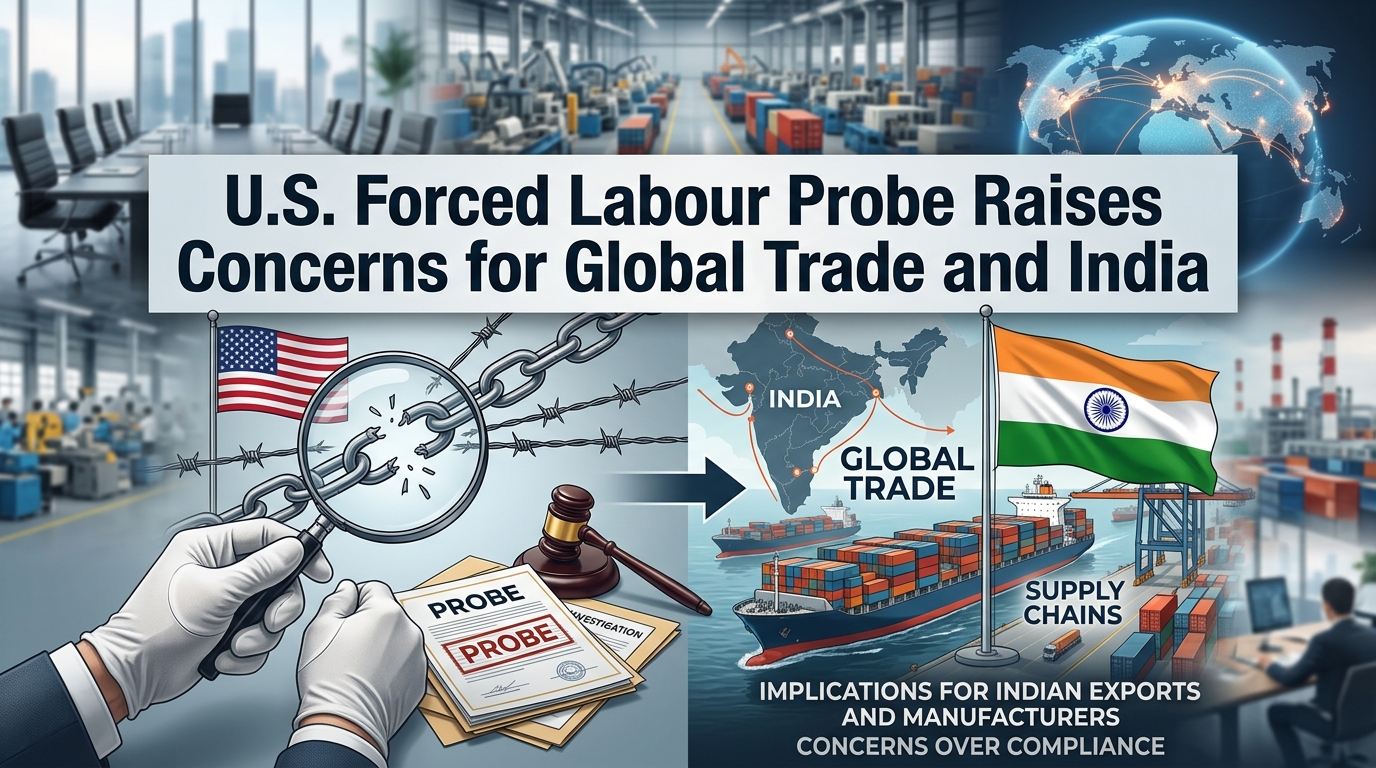
The U.S. Forced Labour Probe launched under Section 301(b) of the Trade Act of 1974 has raised serious concerns for global trade and India’s export sector. The investigation targets around 60 countries, including India, to examine whether adequate steps have been taken to prevent the import of goods produced using forced labour. This move highlights growing global emphasis on ethical supply chains, labour rights, and trade compliance, while also creating uncertainty for developing economies.
Why in the News?
- The United States has started a new investigation into around 60 countries, including India, regarding the import of goods made using forced labour.
- The investigation was launched on March 12, 2026, by the Office of the United States Trade Representative (USTR).
- The probe is being conducted under Section 301(b) of the Trade Act of 1974.
- The main aim is to check whether these countries are taking proper steps to stop the use of forced labour in the production of goods exported to the United States.
- If violations are found, the United States may impose tariffs or other trade restrictions.
What are the Key Highlights of U.S. Forced Labour Probe?
Investigation into 60 Countries
- The United States has started a detailed investigation into 60 major trading partners.
- India is one of the countries included in this list.
- These countries are important exporters to the U.S. market.
Legal Basis: Section 301(b) of Trade Act of 1974
- Section 301(b) is a U.S. law that allows action against unfair trade practices.
- It gives power to investigate countries that violate trade rules or harm U.S. businesses.
- It can be used to impose tariffs, sanctions, or trade restrictions.
- For example, the United States earlier used Section 301 against China in trade disputes.
Focus on Forced Labour
- Forced labour means making people work against their will without proper payment or freedom.
- It is considered a serious human rights violation.
- It includes bonded labour, child labour, and coercive working conditions.
- The investigation will examine whether goods imported into the U.S. are produced using such labour.
Possible Trade Actions
- If the investigation finds violations, the U.S. can take strict trade actions.
- Tariffs can be imposed, which means higher taxes on imported goods.
- Trade restrictions can limit or ban certain imports.
- For example, if Indian goods are found to be linked with forced labour, their cost in the U.S. market may increase.
Related Investigation on Excess Capacity
- On March 11, 2026, the U.S. launched another investigation.
- It is checking whether India and other countries are exporting goods using excess manufacturing capacity.
- Excess capacity means producing more goods than needed, which may harm U.S. industries.
Consultation Process
- The USTR must consult with the governments of the countries involved.
- This is an official part of the investigation process.
- It allows countries to present their position and explain their policies.
Public Hearings
- Public hearings will be conducted on April 28, 2026.
- Businesses, experts, and stakeholders can present their views.
- This ensures transparency in the investigation process.
What are the Significance of U.S. Forced Labour Probe?
Protection of Workers’ Rights
- The investigation highlights the importance of protecting workers globally.
- It aims to eliminate forced labour practices.
- It supports international labour standards set by organizations like the International Labour Organization (ILO).
Impact on Global Trade Relations
- The investigation may affect trade relations between the U.S. and other countries.
- Countries may face tariffs if they fail to meet labour standards.
- This can create trade tensions and negotiations.
Pressure for Supply Chain Transparency
- Companies will need to ensure that their supply chains are transparent.
- Supply chain means the entire process of producing and delivering goods.
- Businesses may need to track the origin of raw materials and labour conditions.
Economic Impact on Exporting Countries
- Exporting countries may face economic challenges.
- If tariffs are imposed, their goods become more expensive in the U.S. market.
- This may reduce demand and affect industries like textiles, agriculture, and manufacturing.
Strengthening Global Labour Standards
- The investigation encourages countries to improve labour laws.
- Governments may strengthen rules against forced labour.
- It promotes ethical and fair trade practices globally.
Challenges of U.S. Forced Labour Probe
Complexity of Global Supply Chains
- Modern supply chains involve many countries and stages of production.
- It becomes difficult to trace whether forced labour is used at any stage.
- For example, raw materials may come from one country and final goods may be assembled in another.
Trade Tensions Between Countries
- Such investigations can lead to conflicts between countries.
- Countries may see these actions as unfair or protectionist.
- This can harm diplomatic relations.
Weak Implementation of Labour Laws
- Some countries may have laws but lack proper enforcement.
- Monitoring systems may be weak or inefficient.
- This allows forced labour practices to continue.
Economic Impact on Developing Countries
- Developing countries may suffer more due to trade restrictions.
- Industries depending on exports may face losses.
- Workers may lose jobs if exports decline.
Way Forward of U.S. Forced Labour Probe
Strengthening Labour Laws
- Countries should improve laws that ban forced labour.
- Strong legal systems can protect workers from exploitation.
Improving Enforcement Mechanisms
- Governments should ensure strict implementation of labour laws.
- Regular inspections and monitoring systems should be developed.
Increasing Supply Chain Transparency
- Companies should adopt systems to trace product origins.
- Technologies like digital tracking can help verify ethical production.
Promoting International Cooperation
- Countries should work together through global platforms.
- Cooperation can help reduce forced labour practices worldwide.
Encouraging Dialogue and Diplomacy
- Countries should resolve issues through discussions and negotiations.
- This will reduce trade conflicts and build trust.
Conclusion
The investigation shows that global trade is no longer only about profit but also about ethical practices and human rights. Countries and companies must adapt to this changing environment by ensuring fairness, transparency, and responsibility in production systems.
Relevant Articles:
India–Canada Relations Strengthen with Strategic Economic and Energy Partnership
Economic Stabilisation Fund Boosts India’s Crisis Preparedness and Fiscal Stability
Peptide Therapies Risks and Benefits: Growing Popularity Raises Safety Concerns
Read More:
India Labour Codes Reform: Opportunities and Challenges in India Labour Codes Reform
Western Media Double Standards: Bias in Global Politics
India China Military Gap: Urgent Need for Defence Reforms
U.S. launches fresh investigation into India, 59 other …