
CSMP IAS : India's Premier Coaching Institute for IAS / PCS
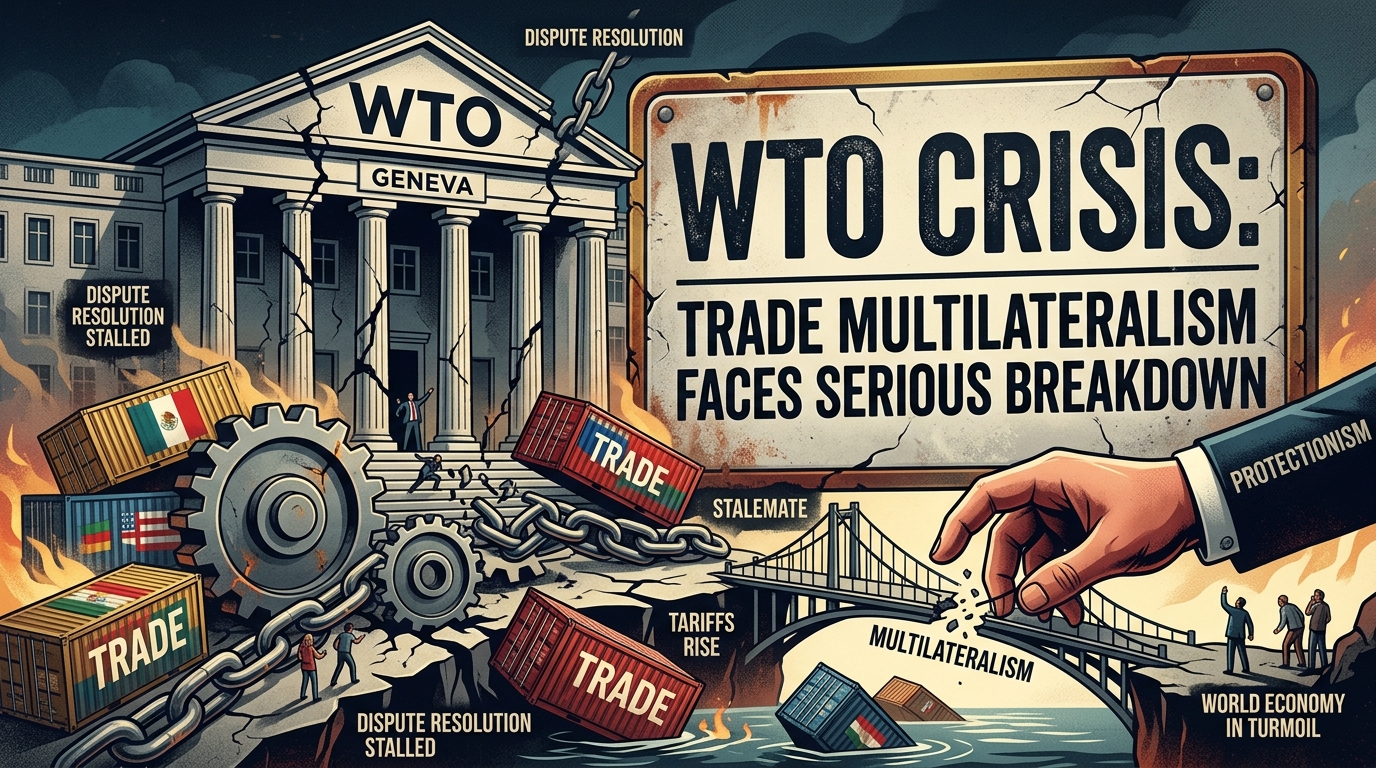
WTO Crisis: Trade Multilateralism Faces Serious Breakdown
Table of Contents
The WTO Crisis has become a major global concern after the failure of the World Trade Organization’s MC14 conference (2026) to deliver meaningful outcomes. The breakdown of consensus, rising unilateralism, and weakening of core principles like MFN (Most-Favoured Nation) signal serious challenges to the global trading system.
Why in the News?
- The fourteenth Ministerial Conference (MC14) of the World Trade Organization was held in Yaoundé, Cameroon in March 2026, where member countries were expected to strengthen the global trading system.
- The conference failed to produce a ministerial declaration, which is usually a key outcome that guides future negotiations and reforms.
- The failure comes at a time when global trade multilateralism is under serious stress, especially due to unilateral actions by the United States and weakening of core WTO principles.
What are the Key Highlights?
Failure to Reach Consensus
- The WTO, with 166 member countries, could not agree on even a basic joint declaration, which shows deep divisions among members.
- This reflects the growing difficulty in achieving consensus-based decision making, which is the backbone of the WTO system.
- Instead, the WTO Director-General announced a “Yaoundé Package”, which includes draft decisions that are yet to be finalized.
- These draft decisions will be discussed later in Geneva, meaning that no final outcomes were achieved.
Breakdown of E-commerce Moratorium
- Since 1998, WTO members had agreed on a moratorium on customs duties on electronic commerce, meaning countries could not impose tariffs on digital trade.
- This was done to promote free flow of digital goods and services across borders.
- At MC14, members failed to extend this moratorium, and it expired on March 31, 2026.
- As a result:
- Countries can now impose tariffs on digital products such as software, music, and online services.
- This may help developing countries increase revenue, but it may also increase costs for businesses and consumers.
- A new E-commerce Agreement (ECA) was signed by 66 countries, which continues to prohibit such tariffs.
- However, this agreement is not part of the WTO framework and applies only to signatories.
- This creates two parallel systems:
- WTO system allowing tariffs
- ECA system prohibiting tariffs
End of TRIPS Non-Violation Moratorium
- Since 1995, WTO members had agreed not to file non-violation complaints under the TRIPS Agreement.
- TRIPS (Trade-Related Aspects of Intellectual Property Rights) is an agreement that protects patents, copyrights, and trademarks globally.
- A non-violation complaint means:
- A country can complain even if no rule is broken, but its expected benefits are harmed.
- With the moratorium ending:
- Countries can now challenge policies like public health laws, claiming they harm intellectual property benefits.
- However, historical evidence shows such complaints rarely succeed.
Failure of Investment Facilitation for Development (IFD) Agreement
- The IFD Agreement aimed to simplify rules for foreign investment and improve transparency.
- It was supported by 129 countries, but it failed to be included in WTO rules due to India’s opposition.
- India opposed it because:
- There are no proper legal rules for adding such plurilateral agreements into WTO law.
- These agreements may become exclusive and discriminatory, going against WTO principles.
No Roadmap for WTO Reforms
- The conference failed to address key structural issues such as:
- Reviving the dispute settlement system, especially the appellate body.
- Reforming rules for modern trade issues like digital trade and investment.
- This lack of direction weakens the WTO’s ability to function as a global trade regulator.

What are the Significance?
Significance of Rules-Based Trade System
- The WTO is built on a rules-based system, which ensures fairness in global trade.
- Countries cannot act arbitrarily and must follow agreed rules.
- This reduces power imbalance, especially protecting weaker economies from stronger ones.
Importance of Most-Favoured Nation (MFN) Principle
- MFN principle means:
- A country must treat all WTO members equally in trade.
- If this principle weakens:
- Countries may form exclusive trade blocs, harming global trade fairness.
Role in Preventing Trade Wars
- WTO helps in resolving disputes peacefully through legal mechanisms.
- Without it, countries may resort to trade wars and retaliation, harming global growth.
Importance for Developing Countries
- WTO provides:
- Special and Differential Treatment (SDT) for developing nations.
- Protection against unfair practices by developed countries.
Significance of Digital Trade Rules
- Digital trade is rapidly growing, including:
- Online services, cloud computing, and e-commerce.
- Clear rules are needed to:
- Ensure fair competition
- Prevent digital monopolies
Significance of Plurilateral Agreements
- Plurilateral agreements involve a group of willing countries rather than all WTO members.
- They can help:
- Address new issues faster
- Break deadlock in negotiations
What are the Challenges?
Crisis of Consensus-Based Decision Making
- WTO decisions require unanimous agreement, which is increasingly difficult with diverse interests.
- Developed and developing countries often have conflicting priorities.
Rise of Unilateralism
- The United States is increasingly using unilateral trade measures, bypassing WTO rules.
- Example:
- Section 301 of the U.S. Trade Act of 1974 allows the U.S. to take action against countries it considers unfair.
- Example:
Weak Dispute Settlement System
- The WTO’s Appellate Body is not functioning properly due to lack of appointments.
- This weakens enforcement of trade rules.
Fragmentation of Global Trade Rules
- Emergence of agreements like ECA creates parallel legal systems.
- This reduces the relevance of the WTO as a central authority.
Digital Divide and Policy Conflicts
- Developing countries want policy space to tax digital trade.
- Developed countries want free digital flows, leading to conflict.
Resistance to Plurilateral Agreements
- Countries like India fear:
- Loss of sovereignty
- Unequal benefits
- This slows down reform and modernization of WTO rules.
Lack of Political Will
- Major economies are not committed to strengthening the WTO.
- Domestic politics often influence international trade decisions.
Way Forward
Reforming Decision-Making Process
- WTO should explore flexible decision-making models instead of strict consensus.
- This can help faster decision-making while maintaining fairness.
Reviving Dispute Settlement Mechanism
- Immediate steps should be taken to restore the Appellate Body.
- This will rebuild trust in the WTO system.
Strengthening Multilateralism
- Countries must commit to collective decision-making instead of unilateral actions.
- This will reduce trade conflicts and instability.
Developing Framework for Plurilateral Agreements
- Clear legal rules should be created to integrate plurilateral agreements into WTO.
- These agreements must be:
- Open to all members
- Transparent and inclusive
Balancing Digital Trade Interests
- A middle path is needed between:
- Free digital trade
- Taxation rights of developing countries
Enhancing Role of Developing Countries
- Countries like India should take leadership in shaping WTO reforms.
- Focus should be on:
- Equity
- Inclusiveness
Promoting Trust Among Members
- Confidence-building measures are needed to reduce mistrust.
- Transparency and dialogue should be increased.
Conclusion
The outcome of MC14 shows that the global trading system is at a turning point where cooperation is weakening and divisions are deepening. If meaningful reforms are not undertaken, the relevance of multilateral institutions may decline, leading to a fragmented and unstable trade environment. Strengthening collective commitment and adapting institutions to modern challenges will determine the future of global trade governance.
Relevant Articles:
Plastic Waste Management Rules 2026: Weakening EPR Enforcement Raises Environmental Concerns
Nuclear Energy Expansion in India: SHANTI Act 2025 and India’s 100 GW Nuclear Energy Push
Read Also:
FCRA Amendment Bill 2026 Controversy: Rising Concerns Over NGO Control in India
Nuclear Fusion Cost Crisis: Overestimated Experience Rate Raises Investment Risks
