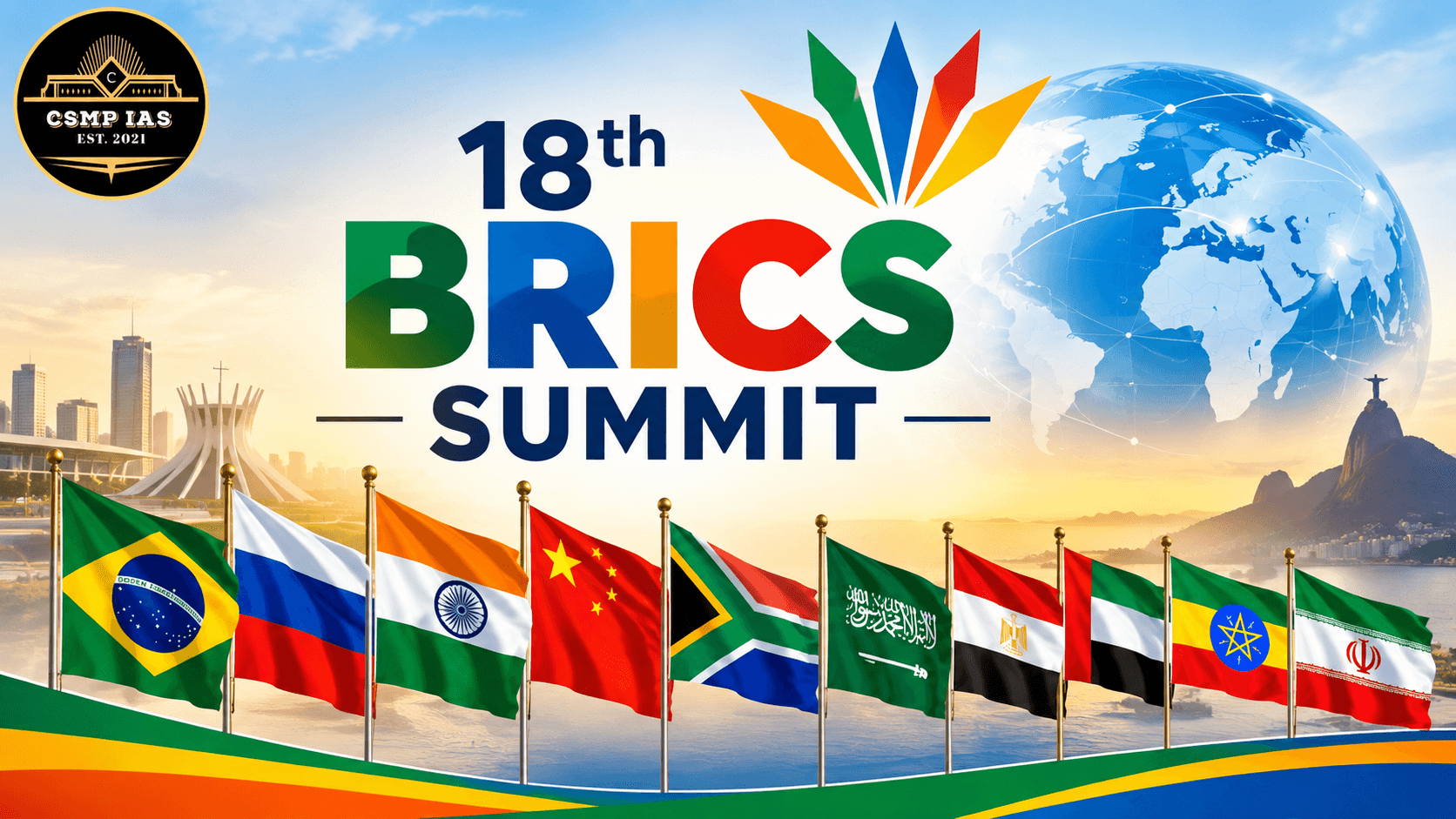
BRICS and the 18th BRICS Summit
BRICS has become one of the most important topics in the International Relations segment of the UPSC syllabus (GS Paper II). With
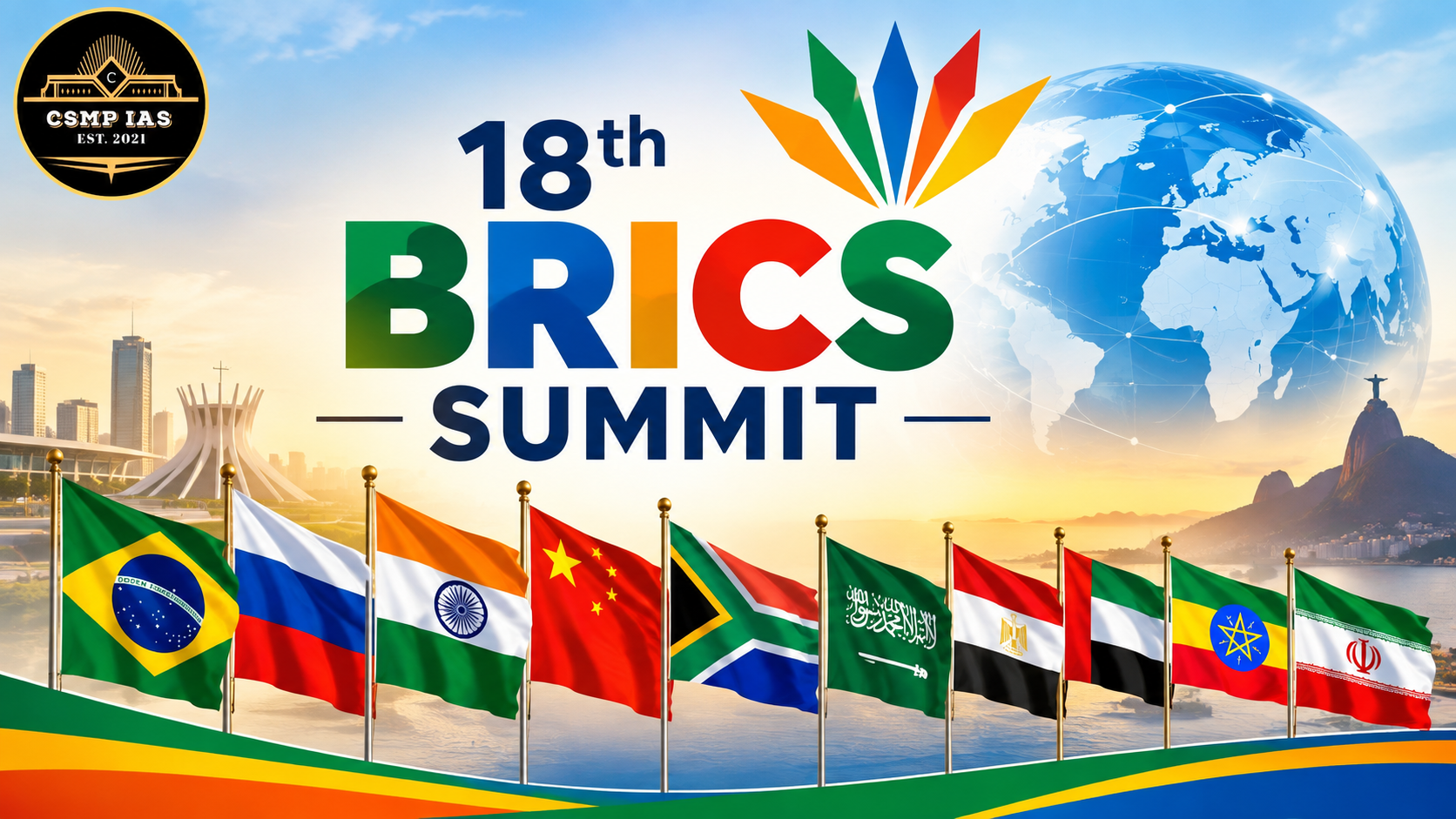
— and in the exam hall. This blog breaks down everything an aspirant needs to know: what BRICS is, the highlights of the 18th Summit, its strategic value for India, and the challenges that limit its effectiveness.
What is BRICS?
BRICS is a grouping of major emerging economies that came together to create a platform for cooperation outside the traditional Western-led institutions of global governance.
Origin: The acronym "BRIC" was coined by economist Jim O'Neill in 2001 to describe Brazil, Russia, India, and China as fast-growing economies. The grouping became a formal political forum with its first summit in 2009 (Yekaterinburg, Russia)
Evolution from BRIC to BRICS+ South Africa joined in 2011, turning BRIC into BRICS.
Major expansion (BRICS+): In 2024, Iran, Egypt, Ethiopia, the UAE, and Saudi Arabia joined as full members. Indonesia joined in 2025. As of the 2026 summit, BRICS has 11 full members: Brazil, Russia, India, China, South Africa, Egypt, Ethiopia, Iran, Saudi Arabia, UAE, and Indonesia.
Partner countries: A separate category of "BRICS Partner Countries" was created to widen outreach without immediately extending full membership — this list includes Belarus, Bolivia, Cuba, Kazakhstan, Malaysia, Nigeria, Thailand, Uganda, Uzbekistan, and Vietnam.
Institutional architecture: BRICS has built its own institutions, most notably the New Development Bank (NDB), headquartered in Shanghai, and the Contingent Reserve Arrangement (CRA), a financial safety net for balance-of-payment crises.
Nature of the grouping: Unlike the WTO or IMF, BRICS is not a treaty-based organisation. It operates through annual summits, sherpa-level meetings, and sectoral ministerial tracks (finance, trade, foreign affairs, health, environment, etc.), with the chairship rotating annually among members.
Key facts about the 18th BRICS Summit (2026)
Host country: India — its fourth time chairing BRICS (after 2012, 2016, and 2021).
Venue: Bharat Mandapam, Pragati Maidan, New Delhi — the same venue that hosted the 2023 G20 Leaders' Summit.
Dates: September 12–13, 2026, preceded by a Business Forum on September 11.
Theme: "Building for Resilience, Innovation, Cooperation and Sustainability" — reflecting four pillars: strengthening resilience to economic and geopolitical shocks, promoting technological innovation, deepening cooperation among members, and supporting sustainable and inclusive growth.
Key sessions: Leaders' discussions include "Inclusive Global Governance and Strengthening Multilateralism" and "Resilience, Innovation, Cooperation and Sustainability: Shaping the Future for Inclusive Global Growth."
Attendance: The summit has drawn heads of state and senior representatives from full members and partner countries, alongside outreach invitees and heads of international organisations such as the UN, WTO, and WHO — reflecting BRICS' growing global outreach ("BRICS Outreach/Plus" format).
India's chairship priorities: People-centric development, reform of multilateral institutions, technology and digital public infrastructure cooperation, and strengthening the voice of the Global South.
What Role does BRICS Play in Advancing India's Strategic Interests?
For India, BRICS is far more than a diplomatic photo-op. It serves several concrete strategic purposes:
Voice for the Global South: BRICS gives India a platform to champion the interests of developing countries on issues like climate finance, equitable vaccine access, and reform of global governance bodies — reinforcing India's self-image as a bridge between the Global North and South.
Reform of global institutions: India uses BRICS to push for reform of the UN Security Council, IMF, and World Bank, whose voting structures still reflect the post-1945 order rather than today's economic realities.
Alternative financial architecture: Through the New Development Bank, India gains access to infrastructure financing without the conditionalities often attached to Western-led institutions like the IMF or World Bank. The NDB has funded numerous Indian infrastructure and urban development projects.
De-dollarisation and payment systems: BRICS discussions on local-currency trade settlement and cross-border payment systems give India a seat at the table in shaping alternatives to dollar-dominated trade — although India has been notably cautious about any move seen as a "BRICS currency," since this could invite friction with the US.
Strategic autonomy and multi-alignment: BRICS membership allows India to engage with China and Russia on economic and multilateral issues while simultaneously deepening ties with the US, EU, and Quad partners — a hallmark of India's multi-alignment foreign policy.
Economic and trade diversification: BRICS accounts for a substantial share of global GDP (in PPP terms) and population. Deeper trade and investment ties within the bloc help India diversify markets and supply chains away from over-reliance on any single partner.
Counterbalancing China's influence within the grouping: By actively shaping the agenda (as seen in India's 2026 chairship), India ensures BRICS does not become a vehicle purely for Chinese or Russian geopolitical objectives, and instead reflects a more balanced, development-oriented agenda.
Cooperation in emerging domains: Recent BRICS declarations (including on AI governance, adopted at the 17th Summit in 2025) let India shape rules on frontier technology governance rather than merely accepting standards set elsewhere.
What are the Major Challenges Hindering BRICS' Effectiveness for India?
Despite its strategic value, BRICS faces structural weaknesses that limit how effectively India can leverage it:
India–China bilateral tensions: Persistent border disputes and strategic distrust with China — a fellow BRICS member — create an inherent contradiction. Cooperating within BRICS while contesting China in the Indo-Pacific and along the LAC is a delicate balancing act.
Lack of institutional cohesion: BRICS is not a treaty-bound organisation with binding rules, unlike the WTO or EU. Its declarations are largely aspirational, making enforcement and follow-through weak.
Divergent political systems and interests: The grouping includes democracies (India, Brazil, South Africa, Indonesia) and authoritarian or semi-authoritarian states (Russia, China, Iran), with sharply different worldviews on issues like sovereignty, human rights, and international law — complicating consensus-building.
Russia's and Iran's adversarial relations with the West: India's balancing act with the US and EU becomes harder when BRICS partners like Russia and Iran are under Western sanctions. India must carefully calibrate its statements to avoid being seen as endorsing anti-Western positions it does not share.
Dilution through rapid expansion: The addition of six new members in quick succession (2024–2025) has made consensus-building more complex and could dilute India's relative influence within the grouping compared to the original BRIC-5 era.
China's outsized economic weight: China's economy dwarfs other BRICS members combined, raising concerns that Beijing could use BRICS institutions (like the NDB) to advance its own strategic and economic interests, including Belt and Road-linked objectives.
Currency and de-dollarisation debates: Proposals for a common BRICS currency or aggressive de-dollarisation — often pushed by Russia — create diplomatic friction with the US. India has had to publicly distance itself from such proposals to protect its ties with Washington.
Limited concrete economic outcomes: Despite two decades of summitry, intra-BRICS trade and investment remain modest relative to potential, and mechanisms like the CRA have rarely been used, raising questions about the bloc's real economic delivery for India.
Geopolitical rivalries among members: Historical and ongoing tensions (e.g., Saudi Arabia–Iran, or competing regional interests among newer members) can spill into BRICS deliberations, making the platform harder to manage diplomatically.
Conclusion
BRICS today stands at an important crossroads. What began as an informal economic grouping of four emerging markets has evolved into an 11-member bloc with real institutional infrastructure and a growing voice for the Global South. The 18th BRICS Summit, hosted by India in New Delhi under the theme "Building for Resilience, Innovation, Cooperation and Sustainability," reflects India's ambition to shape this evolving order rather than simply participate in it.
For India, BRICS offers a valuable platform for strategic autonomy, institutional reform, and South-South cooperation — but it is not a substitute for India's other partnerships, nor is it free of internal contradictions. The India–China rivalry, the bloc's loose institutional structure, and diverging geopolitical alignments among members mean India must engage with BRICS pragmatically: extracting economic and diplomatic value while avoiding entanglement in positions that could complicate its ties with the West.
For UPSC aspirants, BRICS is a rich, multi-dimensional topic connecting IR, economics, and India's foreign policy strategy — exactly the kind of theme that shows up in both Prelims (facts, member countries, institutions) and Mains (analytical questions on India's strategic choices).
FAQs
Q1. What does BRICS stand for, and who are its current members? BRICS originally stood for Brazil, Russia, India, China, and South Africa. It has since expanded to 11 full members with the addition of Egypt, Ethiopia, Iran, Saudi Arabia, the UAE (2024), and Indonesia (2025).
Q2. Where and when is the 18th BRICS Summit being held? The 18th BRICS Summit is being hosted by India at Bharat Mandapam, New Delhi, on September 12–13, 2026, preceded by a Business Forum on September 11.
Q3. What is the theme of the 18th BRICS Summit? The theme is "Building for Resilience, Innovation, Cooperation and Sustainability," reflecting India's focus on people-centric development and stronger cooperation among BRICS members.
Q4. What is the New Development Bank (NDB)? The NDB is a multilateral development bank set up by BRICS countries in 2014, headquartered in Shanghai, that provides infrastructure and sustainable development financing as an alternative to Western-dominated institutions like the World Bank.
Q5. Which country will host the 19th BRICS Summit? China is expected to host the 19th BRICS Summit in 2027, as the chairship rotates annually among member countries.
Q6. Is BRICS a military or security alliance like NATO? No. BRICS is primarily an economic and diplomatic forum for cooperation among emerging economies. It has no binding treaty framework, standing secretariat, or collective security commitments.
Q7. Why is BRICS important for UPSC preparation? BRICS connects multiple GS Paper II and III themes — international institutions, India's foreign policy, global economic governance, and India-China relations — making it a recurring theme in both Prelims and Mains.