Citizenship in India: A Complete Guide for UPSC Aspirants for GS Paper 2
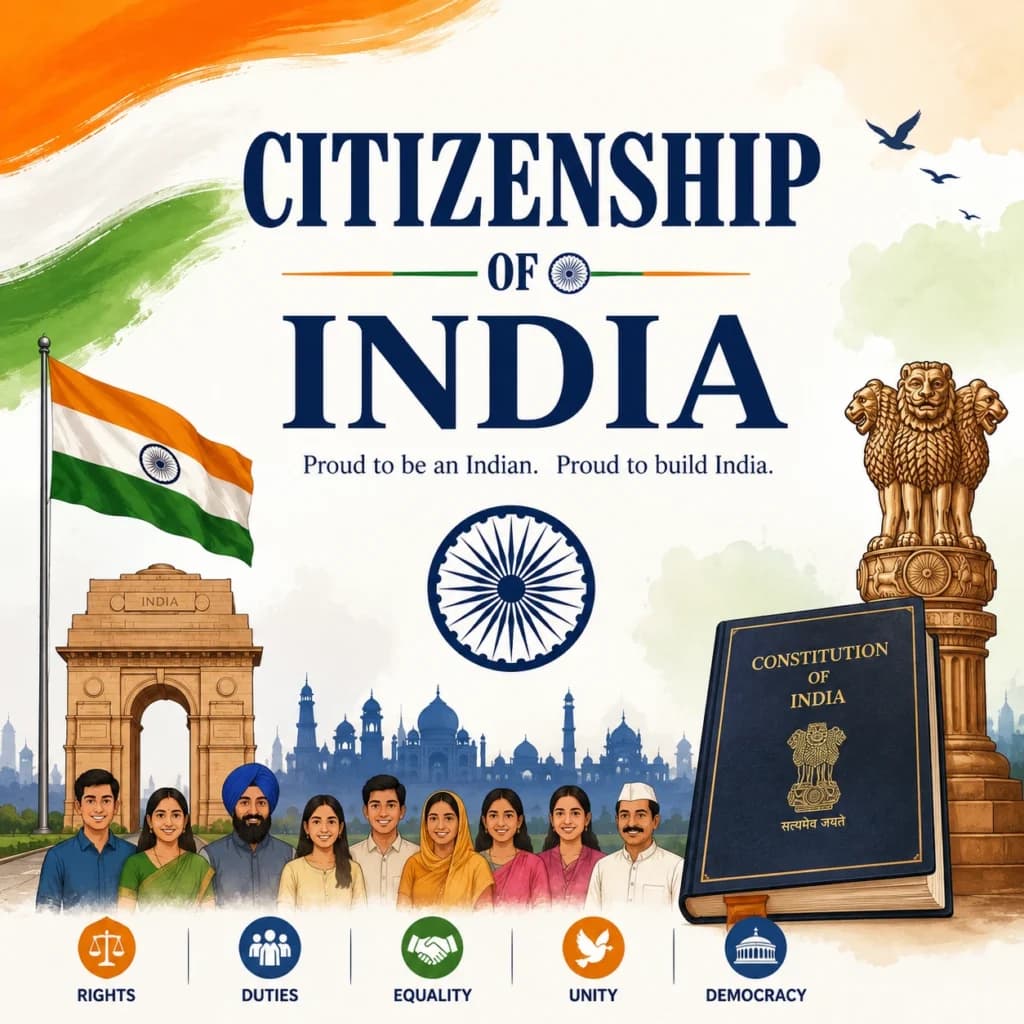
Introduction
Few topics in the UPSC syllabus straddle both the Polity paper and current affairs as neatly as Citizenship. It is a favourite of the UPSC because it combines constitutional provisions (Articles 5–11), a standalone legislation (the Citizenship Act, 1955), and a stream of contemporary developments — the Citizenship Amendment Act (CAA) 2019, the National Register of Citizens (NRC), Overseas Citizenship of India (OCI), and statelessness debates. For Prelims, it tests factual precision; for Mains, it tests your ability to link constitutional design with present-day political and humanitarian questions; and for the interview, it often comes up as a topic of genuine public debate.
This blog walks you through everything you need — from first principles to the latest amendments — in a structured, exam-oriented manner.
1. What is Citizenship and Why Does It Matter?
Citizenship is the legal bond between an individual and a state that confers a bundle of rights (political participation, government employment, certain fundamental rights) and imposes reciprocal duties (allegiance, obedience to laws). Unlike a “person” under the Constitution — who enjoys certain fundamental rights like Article 21 (life and liberty) regardless of nationality — a “citizen” alone enjoys rights such as:
Right to vote and contest elections (Articles 326, 84, 173)
Right to hold certain public offices (President, Vice-President, Judges of Supreme Court/High Courts, Governor, Attorney General, etc.)
Certain Fundamental Rights available only to citizens: Article 15 (prohibition of discrimination), Article 16 (equality of opportunity in public employment), Article 19 (six freedoms), Article 29 and 30 (cultural and educational rights)
Right against being denied entry into or expelled from India
This distinction between “citizen” and “alien/foreigner” makes citizenship one of the most consequential legal statuses a person can hold — it is often called “the right to have rights.”
2. Constitutional Provisions on Citizenship (Articles 5–11)
Unlike most modern constitutions, the Indian Constitution does not provide a permanent, self-contained code on citizenship. Instead, Part II (Articles 5 to 11) deals only with citizenship at the commencement of the Constitution
(26 January 1950), and leaves Parliament free to legislate on citizenship thereafter under Article 11.
Article 5 — Citizenship at the commencement of the Constitution
A person who had their domicile in India and fulfilled one of these conditions became a citizen on 26 January 1950:
Born in India, OR Either parent born in India, OR Ordinarily resident in India for not less than five years before commencement.
Article 6 — Rights of citizenship of certain persons who migrated to India from Pakistan
Persons who migrated from Pakistan to India could become citizens if:
They or their ancestors were born in undivided India, AND If migrated before 19 July 1948 — ordinarily resident since migration.
If migrated after 19 July 1948 — they had to be registered as a citizen (after residing for at least six months).
Article 7 — Rights of citizenship of certain migrants to Pakistan
Persons who migrated to Pakistan after 1 March 1947 but later returned to India under a permit for resettlement could regain citizenship, but this required following the same registration process as under Article 6. Notably, Article 7 overrides Article 5 and Article 6.
Article 8 — Rights of citizenship of certain persons of Indian origin residing outside India
Persons of Indian origin residing outside undivided India (in any country) could register as Indian citizens through Indian diplomatic missions.
Article 9 — Persons voluntarily acquiring citizenship of a foreign state not to be citizens
If a person voluntarily acquired the citizenship of another country, they automatically ceased to be an Indian citizen — an early constitutional endorsement of single citizenship.
Article 10 — Continuance of the rights of citizenship
Every person who is a citizen under the above provisions continues to be a citizen, subject to the provisions of any law made by Parliament.
Article 11 — Parliament to regulate the right of citizenship by law
This is the most important article for exam purposes — it empowers Parliament to make any provision with respect to acquisition and termination of citizenship, and any other matter relating to it. This is what enabled Parliament to enact the Citizenship Act, 1955, and to amend it repeatedly (1986, 1992, 2003, 2005, 2015, 2019).
Exam tip:
Articles 5–8 deal with citizenship at commencement; Article 9 deals with loss through voluntary foreign acquisition; Article 10 deals with continuance; Article 11 is the enabling provision for future legislation. This sequence is a common Prelims trap.
- Foundation Batch 2027 (Hindi Medium)
- 3. The Citizenship Act, 1955 — Acquisition of Citizenship
Since the Constitution itself provides only a snapshot as of 1950, the Citizenship Act, 1955 governs how Indian citizenship is acquired and lost thereafter. There are five modes of acquisition:
(a) By Birth (Section 3)
Born in India on or after 26 January 1950 but before 1 July 1987 → citizen by birth, irrespective of parents’ nationality.
Born on or after 1 July 1987 but before 3 December 2004 → citizen only if either parent was an Indian citizen at the time of birth.
Born on or after 3 December 2004 → citizen only if both parents are Indian citizens, OR one parent is an Indian citizen and the other is not an illegal migrant at the time of birth.
This shift — from unconditional jus soli
(citizenship by soil) to a conditional jus soli combined with jus sanguinis
(citizenship by blood) — reflects growing concerns over illegal migration, especially in border states like Assam.
(b) By Descent (Section 4)
A person born outside India on or after 26 January 1950 is a citizen by descent if their father (pre-1992) or either parent (post-1992 amendment) was an Indian citizen at the time of birth. Since 2004, registration of birth at an Indian consulate within one year is also required, unless special permission is granted by the Central Government.
(c) By Registration (Section 5)
Certain categories of persons can apply for citizenship by registration, including:
Persons of Indian origin who have been ordinarily resident in India for seven years before applying.
Persons of Indian origin resident in undivided India.
Persons married to Indian citizens, resident for seven years.
Minor children of persons who are Indian citizens.
Persons of full age whose parents are registered as Indian citizens.
Overseas Citizens of India (OCI) cardholders registered as such for five years and ordinarily resident in India for one year, may apply for registration as citizens.
(d) By Naturalisation (Section 6)
A foreigner (not an illegal migrant) can acquire citizenship by naturalisation if they satisfy conditions listed in the Third Schedule of the Act — chiefly, residence in India for 12 years
(in aggregate over the preceding 14 years, with the last 12 months continuous), good character, adequate knowledge of a language in the Eighth Schedule, and an intention to reside in India. The CAA 2019 relaxed this 12-year requirement to 5 years for specific categories (discussed below).
(e) By Incorporation of Territory (Section 7)
If a new territory becomes part of India (e.g., Sikkim in 1975, Puducherry, Goa), the Government of India specifies the persons from that territory who shall become Indian citizens.
4. Termination of Citizenship
Section 8, 9, and 10 of the Citizenship Act, 1955 outline three ways citizenship ends:
Renunciation (Section 8):
A citizen of full age and capacity may voluntarily renounce citizenship by declaration. If the person is a male of military age during wartime, this renunciation requires government sanction.
Termination (Section 9):
If an Indian citizen voluntarily acquires the citizenship of another country, Indian citizenship automatically terminates (giving effect to Article 9 and India’s single-citizenship principle).
Deprivation (Section 10):
The Central Government can deprive a person of citizenship (obtained by registration or naturalisation) on specified grounds — fraud, disloyalty, aiding an enemy during war, imprisonment within five years of registration, or ordinary residence outside India for seven continuous years.
- Indian Citizenship Online
- 5. Single Citizenship: India’s Distinctive Choice
Unlike federal nations like the USA, where a person is simultaneously a citizen of the country and of the particular state they reside in (dual citizenship at two levels), India follows a single citizenship model
— every Indian is a citizen of India as a whole, with no separate state citizenship, despite India being a federal (or “quasi-federal”) polity.
Rationale for single citizenship in India:
To promote unity and integrity in a country marked by immense linguistic, religious, and regional diversity.
To avoid the discrimination and parochialism that could arise if states could deny rights to “outsider” Indians.
To strengthen the sense of a shared national identity, especially critical post-Partition.
This is often asked as a comparative question with the USA’s dual citizenship model in Mains answers on Indian federalism.
Important nuance:
India does not recognise dual citizenship with foreign countries either — hence the existence of OCI as a substitute (explained below), not full dual citizenship.
6. Overseas Citizenship of India (OCI) and PIO
Since India doesn’t allow dual citizenship, it created a hybrid status for its vast diaspora:
PIO (Person of Indian Origin) Card Scheme
(introduced 1999) — merged into OCI in 2015.
OCI (Overseas Citizen of India)
— introduced by the Citizenship (Amendment) Act, 2005, effective 2006.
An OCI cardholder is not a citizen of India and does not enjoy political rights (cannot vote, cannot hold constitutional/public offices, cannot buy agricultural land). However, they enjoy:
Lifelong visa-free travel to India.
Exemption from registering with local police for any length of stay.
Parity with NRIs in economic, financial, and educational fields (with some exceptions like agricultural property).
The Citizenship (Amendment) Act, 2015 merged the PIO scheme into the OCI scheme to simplify administration.
7. Citizenship (Amendment) Act, 2019 (CAA) — The Contemporary Flashpoint
This is the most examination-relevant and politically significant recent development, and deserves detailed treatment.
What CAA 2019 does
The CAA amends the Citizenship Act, 1955 to provide an expedited path to Indian citizenship for Hindu, Sikh, Buddhist, Jain, Parsi, and Christian migrants from Pakistan, Afghanistan, and Bangladesh who entered India on or before
31 December 2014, fleeing religious persecution. For these specific communities:
They are exempted from being treated as “illegal migrants” under the Passport Act, 1920 and the Foreigners Act, 1946.
The required period of residence for naturalisation is reduced from 11 years to 5 years.
Key omissions and criticisms
The Act does not include Muslims from these three countries, nor does it cover other neighbouring countries with significant religious minorities such as Sri Lanka (Tamil Hindus), Myanmar (Rohingya Muslims), or China (Tibetan Buddhists).
- Critics argue this violates
- Article 14
(equality before law) by using religion as a criterion for expedited citizenship, and erodes the secular character of the Constitution — a Basic Structure argument, since
Kesavananda Bharati
(1973) held secularism to be part of the Basic Structure.
The government’s defence: CAA is not about denying citizenship to anyone (it doesn’t touch the ordinary naturalisation route available to all, including Muslims, under the general provisions of the 1955 Act); it merely offers a fast-track, humanitarian remedy for persecuted religious minorities from Islamic-majority neighbouring states, using intelligible differentia reasonably linked to a legitimate objective (permissible classification under Article 14 jurisprudence).
The Act explicitly exempts tribal areas under the Sixth Schedule (Assam, Meghalaya, Mizoram, Tripura) and areas covered by the Inner Line Permit regime (Arunachal Pradesh, Mizoram, Nagaland, and now Manipur) from its application — an important safeguard demanded by North-Eastern states worried about demographic change.
Rules under the CAA were notified in March 2024, five years after the Act’s passage, after which implementation and registration began; petitions challenging the Act’s constitutionality remain pending before the Supreme Court.
Balanced Mains framing:
Present both the humanitarian/security rationale (protecting persecuted minorities, addressing statelessness) and the constitutional concerns (equality, secularism, federalism/North-East anxieties) — this is a textbook “discuss” question requiring even-handed treatment.
8. National Register of Citizens (NRC) and Assam
The NRC is often confused with the CAA, but they are conceptually distinct:
NRC is a register of bona fide
Indian citizens, first prepared in Assam in 1951 and updated (2013–2019) under the Supreme Court’s supervision, pursuant to the Assam Accord (1985) and Section 6A of the Citizenship Act (a special provision for Assam, with 24 March 1971 as the cut-off date for detecting foreigners).
The updated Assam NRC (published August 2019) excluded around 19 lakh applicants, triggering widespread concern about statelessness, documentation burdens, and the fate of genuine citizens lacking paperwork — especially women, the poor, and marginalized groups.
There is ongoing debate about a pan-India NRC, which the government has periodically discussed but not formally rolled out; this remains a live policy question that examiners could ask about.
- The distinction to remember:
- CAA offers a path to citizenship (inclusion);
NRC is a mechanism to identify citizens versus illegal migrants (a filtering/verification exercise) — when combined, critics fear NRC could exclude Muslims disproportionately (since they cannot benefit from CAA’s fast-track exemption), which is the crux of the controversy.
9. Illegal Migrants and Related Legal Framework
The Citizenship Act defines an “illegal migrant” as a foreigner who enters India without valid travel documents, or overstays beyond the permitted period. Illegal migrants are barred from acquiring citizenship by registration or naturalisation and are liable for deportation under the Foreigners Act, 1946 and the Passport (Entry into India) Act, 1920.
- Relevant Supreme Court cases:
- Sarbananda Sonowal v. Union of India (2005):
Struck down the Illegal Migrants (Determination by Tribunals) Act, 1983, holding that its burden-of-proof structure made it nearly impossible to detect and deport illegal migrants in Assam, and was thus unconstitutional as it failed to protect India from “external aggression” under Article 355.
Assam Sanmilita Mahasangha v. Union of India (2014):
Referred questions on the constitutional validity of Section 6A to a Constitution Bench.
In Re: Section 6A of the Citizenship Act (2024):
The Supreme Court, by a 4:1 majority, upheld the constitutional validity of Section 6A, affirming 24 March 1971 as the cut-off date for Assam.
10. Statelessness: A Global and Indian Concern
Statelessness — where a person is not considered a national by any state — is a significant human rights issue. India is not a signatory to the 1954 UN Convention relating to the Status of Stateless Persons or the 1961 UN Convention on the Reduction of Statelessness, but Indian courts have occasionally invoked constitutional protections (Article 21) to protect stateless persons’ basic rights even without formal citizenship. Refugee groups like Rohingya, Chakmas, and Sri Lankan Tamils in India illustrate the practical, humanitarian dimension of citizenship law that goes beyond dry legal provisions — a dimension examiners like to test via essay-type questions.
- 11. Comparative Note: Citizenship Models Worldwide
- A quick comparative table is often useful for Mains value addition:
- Country
- Model
- Key Feature
- USA
- Dual (federal + state) citizenship; unconditional jus soli
- 14 th Amendment guarantees birthright citizenship
- UK
- Single citizenship, complex historical categories
- British Nationality Act, 1981
- India
- Single citizenship; conditional jus soli + jus sanguinis
- No dual citizenship with foreign states; OCI as substitute
- France
- Jus soli with conditions, strong assimilation principle
- Naturalization emphasizes integration
- Gulf states (e.g., UAE)
- Very restrictive jus sanguinis
Citizenship rarely granted to migrants despite generations of residence
12. Way Forward — Balancing Security, Humanitarianism, and Constitutional Morality
- For a Mains conclusion, aim to synthesize these threads:
- Codify a clear, humane, and religion-neutral refugee/asylum policy
— India lacks a comprehensive refugee law; a rules-based, non-discriminatory framework (aligned with, though not necessarily accepting, international norms) could address persecution-based migration without constitutional controversy.
Strengthen documentation systems
(birth registration, Aadhaar-linked civil registration) to prevent the kind of large-scale exclusion seen in the Assam NRC.
Judicial vigilance
— the pending Supreme Court cases on CAA’s constitutionality will be a defining test of how India balances Article 14’s equality guarantee with Parliament’s Article 11 power to legislate on citizenship.
Federal sensitivity
— protecting the special status of North-Eastern states while managing genuine security concerns about demographic change.
Humanitarian consistency
— treating persecution as the operative criterion (rather than religion or country of origin alone) would strengthen both the constitutional and moral defensibility of citizenship policy.
- 13. Previous Year Questions (For Practice)
- Prelims-style:
With reference to the Citizenship Act, 1955, examine the different modes of acquiring Indian citizenship.
Which Article empowers Parliament to regulate citizenship by law?
Consider the differences between OCI and PIO card schemes.
Mains-style (GS II):
“Citizenship is chiefly determined not by common polity but by common history and common ideals.” Examine the context and philosophy of Indian citizenship in light of this statement, especially in the wake of the Citizenship (Amendment) Act, 2019. (UPSC 2019 — actual paper)
Discuss the constitutional and legal provisions related to citizenship in India, and examine the recent debates around NRC and CAA.
“Single citizenship in a federal polity like India is both a strength and a source of tension.” Discuss.
Conclusion
Citizenship is not merely a technical legal category for the UPSC syllabus — it is the thread that connects constitutional design (Articles 5–11), statutory law (Citizenship Act, 1955 and its amendments), landmark judicial pronouncements, and some of the most consequential political debates of contemporary India. A strong grasp of this topic requires you to move fluidly between three registers: the black-letter law
(provisions and modes of acquisition/termination), the constitutional principles at stake (equality, secularism, federalism), and the lived human consequences
(statelessness, displacement, documentation burdens). Mastering all three will not only help you score well in Prelims and Mains but will also equip you, as a future civil servant, to engage thoughtfully with one of the most sensitive governance issues India faces.
Found this useful? Bookmark it for revision closer to your exam, and cross-check the latest developments on CAA rules implementation and pending Supreme Court cases, since this is a fast-evolving area of law.