Supreme Court of India: The Guardian of the Constitution 2026 from History Till Now
Introduction
Few institutions in India’s constitutional architecture carry as much weight, both symbolic and functional, as the Supreme Court of India. Established on January 28, 1950, just two days after the Constitution came into force, the Supreme Court sits at the apex of the Indian judicial system as the final interpreter of the Constitution and the last court of appeal.
For UPSC aspirants, understanding the Supreme Court is not merely an academic exercise confined to Polity papers; it is essential for grasping how India’s democracy actually functions, how rights are protected, how federal disputes are resolved, and how the balance of power among the legislature, executive, and judiciary is maintained.
This article provides a comprehensive overview of the Supreme Court of India, covering its constitutional basis, composition, appointment process, jurisdiction, landmark judgments, key doctrines, and the contemporary debates surrounding judicial reform. This is exactly the kind of layered, multi-dimensional topic that UPSC Prelims, Mains (GS-II), and even Essay papers draw upon repeatedly.
Constitutional Basis and Historical Background
The Supreme Court of India derives its existence and powers from Part V of the Constitution, specifically Articles 124 to 147, which fall under Chapter IV titled “The Union Judiciary.” Before independence, the highest judicial authority for India was the Federal Court, established under the Government of India Act, 1935, along with the Privy Council in London, which served as the ultimate court of appeal during colonial rule.
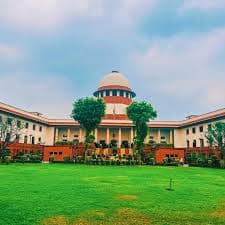
With the adoption of the Constitution on November 26, 1949, and its coming into force on January 26, 1950, the framers replaced this colonial arrangement with an indigenous, unified judicial system. The Supreme Court of India was inaugurated on January 28, 1950, in the Chamber of Princes in the Parliament building, and it functioned there until it moved to its present building on Tilak Marg, New Delhi, in 1958. The design of the Supreme Court building itself is symbolic: it is shaped like scales of justice, reflecting the institution’s core mandate.
India adopted an integrated judicial system, unlike the United States, which has separate federal and state judicial hierarchies. This means the Supreme Court of India is not merely a “federal” court in the American sense; it is the highest court for both central and state laws, and its decisions bind all courts within the territory of India, as laid down in Article 141.
Composition of the Supreme Court
Article 124 of the Constitution provides for the establishment of the Supreme Court, consisting of a Chief Justice of India (CJI) and other judges, the number of which is determined by Parliament. When the Constitution was adopted, the sanctioned strength was the Chief Justice plus seven judges. Over the decades, as the workload of the Court increased manifold, Parliament amended the relevant law multiple times to increase this number.
Composition of the Supreme Court
Currently, the sanctioned strength of the Supreme Court is 34 judges, including the Chief Justice of India, a figure fixed through the Supreme Court (Number of Judges) Amendment Act, 2019. This increase reflects the growing volume of litigation and the Court’s expanding role in adjudicating an ever-widening range of disputes.
Qualifications for Appointment
To be appointed as a judge of the Supreme Court, under Article 124(3), a person must be a citizen of India and must have either:
Been a judge of a High Court (or of two or more such courts in succession) for at least five years, or Been an advocate of a High Court (or of two or more such courts in succession) for at least ten years, or Be, in the opinion of the President, a distinguished jurist.
Notably, unlike for many other constitutional posts, the Constitution does not prescribe a minimum age for appointment as a Supreme Court judge, though the retirement age is fixed at 65 years, which is higher than the 62-year retirement age for High Court judges.
Appointment Process and the Collegium System
The manner of appointing judges to the Supreme Court has evolved dramatically since 1950 and remains one of the most contested issues in Indian constitutional law. Article 124(2) originally stated that judges are appointed by the President after “consultation” with such judges of the Supreme Court and High Courts as the President deems necessary, with the Chief Justice of India being consulted mandatorily in all cases other than the appointment of the CJI himself.
Appointment Process and the Collegium System learn here
The interpretation of the word “consultation” has been the subject of three landmark cases, often referred to collectively as the Three Judges Cases, which fundamentally reshaped the appointment process:
First Judges Case (S.P. Gupta v. Union of India, 1981):
The Supreme Court held that “consultation” did not mean “concurrence,” meaning the President was not bound by the advice of the CJI, and the executive retained primacy in judicial appointments.
Second Judges Case (Supreme Court Advocates-on-Record Association v. Union of India, 1993):
In a significant reversal, a nine-judge bench ruled that “consultation” effectively meant “concurrence” and that the opinion of the CJI, formed after consulting a collegium of the two senior-most judges, would have primacy. This case gave birth to the Collegium System, effectively transferring the power of judicial appointments from the executive to the judiciary.
Third Judges Case (1998):
Through a Presidential Reference under Article 143, the Supreme Court expanded the collegium to include the CJI and four senior-most judges of the Supreme Court, further institutionalizing the collegium’s role and laying down detailed norms for consultation.
Under the current collegium system, the Chief Justice of India and the four senior-most judges of the Supreme Court recommend appointments and transfers of judges. Similarly, High Court collegiums, led by the Chief Justice of the respective High Court along with two senior-most judges, recommend names for appointment to High Courts. These recommendations then go to the government, which can raise objections or seek clarifications but must, under existing norms, approve the appointment if the collegium reiterates its recommendation.
The NJAC Controversy
In an attempt to replace the collegium system, Parliament passed the 99th Constitutional Amendment Act, 2014, along with the National Judicial Appointments Commission (NJAC) Act, 2014. This sought to establish a body comprising the CJI, two senior-most Supreme Court judges, the Union Law Minister, and two eminent persons (selected by a committee including the Prime Minister, CJI, and Leader of Opposition) to make recommendations for judicial appointments.
The NJAC Controversy
However, in the landmark case of Supreme Court Advocates-on-Record Association v. Union of India (2015), popularly known as the NJAC case, a five-judge Constitution Bench struck down both the 99th Amendment and the NJAC Act as unconstitutional. The Court held that the inclusion of the Law Minister and the mechanism giving the executive a decisive say violated the principle of judicial independence, which forms part of the “basic structure” of the Constitution. This restored the collegium system, which continues to operate today, despite ongoing criticism regarding its lack of transparency and accountability.
For UPSC Mains, this is a rich area to discuss the tension between judicial independence and democratic accountability, a recurring theme in GS-II answers on the judiciary.
Removal of Supreme Court Judges
The Constitution provides robust safeguards to protect judges from arbitrary removal, thereby insulating them from political pressure. Under Article 124(4), a judge of the Supreme Court can be removed only on the grounds of “proved misbehaviour or incapacity.” The process, often referred to as impeachment (though this term does not appear in the Constitution), requires:
A motion signed by at least 100 members of the Lok Sabha or 50 members of the Rajya Sabha, submitted to the Speaker or Chairman respectively.
Investigation by a three-member committee comprising a Supreme Court judge, a High Court Chief Justice, and a distinguished jurist, as per the Judges (Inquiry) Act, 1968.
If the committee finds the judge guilty of misbehaviour or incapacity, the motion must be passed by each House of Parliament by a special majority: a majority of the total membership of the House and a majority of not less than two-thirds of members present and voting.
Finally, the President issues an order for removal.
This stringent process explains why, in the history of independent India, no Supreme Court or High Court judge has ever actually been removed through this mechanism, though several motions have been initiated (for instance, against Justice V. Ramaswami in 1993 and Justice Soumitra Sen in 2011, a High Court judge whose motion passed the Rajya Sabha before he resigned).
Independence of the Supreme Court
The framers of the Constitution took extraordinary care to insulate the judiciary from executive and legislative interference, recognizing that an independent judiciary is indispensable to a functioning democracy and the rule of law. Several constitutional provisions secure this independence:
Security of tenure:
Judges cannot be removed except through the difficult process described above.
Fixed service conditions:
Salaries, allowances, and privileges of judges are charged on the Consolidated Fund of India and cannot be altered to their disadvantage after appointment, except during a financial emergency (Article 125).
No discussion in legislature:
Article 121 bars any discussion in Parliament regarding the conduct of a judge in the discharge of his duties, except during impeachment proceedings.
Power to punish for contempt:
The Supreme Court has the power to punish anyone, including government functionaries, for contempt of court, under Article 129.
Separation from executive:
Article 50, a Directive Principle, mandates the separation of the judiciary from the executive in the public services of the State.
Prohibition on practice after retirement:
Retired Supreme Court judges cannot plead or act in any court or before any authority within India (Article 124(7)), though they can still be appointed to tribunals or commissions, a practice that has itself generated debate.
Jurisdiction and Powers of the Supreme Court
The Supreme Court’s jurisdiction is extraordinarily wide, arguably wider than that of the highest courts of most other democracies. It can be broadly classified into the following categories:
- 1. Original Jurisdiction (Article 131)
- The Supreme Court has exclusive original jurisdiction in disputes:
Between the Government of India and one or more states, or Between the Government of India and any state(s) on one side and one or more other states on the other, or Between two or more states.
This jurisdiction applies only where a question of law or fact is involved on which the existence or extent of a legal right depends. It does not extend to disputes arising out of treaties, agreements, or similar instruments entered into before the commencement of the Constitution.
- 2. Writ Jurisdiction (Article 32)
- Supreme Court judgments
Perhaps the most celebrated feature of the Supreme Court’s jurisdiction is its power under Article 32 to issue writs (Habeas Corpus, Mandamus, Prohibition, Certiorari, and Quo Warranto) for the enforcement of Fundamental Rights. Dr. B.R. Ambedkar famously called Article 32 “the very soul of the Constitution and the very heart of it,” because it makes the Supreme Court the guarantor and protector of Fundamental Rights, and citizens can approach it directly, without first exhausting other remedies, whenever a Fundamental Right is violated. This is distinct from the writ jurisdiction of High Courts under Article 226, which is wider in scope (covering not just Fundamental Rights but “any other purpose”) but is not itself a Fundamental Right.
3. Appellate Jurisdiction
This constitutes the bulk of the Supreme Court’s actual workload and is divided into four categories:
Constitutional matters (Article 132):
An appeal lies to the Supreme Court from any judgment of a High Court if it certifies that the case involves a substantial question of law regarding the interpretation of the Constitution.
Civil matters (Article 133):
Appeals lie from High Court judgments in civil cases if the High Court certifies that the case involves a substantial question of law of general importance.
Criminal matters (Article 134):
Appeals lie from a High Court judgment in a criminal case in specific circumstances, such as when the High Court has reversed an order of acquittal and sentenced the accused to death, or has withdrawn a case from a subordinate court and convicted the accused with a death sentence, or when the High Court certifies the case as fit for appeal.
Special Leave Petition (Article 136):
This is one of the most powerful and frequently invoked provisions. It grants the Supreme Court discretionary power to grant special leave to appeal from any judgment, decree, determination, sentence, or order in any cause or matter passed by any court or tribunal in India (except military tribunals). This is an extraordinary, residuary power, and the Court exercises it sparingly, only in cases involving substantial questions of law or gross injustice. The sheer breadth of Article 136 has made it a major contributor to the massive backlog of cases before the Court, a point of frequent discussion in UPSC answers on judicial reform.
4. Advisory Jurisdiction (Article 143)
Under Article 143, the President may refer to the Supreme Court any question of law or fact of public importance for its opinion, and the Court may, after such hearing as it deems fit, report its opinion to the President. Notably, the Supreme Court is not bound to give its opinion (unlike its other jurisdictions where its decision is final), and the opinion tendered is advisory in nature, not a binding judicial pronouncement. Famous instances include the Presidential References in the Kerala Education Bill case, the Ram Janmabhoomi case, and the Third Judges Case itself.
5. Court of Record (Article 129)
The Supreme Court is designated a “Court of Record,” meaning its judgments and proceedings are recorded for perpetual memory and testimony, and they cannot be questioned in any ordinary court. This status also carries with it the power to punish for contempt of itself.
6. Power to Review its Own Judgments (Article 137)
Subject to law made by Parliament and rules made under Article 145, the Supreme Court has the power to review any judgment or order it has pronounced, a power most other apex courts around the world do not typically possess.
Judicial Review and the Basic Structure Doctrine
One of the Supreme Court’s most consequential powers is judicial review, the authority to examine the constitutionality of legislative enactments and executive orders. Although the phrase “judicial review” does not appear explicitly in the Constitution, it is implicit in several provisions, most notably Articles 13, 32, 131-136, 143, and 226.
The doctrine of judicial review has been used by the Supreme Court to strike down laws and constitutional amendments that violate the Constitution. This power reached its zenith in the landmark case of Kesavananda Bharati v. State of Kerala (1973), decided by a razor-thin majority of a thirteen-judge bench, the largest ever constituted in Indian judicial history. The Court held that while Parliament has wide powers to amend the Constitution under Article 368, it cannot alter the “basic structure” or the fundamental framework of the Constitution. This doctrine has since been used to strike down constitutional amendments, most notably in Indira Nehru Gandhi v. Raj Narain (1975) and the Minerva Mills case (1980), which struck down parts of the 42nd Amendment for disturbing the balance between Fundamental Rights and Directive Principles.
The basic structure doctrine remains one of the most important and frequently tested concepts in UPSC Polity, as it represents the ultimate check on the amending power of Parliament and safeguards core constitutional values such as democracy, secularism, federalism, judicial independence, and the rule of law, even though the Constitution itself does not enumerate a closed list of what constitutes “basic structure.”
Public Interest Litigation and Judicial Activism
Beginning in the late 1970s and through the 1980s, the Supreme Court, under judges like Justice P.N. Bhagwati and Justice V.R. Krishna Iyer, pioneered the concept of Public Interest Litigation (PIL), which liberalized the traditional rule of “locus standi” (the requirement that only an aggrieved party could approach the court). Under PIL, any public-spirited citizen or organization can approach the Court on behalf of those who cannot approach it themselves due to poverty, social disadvantage, or disability.
PILs have been used to address a vast range of issues, from environmental protection (as in the numerous cases brought by M.C. Mehta), custodial deaths and prison reforms, bonded labour, sexual harassment at the workplace (leading to the Vishaka Guidelines in Vishaka v. State of Rajasthan, 1997), the right to food, and much more. This expansion of standing has transformed the Supreme Court from a purely adjudicatory body into an active agent of social change, a phenomenon often described as “judicial activism.”
While judicial activism has enabled the Court to fill legislative and executive vacuums on pressing social issues, it has also attracted criticism for encroaching upon the domain of the legislature and executive, raising questions about the separation of powers and judicial overreach, a debate that remains highly relevant for UPSC Mains answer-writing.
- Supreme Court of India | India
- Landmark Judgments Every UPSC Aspirant Should Know
A number of Supreme Court judgments have shaped the trajectory of Indian constitutional law and are indispensable for both Prelims and Mains preparation:
A.K. Gopalan v. State of Madras (1950):
Adopted a narrow interpretation of personal liberty under Article 21, focusing only on “procedure established by law.”
Golaknath v. State of Punjab (1967):
Held that Parliament could not amend Fundamental Rights, later overturned in spirit by Kesavananda Bharati.
Kesavananda Bharati v. State of Kerala (1973):
Established the basic structure doctrine.
Maneka Gandhi v. Union of India (1978):
Expanded the interpretation of Article 21, holding that “procedure established by law” must be fair, just, and reasonable, effectively importing elements of due process into Indian law and creating a golden triangle relationship among Articles 14, 19, and 21.
Minerva Mills v. Union of India (1980):
Reaffirmed the basic structure doctrine and struck down provisions curtailing judicial review.
S.R. Bommai v. Union of India (1994):
Laid down guidelines curbing the misuse of Article 356 (President’s Rule) and affirmed federalism as part of the basic structure.
Vishaka v. State of Rajasthan (1997):
Laid down guidelines against sexual harassment at the workplace in the absence of legislation.
I.R. Coelho v. State of Tamil Nadu (2007):
Held that laws placed in the Ninth Schedule after April 24, 1973, are open to judicial review if they violate the basic structure.
Justice K.S. Puttaswamy v. Union of India (2017):
Declared the right to privacy a Fundamental Right under Article 21.
Navtej Singh Johar v. Union of India (2018):
Decriminalized consensual homosexual acts by reading down Section 377 of the IPC.
Joseph Shine v. Union of India (2018):
Struck down the offence of adultery under Section 497 IPC as unconstitutional.
Indian Young Lawyers Association v. State of Kerala (2018), the Sabarimala case:
Held that the exclusion of women of menstruating age from the Sabarimala temple was unconstitutional (currently under review by a larger bench).
Ayodhya Verdict (M. Siddiq v. Mahant Suresh Das, 2019):
Resolved the decades-long Ram Janmabhoomi-Babri Masjid title dispute.
Abrogation of Article 370 case (2023):
Upheld the constitutional validity of the abrogation of Article 370, which had granted special status to Jammu and Kashmir.
Contemporary Challenges and Reform Debates
Despite its towering constitutional stature, the Supreme Court faces several structural and functional challenges that are frequently discussed in UPSC Mains and interviews:
Pendency and backlog of cases:
The Supreme Court, along with subordinate judiciary, faces a massive backlog, with lakhs of cases pending across all levels of the judiciary. Article 136’s broad discretionary appellate jurisdiction is often cited as a contributing factor, as the Court ends up hearing far more matters than a true “constitutional court” should.
Vacancies:
Delays in filling judicial vacancies, both in the Supreme Court and High Courts, exacerbate pendency, and disputes between the collegium and the government over appointments have periodically caused friction.
Opacity of the Collegium System:
Critics argue that the collegium system lacks a transparent, codified set of criteria and adequate accountability, since it operates largely outside public scrutiny, unlike a statutory body such as the proposed NJAC would have been.
Regional and social diversity on the bench:
There have been persistent calls for improving the representation of women, and judges from diverse social and regional backgrounds, in higher judiciary appointments.
Demand for a National Court of Appeal:
Some legal experts and committees have proposed setting up regional benches of the Supreme Court or a separate National Court of Appeal to handle routine appellate matters, allowing the Supreme Court in Delhi to focus purely on constitutional and matters of national importance, similar to the way apex courts function in many other countries.
Post-retirement appointments:
The practice of appointing retired judges to tribunals, commissions, and even legislative bodies shortly after retirement has raised concerns about potential conflicts of interest and the independence of judicial decision-making in the period leading up to retirement.
Conclusion
The Supreme Court of India occupies a position of extraordinary constitutional significance. As the final interpreter of the Constitution, the guardian of Fundamental Rights, the arbiter of Centre-State disputes, and, through doctrines like basic structure and instruments like PIL, an active shaper of India’s social and political landscape, the Court’s influence extends far beyond the courtroom into the everyday lives of ordinary citizens. For UPSC aspirants, a nuanced understanding of the Supreme Court, its constitutional design, its evolving jurisprudence, and the debates surrounding its functioning is indispensable, not just for scoring well in Polity and Governance sections, but for developing a genuine appreciation of how India’s constitutional democracy is sustained in practice.
As India’s judiciary continues to grapple with questions of transparency, accountability, and efficiency, the Supreme Court’s own journey, from a court of seven judges in 1950 to an institution of 34 judges handling tens of thousands of cases each year, mirrors the broader story of Indian democracy: ambitious in its founding vision, continuously tested by contemporary challenges, and perpetually evolving to meet the needs of a vast and diverse nation.