Comptroller and Auditor General of India (CAG): A Complete Guide for UPSC Aspirants 2026
Introduction
Every year, when a CAG report is tabled in Parliament, it makes headlines — whether it is about a scam involving thousands of crores, an irregularity in defence procurement, or a lapse in the implementation of a welfare scheme. For a UPSC aspirant, the Comptroller and Auditor General of India (CAG) is not just another constitutional body to memorize — it is one of the most frequently tested topics in both Prelims and Mains, and it also forms the backbone of several essay and ethics case studies. This blog attempts to give you a complete, exam-oriented, yet conceptually rich understanding of the CAG, so that you can write confident, well-structured answers regardless of how the question is framed.
The CAG is often called the “guardian of the public purse” and is considered one of the bulwarks of the Indian Constitution, along with the Supreme Court and the Election Commission of India. Dr. B.R. Ambedkar himself remarked that the CAG shall be the most important officer under the Constitution of India, and that their duties are far more important than the duties of even the judiciary. This single statement should tell you why the CAG deserves your undivided attention while preparing for the exam.
Constitutional Basis and Historical Background
The institution of CAG has colonial origins. The office was first created in 1860, following the financial crisis after the Revolt of 1857, primarily to bring order and accountability into British India’s financial administration. Over time, this office evolved through various Government of India Acts, eventually being incorporated into the Constitution of independent India.
The framers of the Constitution recognized that no democracy can function without a robust mechanism to ensure that public money, collected through taxes and other means, is spent for the purposes for which it was sanctioned by Parliament. This led to the creation of an independent constitutional authority who would audit the accounts of the Union and the States, without being answerable to the very executive whose spending it audits.
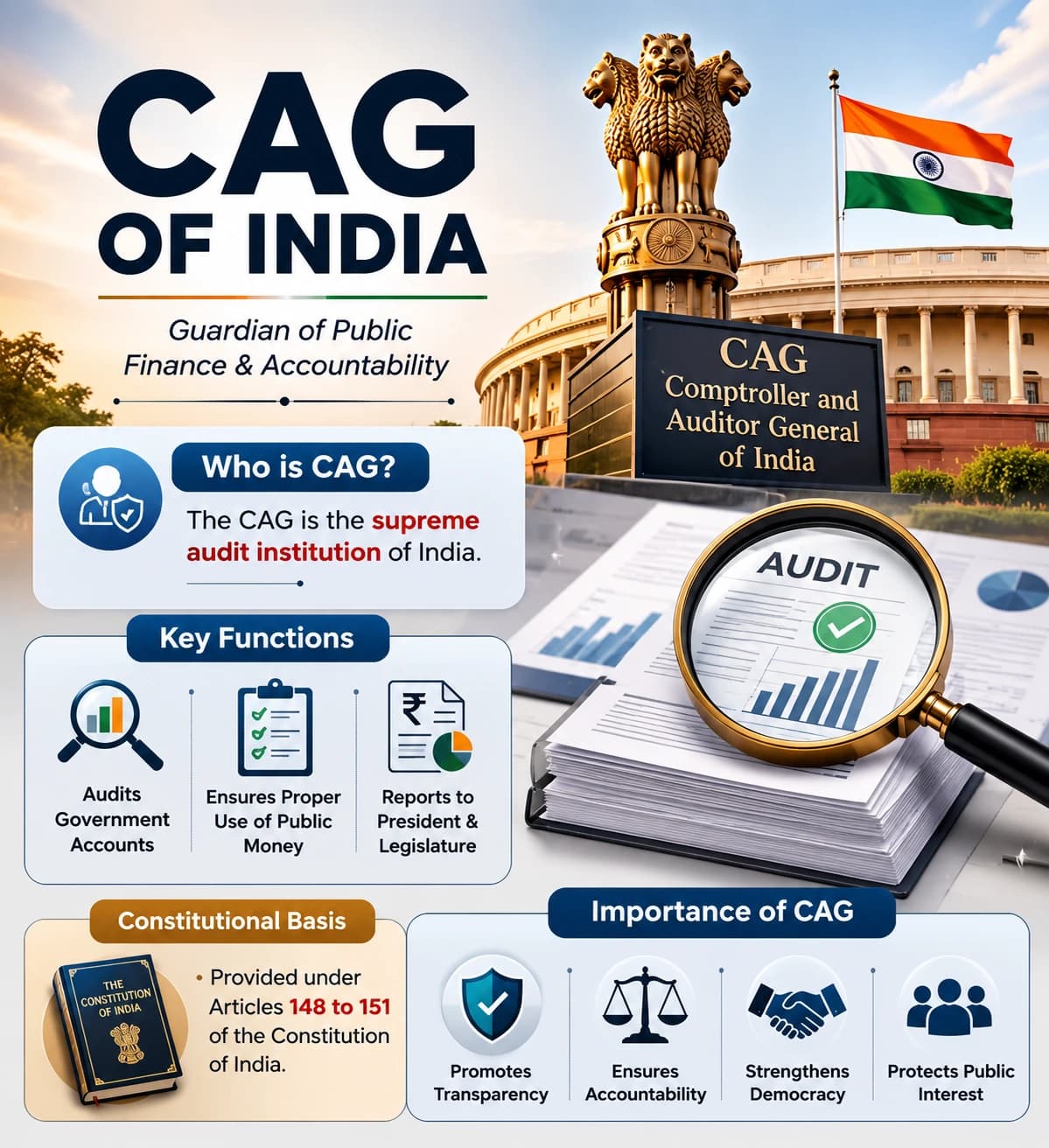
The CAG finds mention in Articles 148 to 151 of the Indian Constitution, which lay down its appointment, conditions of service, duties, powers, and the manner in which its reports are to be handled.
Article 148: Appointment and Conditions of Service
The CAG is appointed by the President of India by warrant under his hand and seal.
The CAG holds office for a term of six years or until the age of 65 years, whichever is earlier.
The CAG can resign at any time by writing to the President.
The CAG can be removed from office only in the manner similar to the removal of a Supreme Court judge — that is, on grounds of proved misbehaviour or incapacity, through a resolution passed by a special majority in each House of Parliament in the same session. This is precisely why the CAG is regarded as an independent and powerful watchdog, since the executive cannot remove them at will.
The salary and conditions of service of the CAG are determined by Parliament and cannot be varied to their disadvantage after appointment.
After ceasing to hold office, the CAG is not eligible for further office, either under the Government of India or of any state. This provision ensures independence — the CAG will not tailor findings hoping for a post-retirement government appointment, unlike some other constitutional posts where this safeguard is absent.
Administrative expenses of the office of CAG, including salaries and pensions of persons serving in that office, are charged upon the Consolidated Fund of India, meaning they are not subject to a vote in Parliament — only discussion. This insulates the institution’s functioning from budgetary pressure or political leverage.
Article 149: Duties and Powers
This article states that the CAG shall perform such duties and exercise such powers in relation to the accounts of the Union, the States, and any other authority or body, as may be prescribed by or under any law made by Parliament. This law is the Comptroller and Auditor General’s (Duties, Powers and Conditions of Service) Act, 1971, which we will discuss in detail below.
Article 150
This article states that the accounts of the Union and the States shall be kept in a form as prescribed by the President, on the advice of the CAG. This gives the CAG an important say in how government accounts should be structured and presented.
- Article 151
- This article deals with the submission of CAG reports:
Reports relating to the accounts of the Union are submitted to the President, who causes them to be laid before each House of Parliament.
Reports relating to the accounts of a State are submitted to the Governor, who causes them to be laid before the State Legislature.
Article 279
This lays down that the CAG’s certification of net proceeds of a tax or duty is final, relevant in matters of distribution of tax revenues between the Union and the States.
Third Schedule
The Third Schedule of the Constitution prescribes the form of oath or affirmation to be made by the CAG before entering office, administered by the President.
The CAG’s (Duties, Powers and Conditions of Service) Act, 1971
This Act, passed under Article 149, is the primary legislation that operationalizes the constitutional mandate of the CAG. It empowers the CAG to:
Audit and report on all expenditure from the Consolidated Fund of India and of each state and union territory having a legislative assembly, to ascertain whether the money shown in accounts was legally available for, and applicable to, the purpose to which it has been applied.
Audit all transactions of the Union and States relating to Contingency Funds and Public Accounts.
Audit all trading, manufacturing, profit and loss accounts, and balance sheets kept by order of the President or Governor.
Audit the receipts and expenditure of bodies or authorities substantially financed from Union or State revenues.
Audit receipts of Government (a role that is relatively newer and less discussed but crucial, since revenue audit ensures that the government is not under-collecting taxes or duties that are legally due).
Audit accounts of government companies and corporations, in accordance with the provisions of the Companies Act, 2013 and other applicable laws.
Audit stores and stock kept in government offices and departments.
The Act also gives the CAG the discretion to decide the scope and extent of audit to be conducted, and the manner in which the accounts are to be audited, giving CAG considerable functional autonomy.
Role of CAG: A Detailed Look
The CAG’s functions can be broadly classified into the following categories. This classification is extremely useful for structuring Mains answers.
1. Audit of Expenditure
The CAG examines whether expenditure incurred by government departments has due sanction, is in accordance with the provisions of the Constitution and applicable laws, rules, and regulations, and is in accordance with the purpose for which funds were allotted. This is the most well-known aspect of CAG’s work, often called regularity audit.
2. Audit of Receipts
The CAG examines whether the rules and procedures ensure an effective check on the assessment, collection, and proper allocation of revenue, and whether adequate provisions exist to prevent leakage of revenue. This is why tax-related scams and revenue losses (spectrum allocation, coal block allocation) have historically fallen under CAG’s scanner.
3. Audit of Public Sector Undertakings (PSUs)
The CAG audits government companies as per the Companies Act, appointing auditors for these companies and issuing directions on the manner in which accounts are audited. The CAG can also conduct a supplementary or test audit of the accounts of these companies.
4. Performance Audit / Efficiency-cum-Performance Audit
Beyond checking legality and regularity, CAG examines whether government programs, schemes, and projects have been executed economically, efficiently, and effectively — whether they have achieved their intended objectives, and at what cost. This is where the CAG goes beyond a mere accountant’s role and becomes an evaluator of public policy outcomes. Performance audits of schemes like MGNREGA, various infrastructure projects, and telecom spectrum allocation have been landmark examples.
5. Compliance Audit
This examines whether the transactions of an auditee comply with the applicable laws, rules, regulations, and various government instructions.
6. Audit of Autonomous Bodies
The CAG also audits autonomous bodies that receive substantial financing from the Consolidated Fund, ensuring public money routed through non-departmental channels is also accounted for.
7. Advisory Role
Under Article 150, the CAG advises the President on the form in which accounts of the Union and States shall be kept, contributing to standardization and transparency of government accounting systems.
Types of Audit Conducted by CAG
For Prelims-level clarity, it helps to remember the broad categories of audit:
Regularity Audit (Financial):
Verifying that expenditure conforms to law, rules, and regulations.
Regularity Audit (Compliance):
Checking compliance with applicable laws and government orders.
Performance Audit:
Assessing economy, efficiency, and effectiveness of government programs.
Audit of Commercial Undertakings:
Applying techniques of company audit modified to suit governmental control.
Comprehensive Appraisal:
Reviewing overall performance of PSUs, especially their investment decisions and project management.
Is the CAG an Auditor Alone, or Also an Accountant?
This is a classic UPSC-type conceptual question. Originally, the CAG performed both accounting and auditing functions for the Union Government. However, the accounting function for the Union Government was separated in 1976, and handed over to the Controller General of Accounts (CGA) under the Ministry of Finance. This was done to maintain a clean separation between the body that prepares accounts and the body that audits them — a basic principle of institutional accountability, since an auditor auditing their own accounts would represent a conflict of interest.
However, at the state level, the CAG continues to compile the accounts for some states, since not all states have a separate accounting mechanism like the CGA. This is worth remembering as it often appears in nuanced Prelims questions.
CAG and Parliamentary Control over Public Finance
The reports of the CAG are not merely descriptive documents — they form the very basis of the parliamentary financial oversight machinery in India. Here’s how the linkage works:
The CAG audits government accounts and submits three principal reports to the President:
- Audit Report on Appropriation Accounts
- Audit Report on Finance Accounts
- Audit Report on Public Undertakings
These reports are laid before Parliament and then referred to the Public Accounts Committee (PAC).
The PAC, a parliamentary committee comprising members from both Houses (with the chairperson traditionally from the principal opposition party since 1967), examines these reports in detail, questions officials, and prepares its own reports with recommendations.
The CAG acts as the “friend, philosopher, and guide” of the Public Accounts Committee — a phrase frequently used in the exam. The CAG’s officers assist the PAC in analysing the audit findings.
Similarly, the CAG’s reports also assist the Committee on Public Undertakings, which specifically examines the reports and accounts of public sector undertakings.
This triad — CAG, PAC, and the Committee on Public Undertakings — forms the backbone of financial accountability of the executive to the legislature in India, given that the legislature itself often lacks the technical expertise and time to scrutinize voluminous government accounts on its own.
Is India’s CAG a “Comptroller” in the True Sense?
This is an important and often-tested nuance. In countries like the United Kingdom, the Comptroller and Auditor General has actual control over the withdrawal of money from the government’s account before expenditure is incurred — that is, the executive cannot draw money without the Comptroller’s approval. This is called ex-ante control.
In India, however, the CAG’s role is essentially that of an auditor, not a comptroller in the true sense, because the CAG has no control over the issue of money from the Consolidated Fund — the actual disbursement is controlled by the executive itself (through the CGA and various Pay and Accounts Offices). The CAG only conducts an ex-post facto (after the fact) audit of the expenditure already incurred. This means the CAG’s name is somewhat a misnomer according to many scholars, since the “Comptroller” function, in its original British sense, does not really exist in India. Aspirants should highlight this distinction whenever a question specifically probes the “Comptroller” aspect of the office.
Independence of the CAG: Safeguards Provided
The framers of the Constitution took great care to ensure that CAG functions without fear or favour. The safeguards include:
Security of tenure, removable only through a Supreme Court judge-like impeachment process.
Salary and conditions of service cannot be altered to the CAG’s disadvantage after appointment.
Administrative expenses charged on the Consolidated Fund of India, not subject to vote.
No further office under Government after retirement, removing the incentive for post-retirement favour-seeking.
Appointment by the President, in theory placing the CAG above party politics (though appointment is on the advice of the Council of Ministers in practice).
Despite these safeguards, the institution has often been criticized on grounds discussed below.
Criticisms and Challenges Associated with the Institution of CAG
A balanced UPSC answer must always include limitations, since questions frequently ask you to “critically examine” or discuss “challenges.”
Appointment Process:
Unlike some other democracies, in India the CAG is appointed solely by the executive, without any parliamentary approval or bipartisan consultation. This raises concerns about the independence of appointment itself, even if the tenure post-appointment is secure.
Post-mortem Audit:
As discussed, since the audit is conducted after the money has already been spent, the CAG cannot prevent financial irregularities in real time — it can only expose them after the damage is done.
Overreach into Policy Domain:
Critics argue that CAG’s performance audits, especially those estimating “notional” or “presumptive” losses (as seen in the 2G spectrum and coal block allocation cases), sometimes stray from auditing financial regularity into questioning policy choices of the executive, which is arguably outside its constitutional mandate.
Delay in Report Submission and Discussion:
CAG reports are sometimes tabled with significant delay, and PAC discussions on them can take years, reducing the timeliness and impact of the findings.
No Power of Enforcement:
The CAG can only point out irregularities; it has no power to penalize erring officials or recover misappropriated funds. Action depends entirely on the political will of the executive and legislature.
Manpower and Technical Capacity:
With the increasing complexity of government finance — public-private partnerships, disinvestment, complex financial instruments — there are concerns about whether the CAG’s institutional capacity keeps pace with modern financial engineering.
Single Auditor Model:
Unlike some countries which have a multi-member audit board or commission (such as India’s own Election Commission, which moved from a single Chief Election Commissioner to a multi-member body), India’s CAG remains a single individual, raising questions about the concentration of such vast authority in one office.
- ASSURED PRELIMS PROGRAMME – UPPCS 2026
- Notable CAG Reports and Their Impact
Several CAG reports have had a significant impact on Indian public life and governance, and are commonly cited in essays and answers:
The report on the allocation of 2G spectrum, which estimated a notional loss to the exchequer and became a major political and legal controversy, eventually leading to the cancellation of licences by the Supreme Court.
The report on coal block allocations, which similarly estimated windfall gains to private allottees due to the absence of a competitive bidding process, contributing to the eventual cancellation of allocations by the Supreme Court in 2014.
Reports on the Commonwealth Games 2010, which flagged irregularities in procurement and organization.
Various reports on defence procurement, including audits of specific equipment purchases, which have periodically triggered parliamentary debate.
These examples demonstrate how CAG reports, despite being purely investigative and non-binding in a legal sense, have had far-reaching political, judicial, and administrative consequences.
- Home | Comptroller and Auditor General of India
- Reforms Suggested
Various committees and scholars have suggested reforms to strengthen the institution further:
Broadening the appointment process for CAG to include consultation with the Leader of Opposition and the Chief Justice of India, similar to reforms suggested for other constitutional appointments, to enhance perceived neutrality.
Strengthening the technical and human resource capacity of the CAG’s office to handle increasingly complex financial audits, especially in the digital economy.
Timely tabling and discussion of CAG reports in Parliament and State Legislatures, with fixed timelines to prevent indefinite delay.
Greater use of technology, data analytics, and real-time audit techniques to move away from a purely ex-post facto model, wherever feasible.
Considering whether certain aspects of performance audit should be supplemented by domain experts to avoid the criticism of policy overreach.
Why This Topic Matters for UPSC
The CAG is significant for UPSC preparation across multiple dimensions:
Polity (GS2):
Constitutional provisions, appointment, powers, and comparison with other countries’ audit institutions.
Governance (GS2):
Its role in ensuring transparency, accountability, and good governance; linkage with PAC and parliamentary oversight.
Economy (GS3):
Its role in auditing government expenditure, PSUs, fiscal responsibility, and public finance management.
Ethics (GS4):
Concepts of accountability, transparency, probity in public life, often illustrated through CAG-related case studies.
Essay:
Themes on accountability, checks and balances, and institutional independence.
Given this multi-dimensional relevance, a thorough understanding of the CAG allows you to write informed answers across papers, rather than treating it as an isolated polity topic.
- Sample Mains-Style Question and Approach
- Question:
“The CAG, despite being a powerful constitutional authority, functions more as a post-mortem auditor than a real-time comptroller. Discuss.”
Suggested approach:
Briefly introduce the constitutional mandate of CAG (Articles 148–151).
Explain the meaning of “post-mortem” or ex-post facto audit versus a true comptroller function (drawing the UK comparison).
Give reasons why India’s CAG lacks ex-ante control (separation of accounting and auditing functions, no control over withdrawal of funds).
Discuss implications: irregularities detected only after the fact, limiting preventive value.
Suggest a way forward: greater use of technology for real-time audit, better internal financial controls within departments, and stronger parliamentary follow-through mechanisms.
Conclude by affirming CAG’s continued relevance as a vital, if imperfect, guardian of public finance.
Conclusion
The Comptroller and Auditor General of India occupies a position of immense constitutional significance — an institution designed to hold the executive accountable for every rupee of public money spent, in a democracy where taxpayers have every right to know how their contributions are utilized. While the CAG is not without its limitations — being a post-facto auditor, facing appointment-related criticisms, and occasionally being accused of overreach — it remains one of the most important checks on executive power in the Indian constitutional scheme.
For a UPSC aspirant, understanding the CAG is not simply about memorizing articles and dates. It is about appreciating the deeper constitutional philosophy of separation of powers, institutional independence, and financial accountability that Dr. Ambedkar and the framers of the Constitution sought to build into the Indian Republic. Mastering this topic will not only help you score well in objective and descriptive papers but will also deepen your understanding of how Indian democracy holds itself accountable — a theme that runs through nearly every aspect of governance you will study for this examination.
As you revise this topic, try to connect it constantly with current affairs — every year, some CAG report or the other makes news, and being able to link the theoretical framework to a live example will make your answers stand out in both Prelims and Mains.
This article is intended as a study resource for UPSC Civil Services Examination aspirants and covers the constitutional, legal, and functional dimensions of the office of the Comptroller and Auditor General of India.