Governor of a State: A Complete UPSC Guide 2027
Introduction
The office of the Governor is one of the most debated institutions in Indian polity, and it is also one of the most frequently tested topics in UPSC Prelims, Mains (GS Paper II), and even the Essay paper. Questions on the Governor’s discretionary powers, his relationship with the Chief Minister, his role as an “agent of the Centre,” and recent controversies involving Governors delaying assent to bills have appeared repeatedly over the last decade.
This article covers everything a serious UPSC aspirant needs: constitutional provisions, appointment and removal, powers and functions, discretionary powers, important case laws, recommendations of various commissions, recent controversies, and probable exam angles — all in one place.
1. Constitutional Basis of the Office of Governor
The office of Governor is dealt with in Part VI of the Constitution, under
Articles 153 to 162. These articles collectively lay down the framework for the executive head of a state.
- Article
- Subject Matter
- 153
- Governor of a state
- 154
- Executive power of the state vested in the Governor
- 155
- Appointment of Governor by the President
- 156
- Term of office of Governor
- 157
- Qualifications for appointment
- 158
- Conditions of Governor’s office
- 159
- Oath or affirmation by the Governor
- 160
- Discharge of functions in certain contingencies
- 161
Power to grant pardons, reprieves, etc.
- 162
- Extent of executive power of state
It is important to note that Article 153 allows one person to be appointed as Governor for two or more states — a provision inserted by the 7th Constitutional Amendment Act, 1956, largely used today as an administrative convenience, especially for smaller states and Union Territories without a separate Legislative Assembly (like Puducherry).
- 2. Appointment of the Governor
- Foundation Batch 2027 (Hindi Medium)
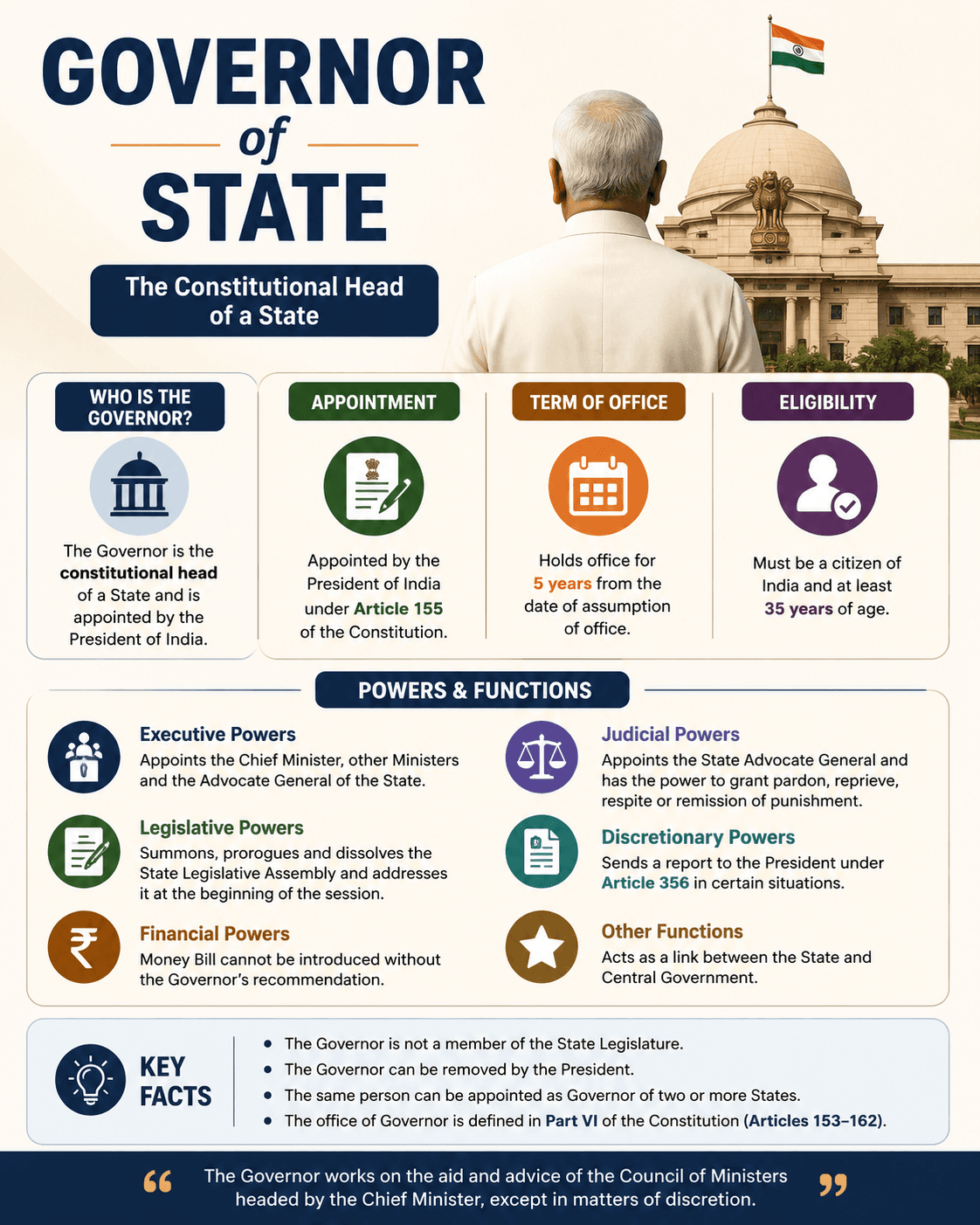
Unlike the President, who is elected indirectly through an electoral college, the Governor is appointed by the President under Article 155, essentially on the advice of the Union Council of Ministers. This is a crucial distinguishing feature: the Governor’s office is nominated, not elected, which forms the basis of much of the criticism against the institution.
- Qualifications (Article 157)
- A person is eligible to be appointed Governor if he/she:
Is a citizen of India.
Has completed the age of 35 years.
Conventions Followed (not constitutionally mandated)
Over the years, certain conventions have developed, based on recommendations of the Sarkaria Commission and Punchhi Commission:
The Governor should be an eminent person from outside the state, so that he is not entangled in local politics.
The person should be one who has not taken too great a part in politics generally, and particularly in the recent past.
The Governor should not belong to the state where he is to be posted.
The Chief Minister of the state should be consulted while appointing the Governor.
In practice, however, these conventions have frequently been violated, and this has been a persistent source of Centre-State friction, especially when the party ruling at the Centre differs from the party ruling in the state.
- 3. Term, Removal, and Conditions of Service
- Term of Office (Article 156)
- The Governor holds office
- “during the pleasure of the President”
— this means the President can remove the Governor at any time, without assigning any reason.
The normal term is 5 years, but this is subject to the “pleasure” doctrine, so a Governor can be removed even before completing five years.
A Governor can also resign by writing to the President, or continue in office until a successor is appointed.
The “Doctrine of Pleasure”
This is a major area of constitutional controversy. Since the Governor holds office at the pleasure of the President (in effect, the Union Council of Ministers), Governors are frequently seen as being removed or transferred when there is a change of government at the Centre. The Supreme Court addressed this issue in the landmark case of:
- B.P. Singhal v. Union of India (2010)
- — The Supreme Court held that:
The President can remove a Governor without assigning any reason and without giving an opportunity of being heard.
However, the power cannot be exercised in an arbitrary, capricious, or unreasonable manner. There must exist a “compelling reason” (though the reason need not be disclosed).
A change in government at the Centre does not, by itself, constitute a valid ground for removal of Governors who were appointed by the previous government.
This case is extremely important for Mains answer writing, as it balances the doctrine of pleasure with the constitutional principle against arbitrariness (Article 14).
Conditions of Service (Article 158)
The Governor shall not be a member of either House of Parliament or of a State Legislature.
He shall not hold any other office of profit.
He is entitled to use of official residence (Raj Bhavan) without payment of rent.
His emoluments, allowances, and privileges are determined by Parliament, and cannot be diminished during his term.
When one person serves as Governor of two or more states, the emoluments are shared between the states as decided by the President.
4. Executive Power of the State (Article 154)
Article 154 vests the executive power of the state in the Governor, exercised either directly or through officers subordinate to him, in accordance with the Constitution. Similar to the President at the Union level, the Governor is a nominal/constitutional head, and in practice, the real executive authority lies with the Council of Ministers headed by the Chief Minister
(Article 163), except in matters where the Governor is required to act in his discretion.
Article 163 states that there shall be a Council of Ministers with the Chief Minister at the head to aid and advise the Governor in the exercise of his functions, “except in so far as he is required by or under this Constitution to exercise his functions… in his discretion.”
- This exception clause is the constitutional root of what is called
- “Governor’s discretionary power”
— a subject that generates immense controversy and is a favourite UPSC theme.
- Governors | Who’s Who | Directory
- 5. Powers and Functions of the Governor
- The Governor’s powers can broadly be classified into five categories:
- (A) Executive Powers
All executive actions of the state government are formally taken in the name of the Governor.
He appoints the Chief Minister and, on the CM’s advice, the other Ministers.
He appoints the Advocate General of the state, State Election Commissioner, and members of the State Public Service Commission.
He can seek information from the Chief Minister regarding administrative and legislative matters (Article 167).
He appoints the Vice-Chancellors of state universities (in most states, by convention/state law).
(B) Legislative Powers
The Governor summons, prorogues, and can dissolve the State Legislative Assembly.
He addresses the State Legislature at the commencement of the first session after each general election and at the beginning of each year (Article 176).
He can nominate one member to the State Legislative Assembly from the Anglo-Indian community —
Note: This provision was removed by the 104th Constitutional Amendment Act, 2019, since Anglo-Indian reservation lapsed for both Parliament and state assemblies.
He nominates members to the Legislative Council (in states having a bicameral legislature) from among persons having special knowledge in literature, science, art, cooperative movement, and social service —
1/6th of total membership.
Assent to Bills (Article 200): A bill passed by the state legislature can become law only after the Governor’s assent. The Governor has four options:
Give assent to the bill.
Withhold assent.
Return the bill (if it is not a Money Bill) for reconsideration. If the legislature passes it again, with or without amendments, the Governor must give assent.
Reserve the bill for the consideration of the President.
This power under Article 200 has become one of the most litigated and politically charged issues in recent years (discussed in detail below).
(C) Financial Powers
Money Bills can be introduced in the State Legislature only with the prior recommendation of the Governor.
The Governor causes the State Budget
(Annual Financial Statement) to be laid before the legislature.
No demand for a grant can be made except on the recommendation of the Governor.
He constitutes a State Finance Commission every five years to review the financial position of Panchayats and Municipalities.
He can make advances out of the Contingency Fund of the State to meet unforeseen expenditure.
(D) Judicial Powers
The Governor is consulted by the President while appointing the judges of the concerned High Court.
He appoints judges of the District Courts and subordinate judiciary in consultation with the State High Court.
Pardoning power (Article 161): The Governor can grant pardons, reprieves, respites, or remissions of punishment, or suspend, remit, or commute the sentence of any person convicted of an offence against a state law.
Important distinction from the President’s pardoning power under Article 72: The Governor cannot pardon a death sentence — that power rests exclusively with the President, even if the offence falls under state law. The Governor also cannot pardon sentences by court martial (unlike the President).
(E) Discretionary Powers
This is the most exam-relevant and controversial category. The Governor exercises certain functions in his own discretion, without the aid and advice of the Council of Ministers. These fall into two types:
1. Constitutional Discretion (situational)
Reserving a bill for the President’s consideration.
Recommending President’s Rule in the state (Article 356) when he is satisfied that the constitutional machinery has failed.
Exercising functions as the administrator of an adjoining Union Territory (in case of additional charge).
Determining the amount payable by the state to an autonomous Tribal District Fund (in Assam, Meghalaya, Tripura, Mizoram under the Sixth Schedule).
2. Situational Discretion (arising from political circumstances, not explicitly listed in the Constitution)
Appointment of the Chief Minister when no party has a clear majority (a “hung assembly”) or when the Chief Minister dies suddenly and there is no obvious successor.
Dismissal of the Council of Ministers when it cannot prove its majority in the Assembly.
Dissolution of the Legislative Assembly if the Council of Ministers has lost its majority.
These situational discretionary powers are precisely where most of the political controversy around Governors arises — since there are no codified, unambiguous rules on floor tests, timing of oath ceremonies, or how to identify the single largest party’s claim to form government.
- 6. Governor vs. President: A Comparative Note
- A frequently asked Prelims-style comparison:
- Feature
- President
- Governor
- Mode of selection
- Indirect election by Electoral College
- Appointment by the President
- Ordinance-making power
- Article 123
- Article 213
- Pardoning power
- Can pardon death sentence, court martial sentences
- Cannot pardon death sentence or court martial sentences
- Emergency powers
- Can proclaim National, State, Financial Emergency
- Can only recommend President’s Rule; cannot proclaim it himself
- Legislative option on bills
- Can also “pocket” a bill (no time limit under original Constitution)
Similarly not bound by a time limit, but this is now under judicial scrutiny
- Removal
- Impeachment (Article 61)
- Removed at the pleasure of the President (no formal procedure)
- 7. Ordinance-Making Power (Article 213)
Just as the President can promulgate ordinances under Article 123 when Parliament is not in session, the Governor can promulgate ordinances under Article 213 when the State Legislature (or one of its Houses in a bicameral legislature) is not in session. Conditions:
The Governor must be satisfied that circumstances exist that make it necessary to take immediate action.
An ordinance must be laid before the legislature when it reconvenes and ceases to operate six weeks after reassembly unless approved earlier.
The Governor cannot promulgate an ordinance without instructions from the President in certain matters — specifically, if a similar bill would have required the President’s prior sanction, or if the Governor would have had to reserve such a bill for the President’s consideration.
8. The Sarkaria Commission and Punchhi Commission Recommendations
Two major Centre-State Relations Commissions have extensively examined the office of the Governor:
Sarkaria Commission (1988)
Governors should be eminent persons, not too closely associated with the ruling party at the Centre.
The state Chief Minister should be consulted before appointment.
A five-year term should not ordinarily be disturbed, except in rare and compelling circumstances.
Governors should be given a fixed tenure, and removal should not be arbitrary.
Punchhi Commission (2010)
Recommended a fixed five-year tenure, with removal only through a resolution by the state legislature (similar to impeachment), to insulate the Governor from arbitrary dismissal.
Suggested a time limit (e.g., six months) for the Governor to decide on assenting to, withholding, reserving, or returning a bill.
Recommended deleting the phrase “during the pleasure of the President” and instead providing that the Governor cannot be removed before completing his term, except through a resolution of the state legislature by a majority, on grounds of proven misbehaviour.
Neither set of recommendations has been implemented through a constitutional amendment so far, though courts have used these recommendations persuasively.
- 9. Recent Controversies and Case Laws (High-Value for Mains)
- (a) Delay in Granting Assent to Bills
In recent years, several opposition-ruled states (Tamil Nadu, Kerala, Punjab, Telangana, West Bengal) accused their Governors of sitting indefinitely on bills passed by the state legislature, neither giving assent, returning them, nor reserving them for the President — effectively exercising a “pocket veto” that is not explicitly provided for in the Constitution.
State of Punjab v. Principal Secretary to the Governor of Punjab (2023): The Supreme Court held that the Governor is a titular head and must act on the aid and advice of the Council of Ministers except where the Constitution expressly requires discretion. The Court emphasized that the Governor cannot keep a bill pending indefinitely — such inaction would be contrary to constitutional norms.
Tamil Nadu Governor case (2025 — decided by the Supreme Court): This case became a landmark judgment on the timelines and scope of Article 200. The Supreme Court:
Held that the Governor cannot indefinitely withhold assent and must act within a reasonable time.
Prescribed that once a bill is re-passed by the legislature after being returned, the Governor is bound to give assent, and cannot reserve it for the President at that stage (except in specific situations like repugnancy with a Central law).
Used its powers under
Article 142 to deem certain long-pending Tamil Nadu bills as having received assent.
This judgment triggered a major debate on federalism, separation of powers, and the extent of judicial power under Article 142 — a very good essay/GS-II theme.
(b) Government Formation Disputes
Nabam Rebia and Bamang Felix v. Deputy Speaker (2016): Arising out of the Arunachal Pradesh political crisis, the Supreme Court held that the Governor’s discretionary power to summon, prorogue, or dissolve the Assembly must be exercised on the aid and advice of the Council of Ministers, and not used to advance the agenda of a political party. The Court held that the Governor cannot act as a mere agent of the Centre or interfere in the internal proceedings of the House (like Speaker’s removal proceedings) unless there is a genuine constitutional breakdown.
Disputes over Governors delaying the invitation to the single largest party/pre-poll alliance to form the government (seen in Karnataka 2018, Maharashtra 2019) have repeatedly drawn judicial intervention, with courts often directing an immediate floor test to resolve the issue rather than leaving it to the Governor’s subjective satisfaction.
(c) Role in University Administration
Many Governors serve as ex-officio Chancellors of state universities, giving them a role in appointing Vice-Chancellors. This has caused friction with state governments (e.g., West Bengal, Kerala, Tamil Nadu), which have passed laws to replace the Governor with the Chief Minister as Chancellor — leading to further Centre-State legal battles.
(d) Use of Article 356 on Governor’s Report
The Governor’s report recommending President’s Rule has historically been misused for partisan purposes. The S.R. Bommai v. Union of India (1994) judgment made the exercise of Article 356 subject to judicial review, holding that the floor of the House is the only constitutionally sanctioned method to test whether a government has lost majority — this significantly curtailed arbitrary misuse of gubernatorial reports to dismiss state governments.
10. Why the Governor’s Office is Controversial: A Summary of Criticisms
Political appointments: Governors are often retired politicians or party loyalists, raising doubts about their neutrality, especially when the Centre and state are ruled by rival parties.
Agent of the Centre: Critics argue Governors sometimes act less like constitutional heads of the state and more like representatives safeguarding central interests — undermining cooperative federalism.
Absence of a fixed, secure tenure: Since Governors serve “during the pleasure of the President,” they can be removed or transferred abruptly, incentivizing alignment with the ruling party at the Centre.
Ambiguity in discretionary powers: The Constitution does not exhaustively define “situational discretion,” leading to subjective and often controversial exercises of power in hung assemblies or floor-test situations.
Delay in assent to bills: As seen in recent Supreme Court cases, indefinite inaction on bills has been used as a de facto veto, disrupting the legislative process of democratically elected state governments.
Misuse of Article 356 recommendations: Historically used to dismiss opposition-ruled state governments (though curtailed post-Bommai).
- 11. Way Forward / Reforms
- Implementing the Sarkaria and Punchhi Commission recommendations
— particularly a fixed tenure and a transparent, consultative appointment process involving the state Chief Minister.
Prescribing a statutory or constitutional time limit for the Governor to act on bills under Article 200, as the judiciary has now started enforcing through interpretation.
Codifying clear, objective procedures for government formation in hung assemblies (order of invitation, time-bound floor tests), reducing reliance on the Governor’s subjective discretion.
Encouraging the appointment of apolitical, eminent individuals as Governors, consistent with the original vision of the Constituent Assembly, where the Governor was meant to be a “friend, philosopher, and guide” to the state government, not a political rival.
12. Previous Year UPSC Questions for Practice
“Discuss the essential conditions for exercise of the legislative powers by the Governor. Discuss the legality of re-promulgation of ordinances by the Governor without placing them before the Legislature.”
(2022)
“The Governor’s Constitutional discretion, being an exception, has to be exercised in exceptional circumstances only, keeping in mind the standards of Constitutional trust and morality. Comment on the statement.”
“Discuss the role of the Governor of a state after the President’s rule is proclaimed in that state.”
“Whether the Supreme Court’s judgement (July 2018) can settle the political tussle between the Lieutenant Governor and elected government of Delhi? Examine.” (relevant for comparison with Article 239AA and LG’s powers, often clubbed with Governor questions)
Aspirants should also prepare a comparison-based answer distinguishing the Governor’s discretionary powers from the ordinary “aid and advice” framework, using recent case laws like the Tamil Nadu Governor case (2025) and Punjab Governor case (2023) for updated, high-scoring answers.
Conclusion
The office of the Governor sits at the intersection of constitutional design and political reality. On paper, it is meant to be a neutral, dignified constitutional head who ensures smooth governance and acts as a bridge between the Centre and the states. In practice, the absence of a secure tenure, ambiguous discretionary powers, and politically motivated appointments have repeatedly turned the office into a flashpoint of Centre-State conflict.
For a UPSC aspirant, mastering this topic requires linking constitutional articles (153–162, 200, 213, 356) with case laws (Bommai, B.P. Singhal, Nabam Rebia, the Punjab and Tamil Nadu Governor cases) and commission recommendations (Sarkaria, Punchhi). This combination of static polity knowledge with dynamic, current affairs-driven judicial developments is exactly what separates an average Mains answer from a high-scoring one.
This article is intended for UPSC Civil Services Examination preparation (GS Paper II – Indian Polity and Governance). Aspirants are encouraged to cross-reference this material with Laxmikanth’s “Indian Polity” and recent Supreme Court judgments for the most updated exam-oriented preparation.