Election Commission of India: A Complete Guide for UPSC Aspirants 2026

Introduction
Democracy without free and fair elections is merely a word without substance. In the world’s largest democracy, where over 900 million voters exercise their franchise across nearly a million polling stations, the institution that makes this staggering exercise possible is the Election Commission of India (ECI). For UPSC aspirants, the Election Commission is not just a static topic to memorize — it is a living, evolving institution that sits at the intersection of constitutional law, political theory, governance, and current affairs. Questions on the ECI have appeared repeatedly in both Prelims and Mains, and it remains a favourite for essay and ethics papers too, given the debates around its independence and impartiality.
Election Commission of India
This blog aims to give you a thorough, exam-oriented understanding of the Election Commission — its constitutional basis, structure, powers, landmark judgments, criticisms, and recent reforms — so that you can write confident, well-rounded answers in the exam.
Constitutional Basis of the Election Commission
The Election Commission of India derives its authority from Part XV (Articles 324 to 329) of the Constitution of India, which deals with elections. Article 324 is the cornerstone provision and is often quoted in Mains answers.
Article 324 vests in the Election Commission the “superintendence, direction, and control” of elections to:
- Parliament (Lok Sabha and Rajya Sabha)
- State Legislatures (Legislative Assemblies and Legislative Councils)
- The office of the President of India
- The office of the Vice-President of India
It is important to note that the ECI does not conduct elections to local bodies such as Panchayats and Municipalities. That responsibility lies with State Election Commissions, constituted under Article 243K (for Panchayats) and Article 243ZA (for Municipalities). This distinction is a frequently tested point of confusion in Prelims, so aspirants must remember it clearly.
Other Relevant Articles
Article 325: No person shall be ineligible for inclusion in the electoral roll on grounds of religion, race, caste, or sex, and no person shall claim to be included in a special electoral roll for any of these reasons. This enshrines the principle of a single, common electoral roll.
Article 326: Establishes universal adult suffrage as the basis of elections to the Lok Sabha and State Legislative Assemblies — every citizen who is 18 years of age or above (except those disqualified on grounds like unsoundness of mind, crime, or corrupt practice) has the right to vote.
Article 327: Empowers Parliament to make laws relating to elections (this is how the Representation of the People Act, 1950 and 1951 derive their legitimacy).
Article 328: Empowers State Legislatures to make laws on election matters in the absence of parliamentary legislation.
Article 329: Bars courts from interfering in electoral matters, providing that election disputes can only be raised through an election petition and not through ordinary litigation.
- Election Commission of India
- Composition of the Election Commission
- Initially, when the ECI was set up on 25th January 1950
(celebrated as National Voters’ Day), it was a single-member body headed only by the Chief Election Commissioner (CEC). It functioned as a single-member commission until 16th October 1989, when two additional Election Commissioners were appointed for the first time, converting it into a multi-member body. This was short-lived, however, as the two posts were abolished in January 1990, only to be revived again in October 1993, and since then, the ECI has functioned as a three-member body comprising the Chief Election Commissioner and two Election Commissioners.
Article 324(2) provides that the President shall appoint the CEC and other Election Commissioners, subject to any law made by Parliament. Importantly, all members of the Commission have equal decision-making powers, and decisions are generally taken by majority vote in case of a difference of opinion, though the CEC does not enjoy any special veto power over the other Commissioners — a distinctive feature that emphasizes the collegial and non-hierarchical nature of the institution’s internal working.
Tenure and Service Conditions
The CEC and Election Commissioners hold office for a term of six years or until they attain the age of 65 years, whichever is earlier.
They enjoy the same status and salary as a Judge of the Supreme Court of India.
The CEC can only be removed from office through a process of impeachment, similar to a Supreme Court judge, requiring a special majority in both Houses of Parliament. This is meant to insulate the CEC from arbitrary removal by the executive.
However, the other Election Commissioners can be removed by the President on the recommendation of the CEC — a provision that has often been debated, since it creates an asymmetry of protection between the CEC and other Commissioners.
The Appointment Controversy: From Executive Prerogative to the Anoop Baranwal Judgment
One of the most significant and exam-relevant developments concerning the ECI relates to the process of appointment of the CEC and Election Commissioners. For decades, appointments were made by the President purely on the aid and advice of the Council of Ministers, effectively meaning that the executive alone decided who would head the institution responsible for supervising elections against that very executive. This raised serious questions about institutional independence.
In March 2023, a Constitution Bench of the Supreme Court in Anoop Baranwal v. Union of India ruled that, in the absence of a law made by Parliament under Article 324(2), the appointment of the CEC and Election Commissioners would be made by the President on the advice of a committee comprising:
The Prime Minister
The Leader of the Opposition in the Lok Sabha (or the leader of the largest opposition party if there is no recognised Leader of Opposition)
The Chief Justice of India
This was widely hailed as a landmark judgment strengthening the independence of the ECI by diluting unilateral executive control.
However, this arrangement was short-lived. Parliament subsequently enacted the Chief Election Commissioner and other Election Commissioners (Appointment, Conditions of Service and Term of Office) Act, 2023, which replaced the Chief Justice of India in the selection committee with a Union Cabinet Minister nominated by the Prime Minister. This meant the selection committee now consists of the Prime Minister, the Leader of the Opposition, and a Union Cabinet Minister — giving the government two votes out of three. This change has attracted significant criticism from opposition parties, civil society groups, and constitutional experts, who argue that it undermines the spirit of the Supreme Court’s judgment and re-concentrates appointment power in the hands of the executive. This remains a live, contested issue and is extremely relevant for both Prelims (as a factual update) and Mains (as an analytical/opinion-based question on institutional independence).
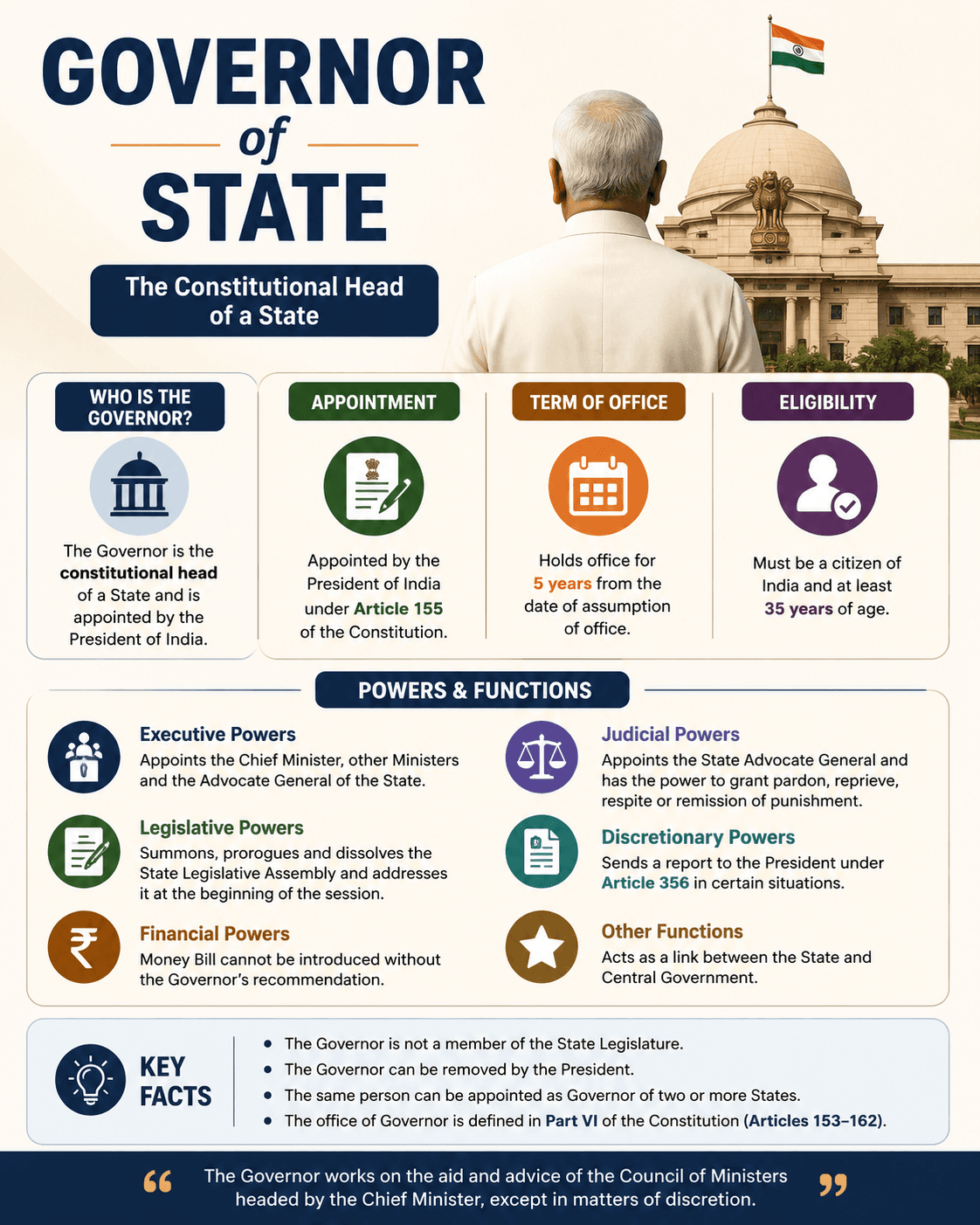
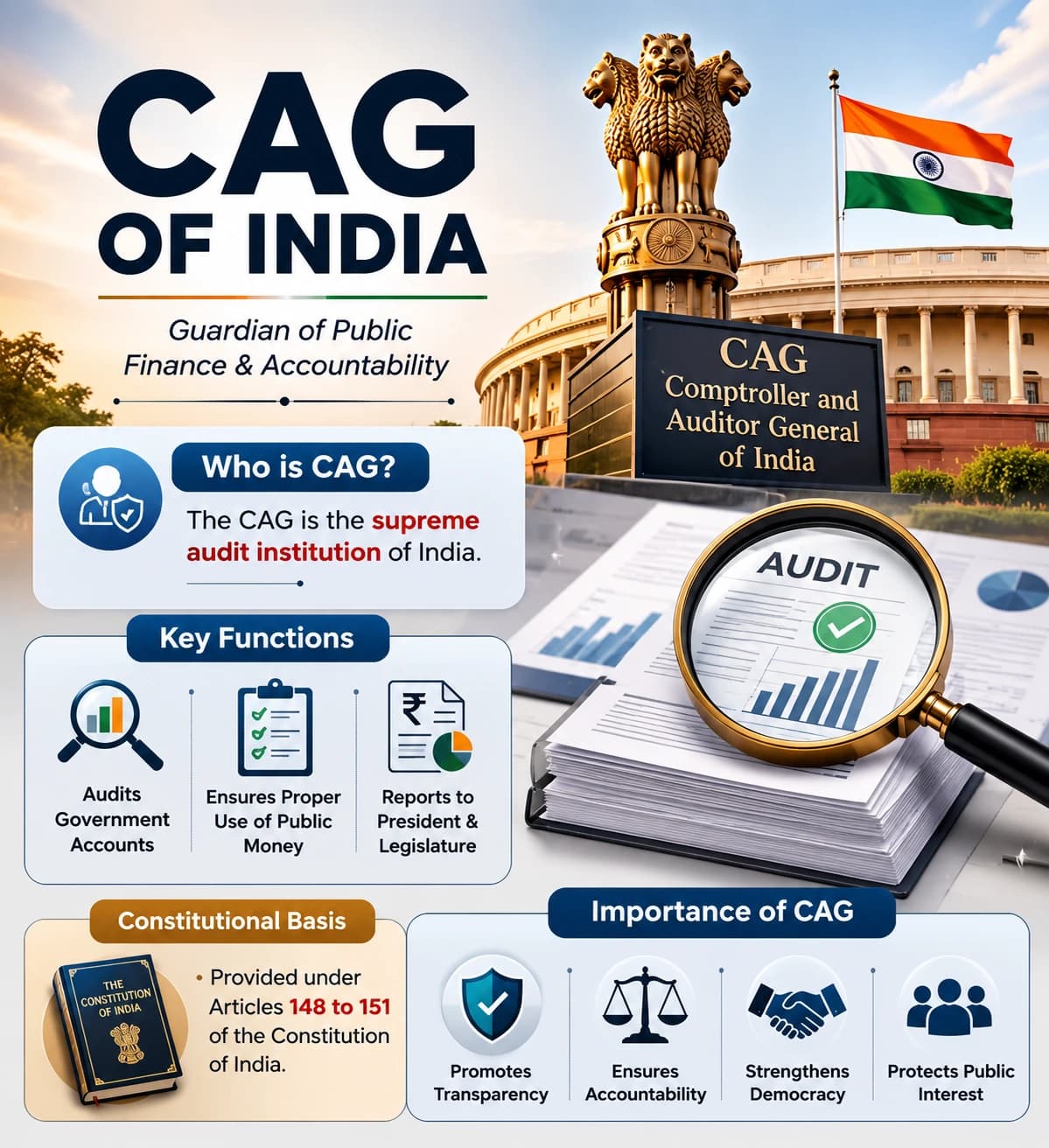
- Constitutional Bodies in India: A Complete UPSC Guide2026
- Functions and Powers of the Election Commission
The ECI’s functions can broadly be divided into administrative, advisory, and quasi-judicial categories.
1. Administrative Functions
Determining the territorial areas of electoral constituencies throughout the country, based on the Delimitation Commission’s recommendations.
Preparing and periodically revising electoral rolls and registering eligible voters.
Notifying the dates and schedules of elections and scrutinizing nomination papers.
Granting recognition to political parties and allotting election symbols to them.
Acting as a court to settle disputes relating to the recognition of political parties and allotment of election symbols.
2. Advisory Functions
Advising the President on matters relating to the disqualification of Members of Parliament.
Advising the Governor on matters relating to the disqualification of Members of State Legislatures.
Advising the President on whether elections can be held in a state under President’s Rule to extend the period beyond one year.
3. Quasi-Judicial Functions
The ECI settles disputes relating to the splitting of political parties and mergers of recognized political parties.
4. Regulatory Powers
Implementing the Model Code of Conduct (MCC) during elections, which comes into force from the date of announcement of elections and remains in effect till the process is completed. Although the MCC does not have direct statutory backing (it is not enforceable through courts), the ECI enforces compliance through its moral authority and administrative powers, such as issuing notices, censuring candidates and parties, and in extreme cases, countermanding an election.
Regulating the use of money and expenditure limits by candidates and parties, including monitoring election-related expenditure ceilings prescribed under the Conduct of Election Rules.
The Supreme Court, in Mohinder Singh Gill v. Chief Election Commissioner (1978), held that Article 324 vests a wide range of residuary powers in the Election Commission, enabling it to act in areas not explicitly covered by legislation, to ensure free and fair elections — this is often cited as recognizing ECI’s power as a “plenary” reservoir of authority to fill gaps left by the law.
Key Reforms and Contributions of the ECI
Over the decades, the Election Commission has taken several landmark steps to enhance the credibility and efficiency of Indian elections.
Introduction of Electronic Voting Machines (EVMs): First used experimentally in 1982 and progressively adopted nationwide, EVMs have significantly reduced instances of booth capturing and ballot tampering, although debates about their tamper-proof nature continue periodically.
Voter Verified Paper Audit Trail (VVPAT): Introduced to increase transparency by allowing voters to verify that their vote has been cast as intended, and enabling post-poll verification of a sample of EVMs against VVPAT slips.
Electoral Photo Identity Card (EPIC): Introduced in the 1990s to prevent impersonation and bogus voting.
National Voters’ Service Portal and Voter Helpline App: Digital initiatives to make voter registration, correction of details, and information dissemination easier and more accessible.
Systematic Voters’ Education and Electoral Participation (SVEEP): A flagship program aimed at voter education, spreading awareness, and encouraging greater voter turnout, especially among underrepresented groups such as urban voters, youth, and women.
Model Code of Conduct enforcement: Strengthened over the years through stricter monitoring of hate speech, paid news, and the use of religion or caste appeals during campaigning.
Linking Aadhaar with voter ID (proposed): Aimed at weeding out duplicate entries, though this raises privacy concerns that have been debated extensively.
One Nation, One Election: While not an ECI initiative per se, the Commission has been closely involved in the discourse around simultaneous elections to the Lok Sabha and State Assemblies, a proposal examined by a high-level committee in recent years, aimed at reducing the frequency of elections and associated costs and disruptions to governance.
Landmark Judicial Pronouncements Relevant to the ECI
For Mains answers, citing case law adds significant value. Some of the most important judgments include:
Mohinder Singh Gill v. Chief Election Commissioner (1978): Recognized the wide residuary powers of the ECI under Article 324 to act in situations not covered by existing law, in order to ensure the conduct of free and fair elections.
Indira Gandhi v. Raj Narain (1975): Though primarily about the validity of an individual election, this case is significant in shaping principles around free and fair elections as part of the basic structure doctrine.
Union of India v. Association for Democratic Reforms (2002): The Supreme Court held that voters have a fundamental right to know the antecedents of candidates, including their criminal records, financial assets, and educational qualifications, under the right to freedom of speech and expression (Article 19(1)(a)). This led to the mandatory disclosure of candidate affidavits.
People’s Union for Civil Liberties (PUCL) v. Union of India (2013): The Supreme Court directed the introduction of a “None of the Above” (NOTA) option on EVMs and ballot papers, recognizing the right of a voter to not vote for any candidate while still exercising their right to secrecy.
Anoop Baranwal v. Union of India (2023): As discussed above, this case reshaped the appointment process for the CEC and Election Commissioners.
Criticisms and Challenges Facing the ECI
No institution is beyond critique, and the ECI is no exception. UPSC often frames questions around the challenges to the Commission’s independence and effectiveness, so it is useful to understand these criticisms holistically.
Appointment Process: As discussed, critics argue that the amended appointment process (post the 2023 Act) tilts the balance heavily in favour of the executive, undermining true institutional independence.
Lack of Security of Tenure for Election Commissioners: Unlike the CEC, who can only be removed through impeachment, the other Election Commissioners can be removed on the recommendation of the CEC, creating an internal imbalance of protection.
No Separate Secretariat and Independent Budget: The Election Commission does not have its own independent secretarial staff or a separate consolidated fund charge for its expenses like the Union Public Service Commission, which some argue affects its financial and administrative autonomy.
Model Code of Conduct’s Lack of Statutory Backing: Since the MCC is not legally enforceable in a court of law, its implementation relies heavily on moral suasion and the political will of the party in power to respect the Commission’s authority. Critics have often pointed to selective or delayed action against violations by ruling party leaders as compared to opposition leaders.
Use of Money and Muscle Power: Despite expenditure ceilings, unaccounted money, use of electoral bonds (before their invalidation), and criminalization of politics remain persistent challenges that the Commission grapples with.
EVM-related Controversies: Periodic allegations by political parties regarding the tamperability of EVMs, though the Commission and multiple judicial and technical reviews have upheld their reliability, continue to be a subject of political and public debate.
Paid News and Misinformation: The rise of social media and digital campaigning has introduced new challenges around the spread of misinformation, deepfakes, and paid news, which existing regulatory frameworks are still catching up with.
Electoral Bonds Judgment: In February 2024, the Supreme Court struck down the Electoral Bonds Scheme as unconstitutional, holding it violative of the right to information of voters under Article 19(1)(a), since it allowed anonymous political funding that could not be scrutinized by the electorate. This judgment has significant implications for electoral funding transparency going forward and is closely linked to the broader discourse on free and fair elections that the ECI is entrusted to protect.
Recommendations for Reform
Several committees and expert bodies, including the Dinesh Goswami Committee (1990), the Indrajit Gupta Committee (1998), and the Second Administrative Reforms Commission, have recommended reforms to strengthen the ECI, some of which include:
State funding of elections to reduce dependence on private and often opaque sources of funding.
Giving statutory backing to the Model Code of Conduct so that violations can be met with legally enforceable consequences.
Providing the ECI with an independent secretariat, akin to the Lok Sabha and Rajya Sabha Secretariats.
Empowering the ECI to deregister political parties for persistent violations, an area where its current powers are limited.
Bringing greater transparency to political party funding, including a cap on cash donations and mandatory disclosure of all sources of income above a nominal threshold.
Providing equal protection of tenure to all Election Commissioners, similar to that enjoyed by the CEC.
Why This Topic Matters for UPSC
The Election Commission is a recurring theme across all three stages of the UPSC examination:
Prelims: Direct factual questions on constitutional articles, composition, tenure, appointment process, and landmark case laws are common.
Mains (GS-II): Questions often ask aspirants to critically analyze the independence of the ECI, evaluate recent reforms (such as the 2023 Act), or discuss its role in strengthening electoral democracy.
Essay Paper: Broader themes like “Free and Fair Elections: The Bedrock of Democracy” or “Reforming India’s Electoral System” often draw upon knowledge of the ECI’s functioning.
Ethics Paper (GS-IV): The conduct expected of constitutional functionaries, including the CEC, in maintaining impartiality despite political pressure, is a recurring ethical theme.
A well-rounded understanding of the ECI, therefore, is not just useful for a single question but forms a foundational pillar for your broader preparation on Indian polity and governance.
Conclusion
The Election Commission of India stands as one of the most vital pillars sustaining the edifice of Indian democracy. From conducting the first general elections in 1951-52 involving a largely illiterate electorate to successfully managing elections involving nearly a billion voters today using sophisticated technology, the ECI’s journey mirrors the maturing of Indian democracy itself. Yet, as recent controversies over the appointment process and ongoing debates around electoral funding reveal, the institution’s independence cannot be taken for granted — it must be continuously safeguarded through legislative reform, judicial oversight, and active civic vigilance.
For UPSC aspirants, mastering this topic requires moving beyond rote memorization of articles and provisions to developing a nuanced, critical understanding of how constitutional design interacts with political reality. As you prepare, keep track of ongoing developments — pending Supreme Court cases, new legislative amendments, and reports from expert committees — since this is a dynamic area of the syllabus where static knowledge alone will not suffice.
Remember: the strength of a democracy is only as good as the strength of the institutions that protect it. Understanding the Election Commission deeply is, in many ways, understanding the health of Indian democracy itself.
Good luck with your preparation!