Constitutional Bodies in India: A Complete UPSC Guide2026

Introduction
For any aspirant preparing for the UPSC Civil Services Examination, few topics carry as much weight — both in the Prelims and Mains — as Constitutional Bodies. These are institutions whose existence, composition, powers, and functions are directly provided for in the text of the Constitution of India. They form the backbone of India’s system of checks and balances, ensuring that democracy does not collapse into the unchecked exercise of power by the executive or the legislature.
Every year, the UPSC draws multiple questions from this theme — sometimes testing basic factual knowledge (appointment procedures, tenure, removal process), and sometimes testing analytical understanding (independence of these bodies, recent controversies, reform proposals). This blog aims to give you a one-stop, exam-oriented, yet conceptually rich understanding of Constitutional Bodies in India.
- By the end of this article, you will understand:
- What exactly makes a body “constitutional”
- How constitutional bodies differ from statutory and executive bodies
- A detailed body-by-body analysis of every major constitutional body
- Their composition, powers, functions, and independence safeguards
- Recent controversies and reform debates
- Previous Years’ Questions (PYQs) for practice
Let’s dive in.
What is a Constitutional Body?
A Constitutional Body is an authority or institution that is established directly by, or under, a provision of the Constitution of India. Because their existence flows from the Constitution itself, they enjoy a certain sanctity and independence — they cannot be abolished or fundamentally altered by an ordinary law of Parliament. Doing so would require a constitutional amendment under Article 368.
This is the single most important distinguishing feature that examiners love to test: constitutional bodies vs. statutory bodies vs. executive (non-statutory) bodies.
- Constitutional Bodies vs Statutory Bodies vs Executive Bodies
- Feature
- Constitutional Body
- Statutory Body
- Executive/Non-Statutory Body
- Origin
- Provisions of the Constitution
- An Act of Parliament/State Legislature
- Executive resolution/order
- Example
- Election Commission, UPSC, CAG
- National Human Rights Commission, CVC, CIC
- NITI Aayog, Planning Commission (erstwhile)
- Amendment needed to alter
- Constitutional Amendment (Article 368)
- Simple legislative amendment
- Executive order/resolution
- Degree of insulation from political control
- Highest
- High, but slightly lower
- Lowest
This table itself is exam gold — a Prelims question could easily ask you to classify NITI Aayog, NHRC, CVC, and UPSC correctly under one of these three heads. Remember:
NITI Aayog is neither constitutional nor statutory
— it is a mere executive resolution-based body, which is why it could be created (replacing the Planning Commission) without any constitutional amendment or parliamentary law.
List of Major Constitutional Bodies in India
The Constitution of India provides for a number of bodies. The major ones commonly asked about in UPSC are:
- Election Commission of India (ECI) — Article 324
- Union Public Service Commission (UPSC) — Article 315-323
- State Public Service Commission (SPSC) — Article 315-323
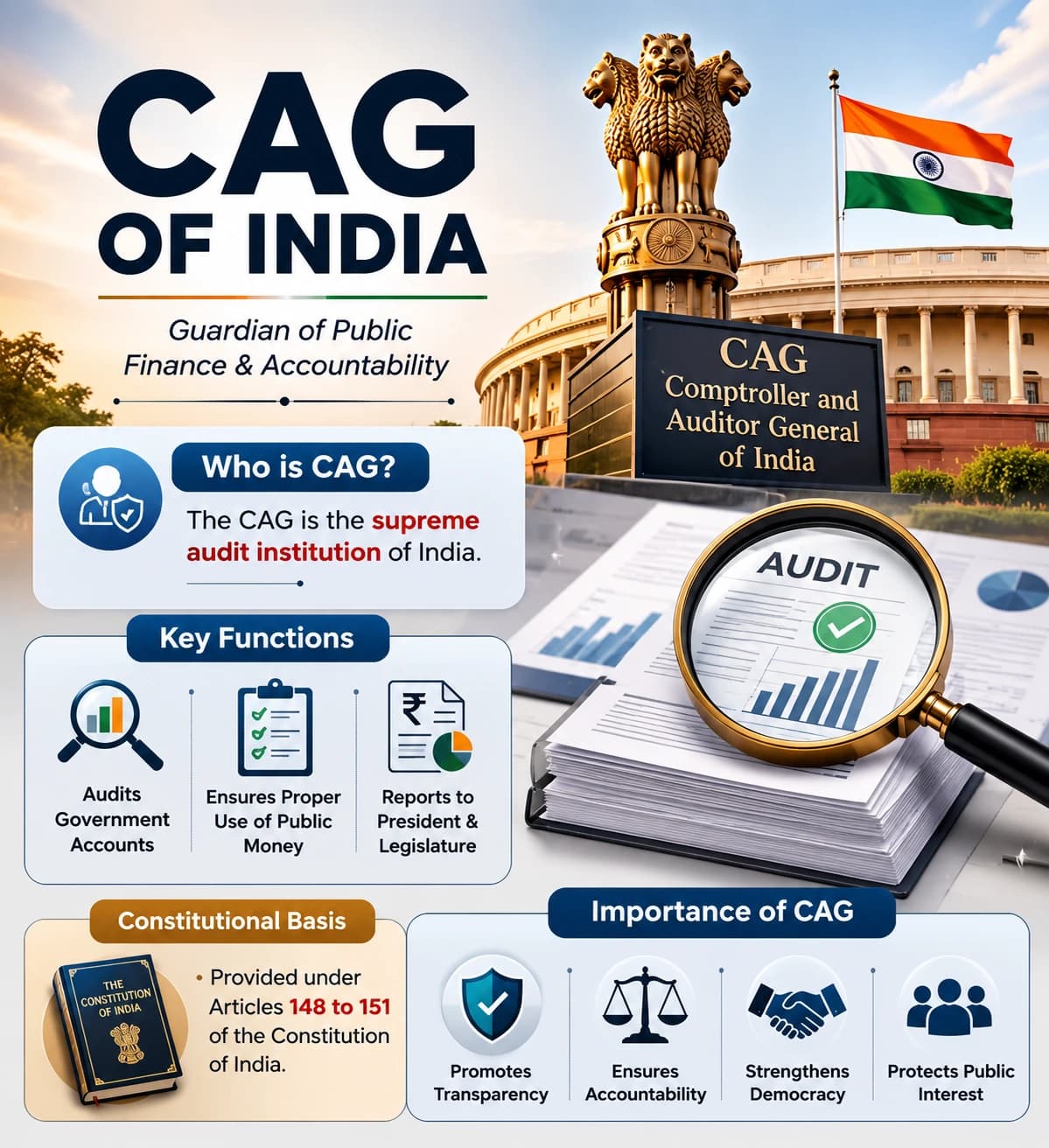
- Comptroller and Auditor General of India (CAG) — Article 148-151
- Finance Commission — Article 280
- Attorney General of India — Article 76
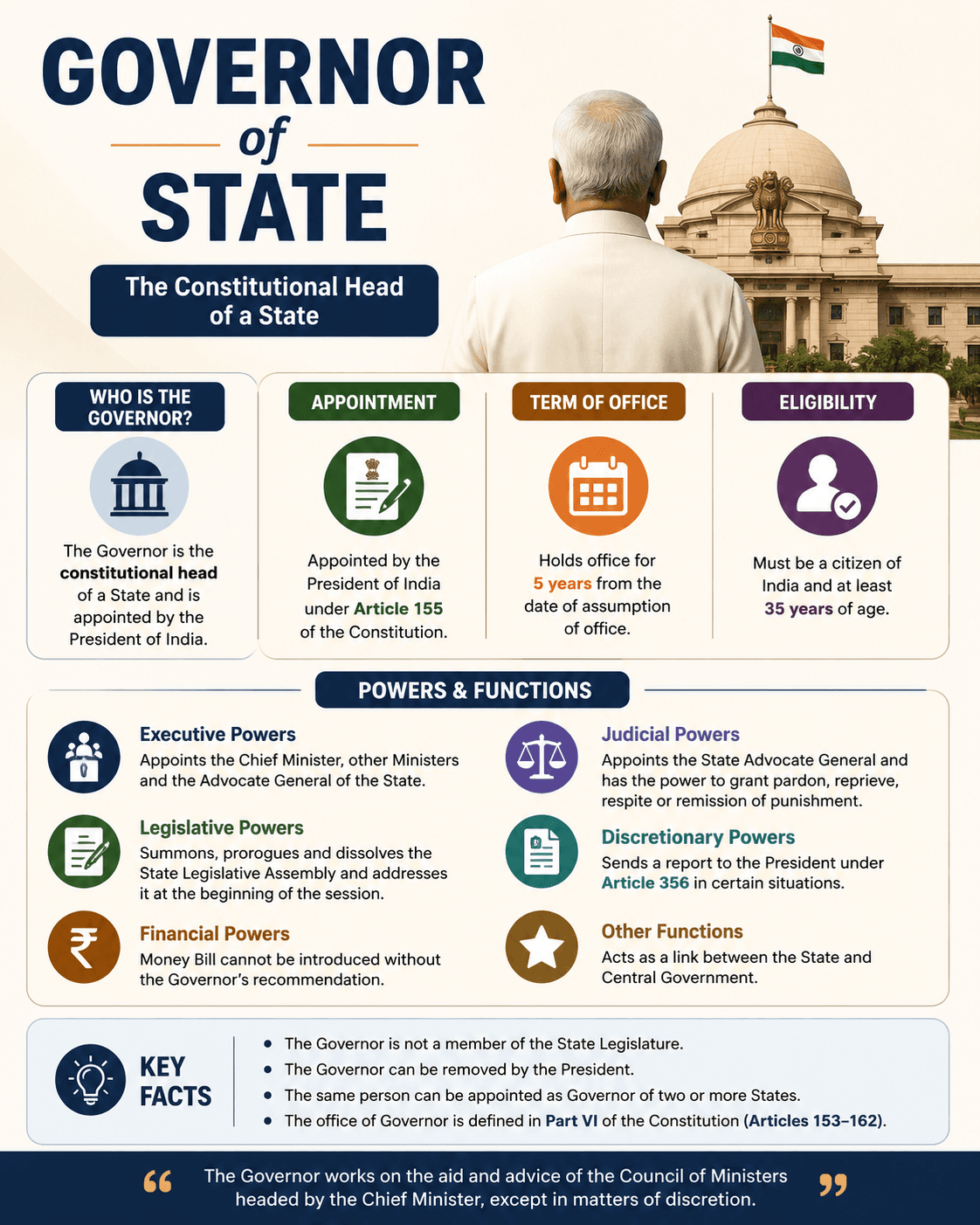
- Advocate General of the State — Article 165
- Special Officer for Linguistic Minorities — Article 350-B
- National Commission for Scheduled Castes (NCSC) — Article 338
National Commission for Scheduled Tribes (NCST) — Article 338-A National Commission for Backward Classes (NCBC) — Article 338-B
GST Council — Article 279-A Let’s examine each of these in detail.
- 1. Election Commission of India (ECI)
- Constitutional Basis:
Article 324 vests the ECI with the power of superintendence, direction, and control of elections to Parliament, State Legislatures, and the offices of President and Vice-President.
Composition:
The Commission consists of the Chief Election Commissioner (CEC) and such number of other Election Commissioners as the President may from time to time fix. Currently, it functions as a three-member body (CEC + 2 ECs), a practice that has generally continued since 1993.
Appointment:
Traditionally, the President appointed the CEC and ECs on the aid and advice of the Council of Ministers. However, a landmark development occurred with the Anoop Baranwal v. Union of India (2023)
Supreme Court judgment, which held that a committee comprising the Prime Minister, the Leader of the Opposition in the Lok Sabha, and the Chief Justice of India should recommend appointments, until Parliament enacts a law. Subsequently, Parliament passed the Chief Election Commissioner and other Election Commissioners (Appointment, Conditions of Service and Term of Office) Act, 2023, which replaced the CJI in the selection committee with a Union Cabinet Minister nominated by the PM — a change that has been criticized by opposition parties and constitutional experts as diluting the independence of the selection process, since it gives the ruling government a 2-1 majority in the committee.
Tenure and Removal:
The CEC and ECs hold office for six years or until they attain the age of 65 years, whichever is earlier. The CEC can be removed only through a process similar to the removal of a Supreme Court judge (impeachment-like process), giving the office high security of tenure. Other Election Commissioners, however, can be removed by the President on the recommendation of the CEC — a safeguard designed to prevent the executive from directly influencing them.
Functions:
Conducting free and fair elections to the Lok Sabha, Rajya Sabha, State Legislatures, and offices of President and Vice-President
- Preparation and revision of electoral rolls
- Recognition of political parties and allotment of symbols
- Enforcement of the Model Code of Conduct
Advising the President/Governor on questions of disqualification of members
- Recent Issues/Debates:
- Criticism over the appointment process post-2023 Act
- Demand for a collegium-based, more neutral appointment mechanism
Issues around Electoral Bonds (struck down by SC in 2024), EVM transparency, and one nation-one election debates (which involve ECI’s logistical role)
@Global Strategic Partnership
2. Union Public Service Commission (UPSC) and State Public Service Commissions (SPSC)
Constitutional Basis:
Articles 315 to 323 deal with Public Service Commissions for the Union and the States.
Composition:
The UPSC consists of a Chairman and other members appointed by the President. The Constitution does not fix the strength of the Commission, leaving it to the President’s discretion — in practice, the UPSC has a Chairman and 10 other members.
Appointment and Tenure:
Members are appointed by the President and hold office for six years or until they attain the age of 65 years (for UPSC) or 62 years (for SPSC), whichever is earlier.
Removal:
A UPSC/SPSC member can be removed by the President only on the ground of misbehaviour, and only after the Supreme Court, on reference made to it, has held an inquiry and reported that the member ought to be removed. This is a crucial safeguard of independence — similar in spirit to judicial removal proceedings.
Functions:
Conducting examinations for appointments to All India Services, Central Services, and public services of the Union
Advising the President on matters of recruitment, promotions, and disciplinary matters relating to civil servants
Advising on matters referred by the Governor of a state (with President’s approval) relating to joint recruitment
- Independence Safeguards:
- Security of tenure
- Removal process requiring Supreme Court inquiry
Expenses charged on the Consolidated Fund of India (not subject to vote in Parliament)
Chairman and members are ineligible for further government employment (with certain narrow exceptions) after retirement, to prevent post-retirement favour-seekingConstitutional body (India)
- 3. Comptroller and Auditor General of India (CAG)
- Constitutional Basis:
Articles 148 to 151.
Appointment:
Appointed by the President by warrant under his hand and seal.
Tenure:
Six years or until the age of 65 years, whichever is earlier.
Removal:
In the same manner as a judge of the Supreme Court — i.e., only on grounds of proven misbehaviour or incapacity, through a resolution passed by each House of Parliament with a special majority (Article 124(4)/Article 148(1)).
Role and Significance:
Dr. B.R. Ambedkar famously described the CAG as “the most important officer under the Constitution”, since the entire financial system rests on his integrity and independence.
Functions:
Audits the accounts related to all expenditure from the Consolidated Fund of India, Consolidated Fund of each state, and Consolidated Fund of each Union Territory having a Legislative Assembly
Audits the receipts and expenditure of bodies substantially financed from Central/State revenues
Submits audit reports relating to accounts of the Union to the President, who places them before Parliament (similarly for States, to the Governor)
Acts as a guide, friend, and philosopher of the Public Accounts Committee (PAC)
Recent Debates:
There have been long-standing demands (also echoed in Second Administrative Reforms Commission reports) for a collegium-based system of appointment for the CAG, similar to that used for the Election Commission, to ensure it does not appear to be an appointee purely of the executive it audits.
- 4. Finance Commission
- Constitutional Basis:
Article 280.
Composition:
Constituted by the President every five years or earlier, consisting of a Chairman and four other members.
Functions:
Recommending the distribution of the net proceeds of taxes between the Union and the States (vertical devolution)
Recommending the allocation of such proceeds among the States themselves (horizontal devolution)
Recommending principles governing grants-in-aid to the states out of the Consolidated Fund of India
Recommending measures needed to augment a state’s Consolidated Fund to supplement the resources of Panchayats and Municipalities (added via the 73rd and 74th Amendments)
Recent Context:
The 15th Finance Commission (Chairman: N.K. Singh) had to grapple with contentious issues such as the use of 2011 Census data (instead of 1971) for devolution — a matter of political sensitivity between southern and northern states — and the fiscal impact of the COVID-19 pandemic. The 16th Finance Commission, under Dr. Arvind Panagariya, is currently examining devolution formulas for the 2026-31 period, amid renewed federal tensions over the criteria used.
- 5. Attorney General of India (AGI)
- Constitutional Basis:
Article 76.
Appointment:
Appointed by the President; must be qualified to be a judge of the Supreme Court.
Tenure:
No fixed tenure is mentioned in the Constitution — holds office during the pleasure of the President.
Role:
He is the highest law officer of the country and gives advice to the Government of India on legal matters referred to him. He has the right to speak and take part in the proceedings of both Houses of Parliament (or any Joint Sitting) and any parliamentary committee of which he is named a member, but without a right to vote.
Distinction:
The AGI is not a member of the Union Cabinet, and unlike a full-time law officer, is permitted to engage in private legal practice (as long as it does not go against government interests), which itself is a debated feature of the office.
- 6. Advocate General of the State
- Constitutional Basis:
Article 165 — the state-level counterpart of the Attorney General.
Appointment:
By the Governor; must be qualified to be appointed as a High Court judge.
Role:
Chief law officer of the state, giving legal advice to the state government and performing legal duties assigned by the Governor.
- 7. Special Officer for Linguistic Minorities
- Constitutional Basis:
Article 350-B, inserted by the 7th Constitutional Amendment Act, 1956.
Appointment:
By the President.
Function:
Investigates all matters relating to safeguards provided for linguistic minorities under the Constitution and reports to the President, who causes such reports to be laid before Parliament and forwarded to concerned state governments.
This office is headquartered in Allahabad and, though less glamorous than others, is a favourite for Prelims-level factual questions.
8, 9, 10. National Commissions for SC, ST, and Backward Classes
These three commissions were carved out through subsequent constitutional amendments and deserve careful attention because of how their evolution reflects changing social justice priorities.
National Commission for Scheduled Castes (NCSC) — Article 338
Originally, Article 338 provided for a Special Officer for SCs/STs. The 65th Amendment Act, 1990 replaced this with a multi-member National Commission for SCs and STs. Subsequently, the 89th Amendment Act, 2003 bifurcated this single commission into two separate bodies:
- National Commission for Scheduled Castes (Article 338)
- National Commission for Scheduled Tribes (Article 338-A)
- Composition:
A Chairperson, Vice-Chairperson, and three other members, appointed by the President, with tenure and conditions of service also determined by the President.
Functions:
Investigating and monitoring matters relating to safeguards for SCs under the Constitution and other laws
Inquiring into specific complaints of deprivation of rights and safeguards
Participating in and advising on planning of the socio-economic development of SCs
Presenting annual reports to the President
National Commission for Scheduled Tribes (NCST) — Article 338-A Mirrors the NCSC in composition and function, but focused on Scheduled Tribes.
National Commission for Backward Classes (NCBC) — Article 338-B
Originally a statutory body created under the National Commission for Backward Classes Act, 1993, it was granted constitutional status through the 102nd Constitutional Amendment Act, 2018. This is a favourite recent-history question — testing whether students know that NCBC transitioned from a statutory to a constitutional body.
Composition:
A Chairperson, Vice-Chairperson, and three other members appointed by the President.
Note on the 102nd Amendment controversy:
The 102nd Amendment also introduced Articles 342-A, which some interpreted as taking away states’ power to notify their own backward classes lists. This led to significant litigation, culminating in the 105th Constitutional Amendment Act, 2021, which restored the power of states and union territories to prepare their own list of socially and educationally backward classes (SEBCs), clarifying that the central list under Article 342-A applies only for purposes of the Central Government.
- 11. GST Council — Article 279-A
- Constitutional Basis:
Inserted by the 101st Constitutional Amendment Act, 2016, which introduced the Goods and Services Tax regime in India.
- Composition:
- Union Finance Minister (Chairperson)
- Union Minister of State in charge of Revenue or Finance
Minister in charge of Finance/Taxation nominated by each state government
- Functions:
- Makes recommendations to the Union and States on:
- Taxes, cesses, and surcharges to be subsumed under GST
- Goods and services to be exempted
Model GST laws, threshold limits, GST rates, special provisions for special-category states
Landmark Judgment:
In Union of India v. Mohit Minerals (2022), the Supreme Court held that the recommendations of the GST Council are not binding on the Union and States — they only have persuasive value, reaffirming the cooperative and consultative (rather than purely directive) nature of Indian fiscal federalism. This is a critical point often tested in Mains answers on cooperative federalism.
Why Independence of Constitutional Bodies Matters
A recurring theme across all these bodies is the deliberate design of structural insulation from executive control. The Constitution-makers built in several common safeguards:
- Security of tenure
- — fixed terms that cannot be arbitrarily curtailed
- Difficult removal procedures
— often requiring judicial inquiry (UPSC) or a special parliamentary majority (CAG), rather than a simple executive order
Charged expenditure
— salaries and expenses charged on the Consolidated Fund, not subject to annual vote, insulating them from budgetary pressure
Post-retirement restrictions
— to reduce the temptation of currying favour with the government of the day in hopes of future appointments
These safeguards exist precisely because these bodies are meant to check the government — whether by conducting fair elections, recruiting civil servants meritocratically, auditing public expenditure, or protecting minority rights. Any erosion of these safeguards (such as changes to appointment processes) becomes a matter of serious constitutional debate, as seen in the ECI appointment controversy.
Common Prelims Traps to Watch Out For NITI Aayog is NOT a constitutional or statutory body — it’s an executive body (a common trap).
CVC and CIC are statutory, NOT constitutional bodies
— created by Acts of Parliament (CVC Act, 2003; RTI Act, 2005), not by constitutional provisions directly.
NHRC (National Human Rights Commission) is statutory, established under the Protection of Human Rights Act, 1993 — not constitutional.
NCBC became constitutional only in 2018
— before that, it was statutory.
State Election Commission (for local bodies) — Article 243-K and 243-ZA — is a separate constitutional body from the Election Commission of India, dealing specifically with Panchayat and Municipality elections. Do not confuse the two!
Removal of CAG and Election Commissioners requires the same procedure as removal of a Supreme Court Judge — a frequently confused point with UPSC members, who are removed via a different (though also SC-involved) process.
- Sample Previous Year Questions (PYQs) for Practice
- (Prelims, 2021)
“Rule of Law” is considered a basic feature of the Constitution… (test related conceptual overlaps with independence of institutions)
(Prelims)
Consider the following: 1. Election Commission of India 2. Union Public Service Commission 3. Finance Commission — Which of the above are constitutional bodies?
(Mains, GS-II)
Discuss the role of the Finance Commission in Centre-State fiscal relations. Has its scope evolved after the recommendations of the 14th and 15th Finance Commissions?
(Mains, GS-II)
“The Comptroller and Auditor General (CAG) has a very vital role to play.” Explain how this is reflected in the method and terms of his appointment, as well as the range of powers he can exercise.
(Mains, GS-II)
Discuss the role of the Election Commission of India in the light of the evolution of the Model Code of Conduct.
Conclusion
Constitutional Bodies represent India’s founding vision of a state where power is distributed, checked, and balanced — never concentrated. From the Election Commission safeguarding the sanctity of the ballot, to the CAG guarding the public purse, to the UPSC ensuring meritocracy in civil services, to the GST Council embodying cooperative federalism — these institutions collectively keep the machinery of Indian democracy honest and accountable.
For UPSC aspirants, mastering this topic is not just about memorizing articles and tenures — although that is essential for Prelims — but about internalizing why these bodies were given constitutional status and independence in the first place. When you understand the underlying philosophy of institutional insulation from executive whims, you’ll find that even the trickiest Mains questions on institutional reform, federalism, or accountability become far easier to answer with nuance and confidence.
Keep revising this topic alongside current affairs — appointment controversies, pending reforms, and recent Supreme Court judgments are exactly where UPSC likes to test your ability to connect the static portion of the syllabus with dynamic, real-world developments.
All the best for your preparation!