Fundamental Rights: A Complete UPSC Guide with Landmark Case Laws 2026
Introduction
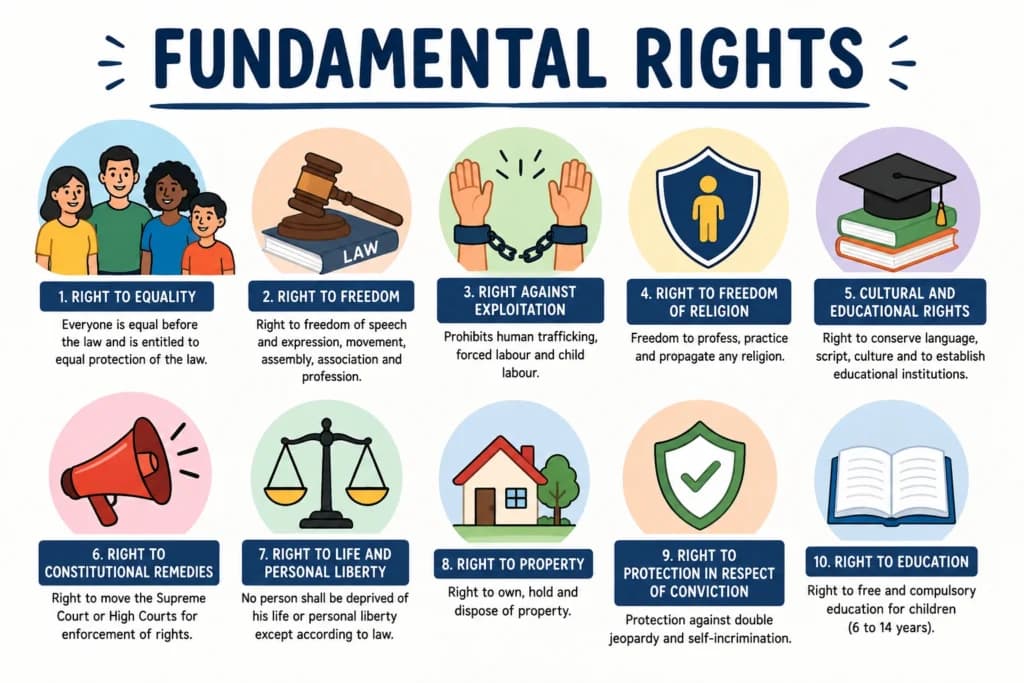
Part III of the Indian Constitution (Articles 12–35) is often called the “Magna Carta of India.”
It guarantees Fundamental Rights (FRs) that are justiciable — meaning citizens can directly approach the Supreme Court (Article 32) or High Courts (Article 226) if these rights are violated. For UPSC Prelims and Mains (GS Paper II), this is one of the highest-yield topics, and questions frequently test the interplay between Articles and case law. This blog covers every FR article along with the landmark judgments that shaped its interpretation.
Article 12: Definition of “State”
Article 12 defines “State” to include the Government and Parliament of India, State governments and legislatures, and all local or other authorities within India or under the control of the Government of India.
- Key Case:
- Rajasthan Electricity Board v. Mohan Lal (1967)
– Held that “other authorities” includes bodies created under statute, even if not exercising sovereign functions.
Ajay Hasia v. Khalid Mujib (1981)
– Laid down the “instrumentality or agency of the State” test: if a body is financially, functionally, and administratively controlled by the government, it qualifies as “State” under Article 12.
Pradeep Kumar Biswas v. Indian Institute of Chemical Biology (2002)
– Refined the Ajay Hasia test, holding that deep and pervasive control by government is the real test, not just the source of funding.
Article 13: Laws Inconsistent with Fundamental Rights
Article 13 declares that any law inconsistent with FRs is void to the extent of such inconsistency. This gave rise to the doctrine of judicial review.
- Key Case:
- Shankari Prasad v. Union of India (1951)
– Held that Parliament’s power to amend the Constitution under Article 368 includes the power to amend Fundamental Rights, and a Constitutional Amendment is not “law” under Article 13.
Golaknath v. State of Punjab (1967)
– Reversed this position; held that Fundamental Rights are “transcendental” and Parliament cannot amend Part III. This led to the 24th Constitutional Amendment (1971), which restored Parliament’s amending power.
Article 14: Right to Equality
Guarantees “equality before law” and “equal protection of laws.” It permits reasonable classification but prohibits class legislation.Fundamental Rights:
- Key Cases:
- State of West Bengal v. Anwar Ali Sarkar (1952)
– Struck down a special courts law for lacking a rational basis for classification, establishing the twin test: intelligible differentia + rational nexus with the object.
E.P. Royappa v. State of Tamil Nadu (1974)
– Justice Bhagwati introduced the “new dimension” of Article 14: equality is antithetic to arbitrariness; arbitrariness in State action violates Article 14.
Maneka Gandhi v. Union of India (1978)
– Linked Article 14 with Article 21, holding that any procedure affecting life and liberty must be fair, just, and reasonable — not arbitrary.
Shayara Bano v. Union of India (2017)
– Struck down instant Triple Talaq as arbitrary and violative of Article 14.
Article 15: Prohibition of Discrimination
Prohibits discrimination on grounds of religion, race, caste, sex, or place of birth, while allowing affirmative action (special provisions) for women, children, SC/ST, and OBCs.
- Key Cases:
- State of Madras v. Champakam Dorairajan (1951)
– Struck down caste-based reservation in college admissions as violative of Article 15(1); led to the First Constitutional Amendment, inserting Article 15(4).
Indra Sawhney v. Union of India (1992)
(“Mandal Case”) – Upheld 27% OBC reservation, introduced the concept of “creamy layer” exclusion, and capped total reservation at 50% (with exceptions).
Navtej Singh Johar v. Union of India (2018)
– While primarily an Article 21 case, it also read “sex” in Article 15 to include sexual orientation, decriminalizing consensual homosexual acts by striking down parts of Section 377 IPC.
Article 16: Equality of Opportunity in Public Employment
Guarantees equality of opportunity in matters of public employment, subject to reservation provisions for backward classes.
- Key Cases:
- M. Nagaraj v. Union of India (2006)
– Upheld reservation in promotions (Article 16(4A)) but required the State to collect quantifiable data on backwardness, inadequacy of representation, and administrative efficiency before granting such reservation.
Jarnail Singh v. Lachhmi Narain Gupta (2018)
– Removed the requirement of collecting quantifiable data specifically on “backwardness” for SC/STs (since they are already recognized as backward), while retaining the need for adequate representation data.
Janhit Abhiyan v. Union of India (2022)
– Upheld the 103rd Amendment providing 10% EWS (Economically Weaker Sections) reservation, holding that economic criteria alone can be a valid basis for reservation and that this does not violate the basic structure.
Article 17: Abolition of Untouchability
Abolishes “untouchability” in any form and forbids its practice, made punishable under the Protection of Civil Rights Act, 1955.
- Key Case:
- State of Karnataka v. Appa Balu Ingale (1993)
– Supreme Court gave a wide interpretation to “untouchability,” covering all forms of social discrimination arising from caste-based practices.
Article 18: Abolition of Titles
Prohibits the State from conferring titles (except military/academic distinctions) and prohibits citizens from accepting titles from foreign states.
- Key Case:
- Balaji Raghavan v. Union of India (1996)
– Upheld the constitutional validity of National Awards (Bharat Ratna, Padma awards), holding they are not “titles” under Article 18 as long as they are not used as suffixes/prefixes.
Article 19: Right to Freedom (Six Freedoms)
Guarantees freedom of speech and expression, assembly, association, movement, residence, and profession — all subject to “reasonable restrictions.”
- Key Cases:
- Romesh Thappar v. State of Madras (1950)
– Held that freedom of speech includes freedom of the press and freedom of circulation.
Kedar Nath Singh v. State of Bihar (1962)
– Upheld the constitutionality of Section 124A IPC (sedition) but narrowed its scope to acts involving incitement to violence or public disorder.
Maneka Gandhi v. Union of India (1978)
– Held that the right to travel abroad falls under Article 21, and any restriction on Article 19 rights must satisfy the test of reasonableness.
Shreya Singhal v. Union of India (2015)
– Struck down Section 66A of the IT Act, 2000, as unconstitutional for being vague and having a “chilling effect” on free speech.
Indibly Creative Pvt. Ltd. v. State of West Bengal (2019) and S. Rangarajan v. P. Jagjivan Ram (1989) — Reinforced that freedom of speech cannot be curtailed merely due to threat of public disorder from hostile audiences (“heckler’s veto”).
Anuradha Bhasin v. Union of India (2020)
– Held that the right to access the internet is part of the freedom of speech and expression under Article 19(1)(a) and freedom to carry on trade/business under 19(1)(g).
Article 20: Protection in Respect of Conviction for Offences
Provides protection against ex-post-facto laws, double jeopardy, and self-incrimination.
- Key Cases:
- Kalawati v. State of Himachal Pradesh (1953)
– Clarified that protection against double jeopardy applies only when there has been a prior prosecution and punishment for the same offence.
Selvi v. State of Karnataka (2010)
– Held that involuntary administration of narco-analysis, polygraph, and BEAP tests violates Article 20(3) (protection against self-incrimination) and Article 21.
Article 21: Right to Life and Personal Liberty
The most dynamically interpreted Article — “No person shall be deprived of his life or personal liberty except according to procedure established by law.”
- Key Cases (the backbone of UPSC FR questions):
- A.K. Gopalan v. State of Madras (1950)
– Initially gave a narrow interpretation; held “procedure established by law” only requires that a valid law be enacted, regardless of fairness.
Maneka Gandhi v. Union of India (1978)
– The turning point. Held that “procedure established by law” must be fair, just, and reasonable, effectively importing the American “due process” standard and establishing the golden triangle of Articles 14, 19, and 21.
Francis Coralie Mullin v. Union Territory of Delhi (1981)
– Expanded Article 21 to include the right to live with human dignity.
Olga Tellis v. Bombay Municipal Corporation (1985)
– Held that the right to livelihood is an integral part of the right to life.
M.C. Mehta v. Union of India (multiple cases, 1986 onwards)
– Read the right to a clean and healthy environment into Article 21.
Bandhua Mukti Morcha v. Union of India (1984)
– Held that the right to live with dignity includes protection against bonded labour and exploitation.
Vishaka v. State of Rajasthan (1997)
– Laid down guidelines against sexual harassment at the workplace, reading them into Articles 14, 19, and 21, in the absence of specific legislation (later codified as the POSH Act, 2013).
K.S. Puttaswamy v. Union of India (2017)
– Landmark 9-judge bench ruling declaring the Right to Privacy as a fundamental right intrinsic to Article 21.
Common Cause v. Union of India (2018)
– Recognized the right to die with dignity and legalized passive euthanasia along with “living wills.”
Navtej Singh Johar v. Union of India (2018)
– Decriminalized consensual homosexual acts between adults, reading dignity, autonomy, and privacy into Article 21.
Joseph Shine v. Union of India (2018)
– Struck down Section 497 IPC (adultery) as unconstitutional, holding it violated the dignity and autonomy of women.
Hussainara Khatoon v. State of Bihar (1979)
– Established the right to speedy trial as part of Article 21.
Parmanand Katara v. Union of India (1989)
– Held that every doctor has a duty to provide emergency medical aid, and this is part of the right to life.
Article 21A: Right to Education
Inserted by the 86th Constitutional Amendment (2002), guarantees free and compulsory education to children aged 6–14 years, later given effect through the Right to Education Act, 2009.
Key Case:
Society for Unaided Private Schools of Rajasthan v. Union of India (2012) — Upheld the constitutional validity of the RTE Act’s 25% reservation for economically weaker sections in private unaided schools.
Article 22: Protection Against Arrest and Detention
Provides safeguards against arbitrary arrest (informed of grounds, right to legal counsel, production before a magistrate within 24 hours) but permits preventive detention laws with separate safeguards.
- Key Cases:
- D.K. Basu v. State of West Bengal (1997)
– Laid down detailed guidelines for arrest and detention to prevent custodial violence, later incorporated into the CrPC.
A.K. Roy v. Union of India (1982)
– Upheld the constitutional validity of the National Security Act, 1980, but read in certain due-process safeguards for preventive detention.
- Welcome to UPSC | UPSC
- Articles 23–24: Right Against Exploitation
Article 23 prohibits human trafficking, begar (forced labour), and similar forms of forced labour; Article 24 prohibits employment of children below 14 years in hazardous occupations.
- Key Cases:
- People’s Union for Democratic Rights v. Union of India (1982)
– Held that paying wages below the minimum wage amounts to “forced labour” under Article 23.
M.C. Mehta v. State of Tamil Nadu (1996)
– Directed the elimination of child labour in hazardous industries and set up a welfare fund for rehabilitated children.
Articles 25–28: Right to Freedom of Religion
Guarantees freedom of conscience and free profession, practice, and propagation of religion (Art. 25); freedom to manage religious affairs (Art. 26); freedom from taxation for promotion of a religion (Art. 27); and freedom from religious instruction in State-funded educational institutions (Art. 28).
Key Cases:
Commissioner, Hindu Religious Endowments v. Sri Lakshmindra Thirtha Swamiar (1954) — Introduced the “essential religious practices” test — only practices essential and integral to a religion are protected under Article 25.
S.R. Bommai v. Union of India (1994)
– Held secularism to be part of the “basic structure” of the Constitution.
Sabarimala Case – Indian Young Lawyers Association v. State of Kerala (2018) — Held that the exclusion of women (aged 10–50) from the Sabarimala temple violated Articles 14, 15, and 25; the matter is now pending review before a larger 9-judge bench.
Shayara Bano v. Union of India (2017)
– Held instant Triple Talaq (talaq-e-biddat) unconstitutional, not being an essential religious practice.
- Surha Taal: India’s 100th Ramsar Site
- Articles 29–30: Cultural and Educational Rights
Article 29 protects the right of any section of citizens to conserve their distinct language, script, or culture. Article 30 grants minorities the right to establish and administer educational institutions of their choice.
- Key Cases:
- T.M.A. Pai Foundation v. State of Karnataka (2002)
– Upheld the right of minority institutions to administer their own affairs, including admissions and fee structures, subject to reasonable regulation.
P.A. Inamdar v. State of Maharashtra (2005)
– Held that the State cannot impose its reservation policy on unaided minority and non-minority educational institutions.
Articles 31A, 31B, 31C: Savings Clauses
These provisions save certain laws (land reform laws, Ninth Schedule laws, and laws giving effect to Directive Principles under Articles 39(b)/(c)) from being challenged as violative of Articles 14, 19, and (in some cases) 31.
- Key Cases:
- I.R. Coelho v. State of Tamil Nadu (2007)
- – Held that laws placed in the Ninth Schedule after
- 24 April 1973
(the date of the Kesavananda Bharati judgment) are open to judicial review if they violate the basic structure of the Constitution or FRs under Articles 14, 19, and 21.
Article 32: Right to Constitutional Remedies
Called the “heart and soul” of the Constitution by Dr. B.R. Ambedkar, it empowers citizens to move the Supreme Court directly for enforcement of Fundamental Rights, through five writs:
Habeas Corpus, Mandamus, Prohibition, Certiorari, and Quo Warranto.
- Key Cases:
- Kesavananda Bharati v. State of Kerala (1973)
– The most important case in Indian constitutional history. A 13-judge bench held that Parliament can amend any part of the Constitution, including Fundamental Rights, but cannot alter its “basic structure.”
Minerva Mills v. Union of India (1980)
– Struck down parts of the 42nd Amendment, holding that the harmonious balance between Fundamental Rights (Part III) and Directive Principles (Part IV) is itself part of the basic structure.
Waman Rao v. Union of India (1981)
– Reaffirmed and applied the “basic structure” doctrine with the 24 April 1973 cut-off date for Ninth Schedule laws.
S.P. Gupta v. Union of India (1981)
(“Judges Transfer Case”) – Expanded the concept of locus standi, laying the foundation for Public Interest Litigation (PIL) as a tool to enforce FRs for those unable to approach courts themselves.
Bandhua Mukti Morcha v. Union of India (1984)
– Further broadened PIL jurisdiction under Article 32, allowing even a letter to the Court to be treated as a writ petition.
Article 33, 34 & 35: Restrictions and Uniformity
Article 33 empowers Parliament to restrict or modify FRs as applicable to armed forces, police, and similar forces to ensure discipline.
Article 34 permits restriction of FRs while martial law is in force in any area.
Article 35 vests exclusive power in Parliament (not State legislatures) to make laws giving effect to certain Fundamental Rights (e.g., Articles 16(3), 32(3), 33, and 34).
- Doctrines to Remember (High-Yield for Prelims)
- Doctrine
- Case
- Principle
- Doctrine of Basic Structure
- Kesavananda Bharati (1973)
- Parliament cannot destroy the Constitution’s basic features
- Doctrine of Eclipse
- Bhikaji Narain Dhakras v. State of MP (1955)
- Pre-constitutional laws inconsistent with FRs become dormant, not dead
- Doctrine of Severability
- A.K. Gopalan v. State of Madras (1950)
- Only the invalid part of a law is struck down, if separable
- Doctrine of Waiver
- Basheshar Nath v. CIT (1959)
- FRs cannot be waived, as they exist for public good
- Golden Triangle
- Maneka Gandhi (1978)
- Articles 14, 19, and 21 must be read together
- Essential Religious Practices Test
- Shirur Mutt Case (1954)
- Only essential practices get Article 25/26 protection
- UPSC Exam Tips
- Prelims:
Focus on matching Articles with correct case names and the year of the judgment — a common statement-based question format.
- Mains (GS-II):
- Always link FRs with Directive Principles of State Policy (DPSP)
— questions often ask about the “harmonious construction” between Part III and Part IV, especially using Minerva Mills.
Answer writing:
Structure your answer as Constitutional Provision → Judicial Interpretation → Contemporary Relevance to maximize value addition.
Current Affairs Link:
Track ongoing cases like the Sabarimala review (9-judge bench) and Uniform Civil Code debates, as these frequently connect to Articles 25, 26, and 44.
Conclusion
Fundamental Rights are not static text — they are a living framework shaped continuously by judicial interpretation. From the narrow reading in A.K. Gopalan to the transformative approach in Maneka Gandhi and Puttaswamy, the judiciary has progressively expanded the scope of Part III to meet the needs of a changing society. For UPSC aspirants, mastering the interplay between constitutional text and landmark case law is essential — not just for Prelims MCQs, but for writing nuanced, example-backed Mains answers.
This blog is intended for educational and exam-preparation purposes. Aspirants are advised to cross-verify case details with the bare Constitution text and standard reference books (M. Laxmikanth, Granville Austin) before final revision.