India-Japan Strategic Partnership: A Comprehensive Analysis for UPSC Aspirants 2027
Introduction
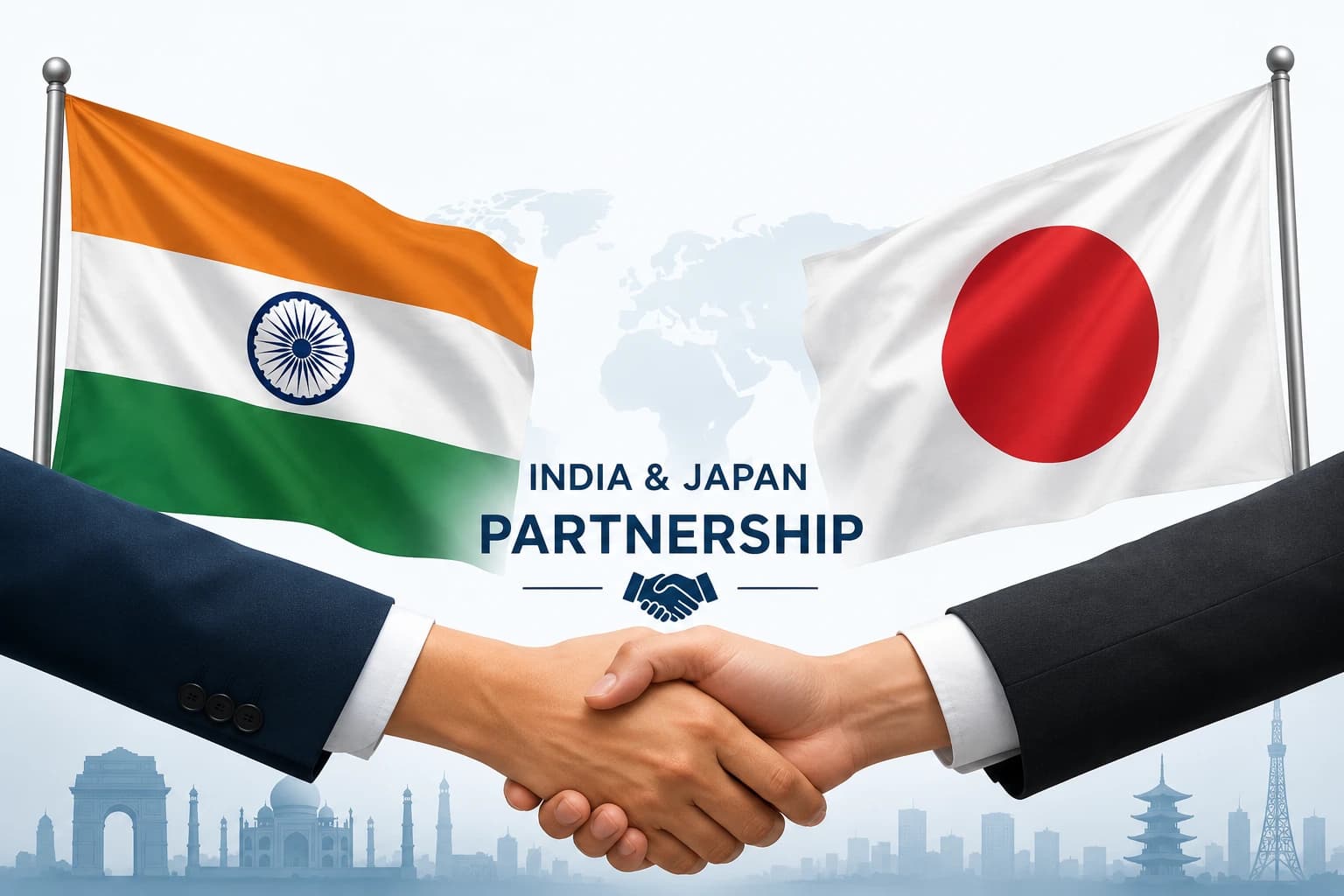
Among India’s bilateral relationships in the 21st century, few have grown as steadily, substantively, and strategically as the one with Japan. What began in the post-war decades as a modest engagement rooted in development assistance has today matured into a “Special Strategic and Global Partnership” — a term the two countries formally adopted in 2014. From co-developing naval equipment to jointly building bullet trains, from anchoring the Quad to shaping the Indo-Pacific discourse, India and Japan have built one of Asia’s most consequential relationships.
India-Japan Strategic Partnership: learn here
For UPSC aspirants, this topic sits at the intersection of International Relations, Indian Foreign Policy, Economic Diplomacy, and Security Studies — making it a recurring favourite in both Prelims and Mains (GS Paper II and III). This article offers an in-depth, exam-oriented examination of the historical evolution, pillars, achievements, challenges, and future trajectory of the India-Japan relationship.
- Historical Background
- Early Foundations
India and Japan established diplomatic relations in 1952, through the Treaty of Peace, making India one of the first countries to sign a peace treaty with Japan after the Second World War. Notably, India had declined to attend the San Francisco Peace Conference of 1951, choosing instead to negotiate a separate, more generous treaty — a gesture that left a lasting positive impression in Japan. Further back, the historical and civilizational connect between the two nations, transmitted largely through Buddhism, gave the relationship deep cultural roots that both sides have consistently invoked as a foundation for modern ties.
Cold War Distance
Despite this promising start, the relationship remained relatively subdued through the Cold War decades. India’s non-alignment and closeness to the Soviet Union, combined with Japan’s tight security alliance with the United States, meant the two countries occupied different strategic universes. Economic engagement existed but was modest, largely confined to Japanese Official Development Assistance (ODA) and some trade.
Post-Cold War Thaw and the 1998 Setback
The end of the Cold War and India’s 1991 economic liberalization opened new possibilities. However, India’s nuclear tests in Pokhran-II (1998) caused a serious, if temporary, setback — Japan suspended aid and strongly protested. This period is a useful example for aspirants of how strategic and normative concerns can disrupt even historically warm relationships.
Recovery and Acceleration (2000 onward)
Ties were normalized by the early 2000s, and the relationship entered a period of sustained upgrades:
2000: “Global Partnership” established.
2006: “Strategic and Global Partnership” — the first mention of “strategic” in the relationship’s vocabulary.
2014: Upgraded to “Special Strategic and Global Partnership” during PM Modi’s visit to Japan, reflecting deepening convergence on economic and security matters.
This steady progression — Global to Strategic to Special Strategic — is itself a useful timeline for Prelims-style questions.
Institutional Architecture of the Relationship
A hallmark of the India-Japan relationship is its dense institutional scaffolding, which ensures continuity regardless of changes in government on either side.
1. Annual Summit Mechanism
Since 2006, India and Japan have held an Annual Summit, alternating between New Delhi and Tokyo — a rare privilege Japan extends to very few countries. This mechanism has weathered leadership transitions on both sides (from Manmohan Singh to Modi in India, and from Koizumi through Abe, Suga, Kishida, Ishiba, to the current Japanese leadership) without interruption, reflecting the institutionalized, non-personalized character of the partnership. The most recent Annual Summit was held in Tokyo in 2025, and the two sides are working towards the next summit as they approach the 75th anniversary of diplomatic relations in 2027.
2. 2+2 Ministerial Dialogue
India and Japan hold a “2+2” Foreign and Defence Ministerial Dialogue, a format India maintains with only a handful of countries (the US, Australia, Russia, and Japan). This underscores the security depth of the relationship. The 2024 round of this dialogue in New Delhi led to the launch of a dedicated
Dialogue on Economic Security, reflecting how traditional defense diplomacy is now merging with economic security concerns.
3. National Security Advisor-level and Foreign Office Consultations
Regular NSA-level dialogues and Foreign Office Consultations supplement the ministerial mechanisms, ensuring continuous coordination on regional security, counter-terrorism, and multilateral issues.
4. Business and Economic Mechanisms
The India-Japan Business Leaders Forum, CEPA Joint Committee, and sector-specific working groups on critical minerals, semiconductors, and AI provide the economic ballast to the relationship.
- Pillars of the India-Japan Partnership
- Pillar 1: Economic and Trade Cooperation
Trade and investment remain, in the words of recent joint statements, the “backbone” of the relationship.
CEPA (Comprehensive Economic Partnership Agreement): In force since
August 2011, CEPA covers trade in goods and services, movement of natural persons, investment, intellectual property, and customs cooperation. It led to tariff reductions on roughly 94% of traded items between the two countries by 2021. The CEPA Joint Committee continues to meet regularly — the 7th round was held in March 2026 — to review and expand its scope.
Bilateral Trade: Trade between India and Japan crossed
$27 billion in 2025-26, a figure that, while significant, both sides acknowledge remains below potential given the size of the two economies.
Japanese Investment: Japan is India’s fifth-largest source of FDI, with cumulative investment of $48.17 billion between April 2000 and March 2026. Japanese companies such as Suzuki (Maruti Suzuki), Toyota, Sony, Honda, and Panasonic have had a transformative presence in Indian manufacturing, particularly the automobile sector.
India-Japan Industrial Competitiveness Partnership (IJICP) and the “Japan Plus” facilitation mechanism have been created to smoothen the entry and expansion of Japanese businesses in India.
Yen Loans and ODA: Japan remains India’s largest bilateral development partner through concessional yen loans, which have funded landmark infrastructure projects.
Pillar 2: Infrastructure and Connectivity
Japanese assistance has been central to some of India’s most iconic infrastructure projects:
Mumbai-Ahmedabad High Speed Rail (Bullet Train): India’s first high-speed rail corridor, based on Japan’s Shinkansen technology, funded substantially through concessional Japanese loans.
Delhi Metro: One of the most successful examples of Japanese ODA-backed infrastructure, often cited as a model of project execution.
Eastern Dedicated Freight Corridor (DFC): A transformative rail freight project supported by Japanese financing.
North-East Region connectivity projects: Japan has emerged as a key partner in developing infrastructure in India’s strategically sensitive North-East, including road connectivity and the India-Japan Act East Forum, which coordinates development cooperation in the region — a subtle but important signal given the region’s proximity to China.
Pillar 3: Defence and Security Cooperation
Defence cooperation has grown from a near-blank slate to a substantive pillar in under two decades.
Malabar Exercise: Japan became a permanent participant in the India-US
Malabar naval exercise from 2015, transforming a bilateral exercise into a trilateral (and now effectively Quad-adjacent) engagement.
Dharma Guardian and Shinyuu Maitri: Bilateral army and air force exercises respectively, reflecting expanding tri-service engagement.
Acquisition and Cross-Servicing Agreement (ACSA): Signed in 2020, allowing reciprocal provision of supplies and services between the armed forces.
UNICORN Mast Co-development: In November 2024, India and Japan signed a Memorandum of Implementation for the joint development of UNICORN (Unified Complex Radio Antenna) masts for the Indian Navy — marking the first-ever co-development of defence equipment between the two countries, a significant milestone given Japan’s historically cautious approach to defence exports.
Joint Declaration on Security Cooperation (2025): Adopted during the Annual Summit to deepen defence and security cooperation in response to evolving regional challenges.
Army Staff Talks: Regular institutional talks — the 8th round was held in Tokyo in April 2026 — sustain military-to-military engagement.
Pillar 4: Technology, Semiconductors, and Economic Security
This is the fastest-growing dimension of the relationship, reflecting a global shift toward “friend-shoring” and technology alliances amid supply chain vulnerabilities exposed by the pandemic and geopolitical tensions.
Economic Security Dialogue: Launched following the 2024 2+2 Ministerial, this dialogue identifies five priority sectors for strategic collaboration — telecommunications, clean energy, critical minerals, pharmaceuticals, and semiconductors. The second round of this dialogue was held in May 2026.
Critical Minerals Cooperation: A Memorandum of Cooperation on Mineral Resources was signed in 2025 to strengthen supply chain resilience through joint investment in exploration, mining, and processing technologies, and stockpiling of critical minerals. The first Joint Working Group meeting under this MoC was held in April 2026.
Semiconductor Cooperation: Both countries have identified semiconductors as a strategic priority, aligning with India’s Semicon Mission and Japan’s own chip revival strategy.
Artificial Intelligence: A landmark development in 2026 has been the deepening of AI cooperation — the first
India-Japan Strategic AI Dialogue was held in Mumbai in April 2026, and the two countries have agreed to jointly develop AI models, strengthen research-industry exchange, cooperate on vertical AI applications, and collaborate on cybersecurity for critical infrastructure. Japanese PM Takaichi also sent a video message to the AI Impact Summit hosted in New Delhi in February 2026, underlining the growing salience of AI in the bilateral agenda.
Healthcare Cooperation: The India-Japan Joint Committee on Healthcare (3rd meeting held in 2026) reflects growing collaboration in pharmaceuticals and health technology.
Pillar 5: People-to-People Ties and Soft Power
Buddhism remains a powerful civilizational bridge, with Japanese leaders frequently visiting Indian Buddhist sites.
Skilled Workforce Mobility: The Specified Skilled Worker (SSW) framework allows Indian workers to take up employment in Japan, addressing Japan’s demographic labour shortage while providing opportunities for Indian youth.
Educational and Cultural Exchange: Japan-India Friendship Associations, Japanese language promotion in India, and growing student exchange programs strengthen grassroots ties.
Japanese Investment in Indian States: Chief Ministers of several Indian states have led investment delegations to Japan, and Japanese Industrial Townships have been established in states like Gujarat, Rajasthan, and Tamil Nadu.
- Strategic and Geopolitical Convergence
- The Indo-Pacific Vision
India and Japan share a deep and largely convergent vision of a “Free and Open Indo-Pacific” (FOIP) — a concept that, notably, was substantially shaped by Japan (through PM Shinzo Abe’s 2007 “Confluence of the Two Seas” speech to the Indian Parliament) and later embraced by India as a cornerstone of its own Indo-Pacific policy. Both countries emphasize:
- Freedom of navigation and overflight
- Adherence to international law, particularly UNCLOS
- Rules-based order and peaceful resolution of disputes
Connectivity and infrastructure development that is transparent, sustainable, and debt-non-coercive — an implicit contrast with China’s Belt and Road Initiative
The Quad
India and Japan are both founding members of the Quadrilateral Security Dialogue (Quad), alongside the US and Australia. The Quad has evolved from a loosely defined consultative mechanism into a platform coordinating vaccine diplomacy, critical technology standards, maritime domain awareness, supply chain resilience, and infrastructure financing. Japan and India’s bilateral convergence significantly reinforces the coherence of the broader Quad agenda.
Balancing China
While neither country frames its relationship as explicitly anti-China, the shadow of China’s rise looms large over the partnership’s logic. Both India (following the 2020 Galwan clash and prolonged border standoff) and Japan (facing tensions over the Senkaku/Diaoyu Islands and China’s assertive posture in the East China Sea) have compelling reasons to hedge against an overly China-centric regional order. Cooperation in the North-East region, connectivity initiatives as alternatives to BRI, and defence technology-sharing all carry an implicit balancing logic — though both governments carefully avoid explicit confrontational framing in official statements.
- Act East Policy and Japan
- Japan has been an important partner in India’s
Act East Policy, particularly through the India-Japan Act East Forum, established in 2017 to coordinate development projects in India’s North-Eastern states — a region of considerable strategic importance given its proximity to Myanmar and, by extension, China’s periphery.
Key Multilateral and Minilateral Engagements
Beyond the bilateral and Quad frameworks, India and Japan cooperate in several other formats:
India-Japan-Australia Trilateral: Focused on supply chain resilience (the Supply Chain Resilience Initiative, SCRI, also includes these three countries).
India-Japan-US Trilateral: A ministerial-level dialogue mechanism addressing regional and global issues.
G20 and G4: Both countries coordinate on global governance reform, including their shared aspiration for permanent UN Security Council membership as part of the G4
(India, Japan, Germany, Brazil).
International Solar Alliance and IPEF: Japan supports Indian-led initiatives such as the International Solar Alliance, while both are founding members of the US-led
Indo-Pacific Economic Framework (IPEF).
- Foundation Batch 2027 (Hindi Medium)
- Challenges and Areas of Concern
A balanced UPSC answer must also address the frictions and limitations in the relationship:
Trade Volume Below Potential: Despite CEPA, bilateral trade of around $27 billion remains modest compared to India’s trade with China or the US, reflecting underutilized economic complementarities.
Slow Pace of Big-Ticket Projects: The bullet train project, while progressing, has faced land acquisition delays and cost overruns, illustrating the gap between strategic intent and ground-level execution.
Demographic and Economic Asymmetry: Japan’s aging population and economic stagnation over the past decades contrast with India’s youthful demography and growth trajectory, creating both complementarities (labour mobility) and structural asymmetries in negotiating power.
Japan’s Cautious Defence Export Posture: Japan’s post-war pacifist constitution (Article 9) and historically restrictive arms export policies have limited the scope and pace of defence co-production, though this is gradually easing — the UNICORN mast co-development being a notable exception.
Divergent China Postures: While both hedge against China, Japan’s economic interdependence with China is deep, and Tokyo’s approach to Beijing has, at various points, been more accommodative than India might prefer, creating occasional divergence in tone.
Global South Positioning: India’s growing leadership role in the Global South and its emphasis on strategic autonomy sometimes create subtle differences in approach compared to Japan’s closer alignment with the US-led alliance system.
Bureaucratic and Regulatory Hurdles: Japanese investors have historically flagged concerns about India’s regulatory unpredictability, land acquisition complexities, and labour law rigidities, even as reforms have improved the investment climate considerably.
Way Forward
For the relationship to realize its full potential, several trajectories are worth noting:Fact Sheet : India-Japan Economic Security Cooperation
Ministry of External Affairshttps://www.mea.gov.in › bilateral-documents › Fact+Sh
Deepening Technology Cooperation: With AI, semiconductors, and critical minerals emerging as central pillars, sustained follow-through on the 2026 AI Dialogue and Economic Security initiatives will be crucial.
Accelerating Infrastructure Delivery: Timely completion of the bullet train project would serve as a powerful symbol of what the partnership can deliver.
Expanding Defence Co-production: Building on the UNICORN mast precedent, both sides could explore further joint development in areas like maritime domain awareness systems and dual-use technologies.
Broadening Trade: Renewed efforts to review and modernize CEPA, alongside diversification of trade beyond traditional sectors, could help trade volumes catch up with the strategic depth of the relationship.
North-East and Act East Synergy: Continued Japanese investment in India’s North-East can simultaneously advance regional development and India’s broader Indo-Pacific connectivity goals.
75th Anniversary in 2027: As the two countries approach this milestone, there is an opportunity to set an ambitious new roadmap — potentially including a revised joint vision statement, updated trade targets, and expanded defence and technology commitments.
Conclusion
The India-Japan Special Strategic and Global Partnership stands today as a model of how two Asian democracies — bound by shared values of a rules-based order, complementary economic strengths, and converging strategic interests in the Indo-Pacific — can build a relationship of substance rather than symbolism. From the Delhi Metro to the bullet train, from Malabar exercises to AI dialogues, the relationship has moved steadily from development cooperation to a genuine strategic partnership spanning defence, technology, and economic security.
For India, Japan offers capital, technology, and a reliable partner in balancing the regional order. For Japan, India offers scale, demographic dynamism, and a critical partner in its Indo-Pacific vision. As both nations look toward the 75th anniversary of their diplomatic relations in 2027, the India-Japan partnership is likely to remain a cornerstone of Asia’s evolving strategic architecture — and a rich, evolving theme for UPSC aspirants to track closely.
- Fact Sheet : India-Japan Economic Security Cooperation
- Quick Revision Points (For Prelims/Mains)
- 1952: Diplomatic relations established (Treaty of Peace)
- 2000: “Global Partnership”
2006: “Strategic and Global Partnership”; Annual Summit mechanism begins
- 2011: CEPA comes into force
- 2014: Upgraded to “Special Strategic and Global Partnership”
- 2015: Japan becomes permanent Malabar exercise participant
- 2017: India-Japan Act East Forum established
- 2020: ACSA signed
2024: 3rd 2+2 Ministerial; UNICORN mast co-development MoI signed; Economic Security Dialogue launched
2025: Joint Declaration on Security Cooperation; Mineral Resources MoC signed
2026: 1st Strategic AI Dialogue (Mumbai); trade crosses $27 billion; cumulative FDI reaches $48.17 billion
2027: 75th anniversary of diplomatic relations (upcoming milestone)
Key Concepts to Remember: CEPA, 2+2 Dialogue, Quad, FOIP (Free and Open Indo-Pacific), Act East Forum, ACSA, SCRI, G4, UNICORN masts, Economic Security Initiative.