Parliamentary Committees in India: A Complete UPSC Guide2026

Introduction
The Indian Parliament is often called the “grand debating society” of the nation, but the real, detailed legislative and oversight work rarely happens on the floor of the Lok Sabha or Rajya Sabha. With hundreds of Bills, thousands of crores of public expenditure, and an ever-expanding administrative machinery to scrutinize, it is simply not possible for 543 or 245 members sitting together in the House to examine every issue in depth. This is where
Parliamentary Committees come in.
Parliamentary Committees in India
Parliamentary Committees are often described as “mini-legislatures” or the “engine rooms of Parliament.” They allow smaller groups of MPs to study issues in detail, away from the noise of political posturing, and to bring back reasoned recommendations to the House. For UPSC aspirants, this topic sits at the intersection of Polity (Parliament and its functioning), Governance (accountability mechanisms), and occasionally Current Affairs (when Bills are referred to committees or committee reports make headlines). This makes it a high-yield, frequently tested topic in both Prelims and Mains.
This blog provides an exhaustive, exam-oriented understanding of Parliamentary Committees — their constitutional and legal basis, types, composition, powers, functions, significance, and the criticisms they face, along with the way forward.
What is a Parliamentary Committee?
A Parliamentary Committee is a panel of Members of Parliament (MPs), appointed or elected by the House or nominated by the Speaker/Chairman, which works under the direction of the Speaker (Lok Sabha) or Chairman (Rajya Sabha) and presents its report to the House or to the Speaker/Chairman.
According to the Rules of Procedure and Conduct of Business, a Parliamentary Committee means a committee which is appointed or elected by the House, or nominated by the Speaker/Chairman, and which works under the direction of the Speaker/Chairman and presents its report to the House or to the Speaker/Chairman.
- Parliamentary Committees in India
- Constitutional and Legal Basis
Interestingly, the term “Parliamentary Committee” does not appear explicitly in the Constitution as an elaborate scheme. However, several constitutional provisions provide the basis:
Article 105: Deals with the powers, privileges, and immunities of Parliament and its members, which extend to committee proceedings as well.
Article 118: Empowers each House of Parliament to make rules for regulating its own procedure and conduct of business, which forms the basis for constituting committees.
Articles 105 and 122: Protect the internal proceedings of Parliament, including committees, from judicial scrutiny in most matters of procedure.
Beyond these general provisions, specific committees like the Public Accounts Committee derive further authority from statutory audit provisions and financial rules, while most committees function under the Rules of Procedure framed by each House.
Parliamentary Committees in India
Why Do We Need Parliamentary Committees?
Before diving into the types, it’s important to understand why this institutional mechanism exists. The reasons include:
Volume of Work: Parliament sits for a limited number of days each year, and the sheer volume of legislative, financial, and oversight work cannot be handled on the floor alone.
Technical and Specialized Scrutiny: Modern governance involves highly technical subjects — defence procurement, telecom spectrum allocation, food safety standards, digital privacy laws. Committees allow MPs to consult experts, stakeholders, and officials in a focused setting.
Depoliticized Environment: Committee meetings are usually held in-camera (behind closed doors) and proceedings are not broadcast. This allows MPs across party lines to engage more collaboratively and less adversarially than they might in the full House, where party whips and public posturing dominate.
Executive Accountability: Committees are a vital instrument through which the legislature holds the executive accountable, examining not just policies but their implementation, and probing government spending line by line.
Continuous Oversight: Unlike the House, which addresses issues intermittently based on the Question Hour or debates, committees can engage in sustained, continuous oversight of ministries and departments throughout the year.
Classification of Parliamentary Committees
Parliamentary Committees can broadly be classified into two categories:
- UPSC Mains Study Material
- A. Standing Committees
Permanent and regular committees, constituted from time to time, whose work continues from year to year.
B. Ad Hoc Committees
Appointed for a specific purpose and cease to exist once that purpose is fulfilled and their report is presented.
Let us examine each category in detail.
- List of committees of the Parliament of India
- Standing Committees
Standing Committees are further divided into Financial Committees, Departmentally Related Standing Committees (DRSCs), and other Standing Committees dealing with the day-to-day business of the House.
1. Financial Committees
These are considered the backbone of parliamentary financial control over the executive. There are three key financial committees:
(a) Public Accounts Committee (PAC)
Origin: First constituted in 1921 under the provisions of the Government of India Act, 1919, making it one of the oldest parliamentary committees in India.
Composition: Consists of 22 members — 15 from the Lok Sabha and 7 from the Rajya Sabha, elected annually by the respective Houses using the system of proportional representation by means of a single transferable vote. Ministers are not eligible to be elected as members.
Chairperson: By convention, since 1967, the Chairman of the PAC has been a member of the principal Opposition party, appointed by the Speaker of the Lok Sabha. This convention was introduced during the tenure of Speaker N. Sanjiva Reddy to ensure impartial scrutiny of the government’s finances.
- Functions:
- Examines the annual
Appropriation Accounts and the Finance Accounts of the Government of India.
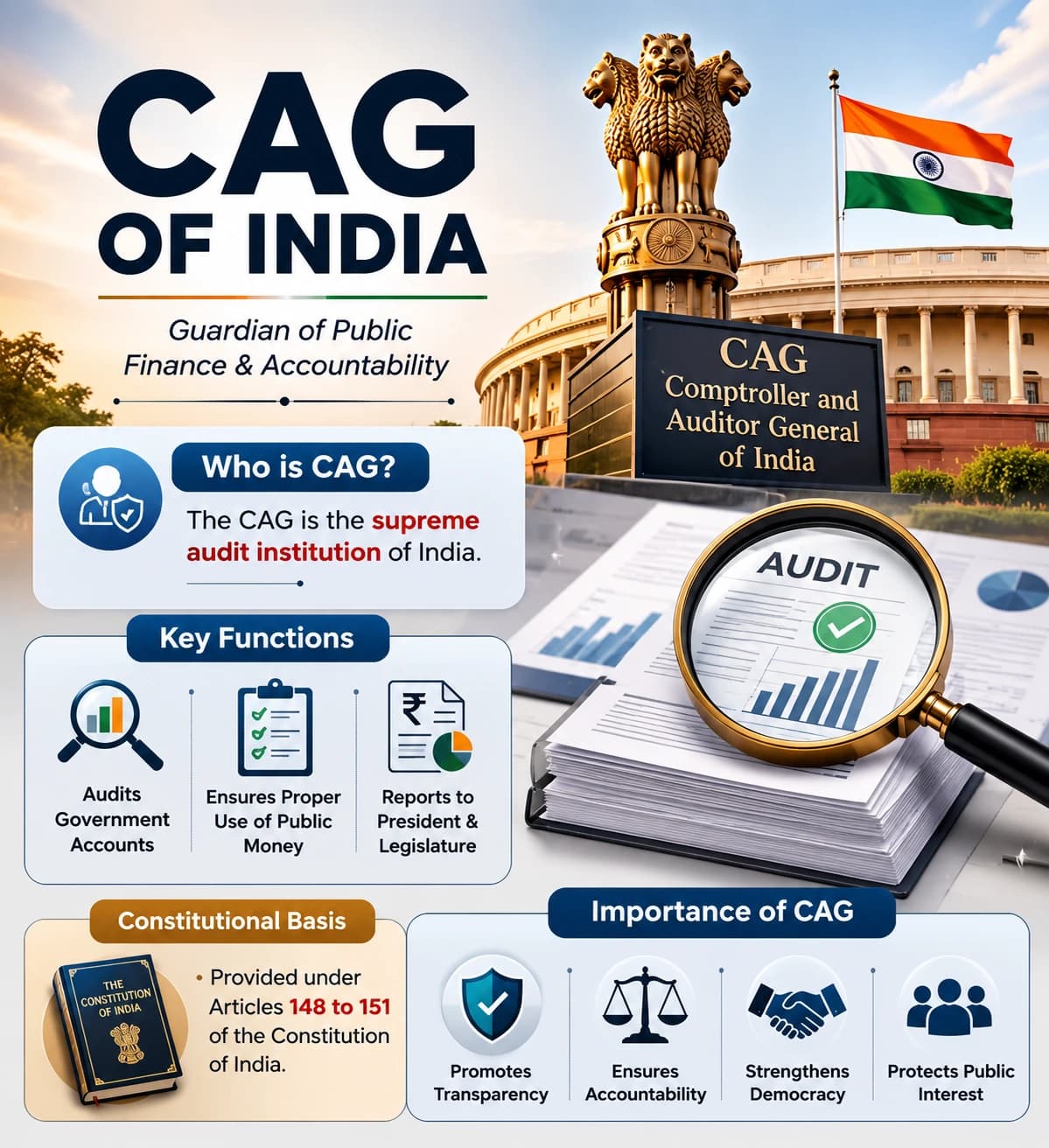
Scrutinizes the reports of the Comptroller and Auditor General (CAG) of India, which are laid before Parliament under Article 151.
Examines whether money shown in the accounts as having been disbursed was legally available for the service to which it has been applied.
Checks that expenditure conforms to the authority governing it.
Examines cases involving losses, nugatory expenditure, and financial irregularities.
Examines the accounts of autonomous and semi-autonomous bodies, the audit of which is conducted by the CAG.
Limitations: The PAC scrutinizes accounts after the expenditure has been incurred (post-facto examination), so it cannot prevent expenditure, only highlight irregularities for future correction. It also cannot summon a matter suo motu without a CAG report typically triggering its examination in most cases, and it has no power to intervene in policy matters, only in matters of financial propriety.
(b) Estimates Committee
Origin: First constituted in 1950 on the recommendation of John Mathai, the then Finance Minister.
Composition: Consists of 30 members, all from the Lok Sabha only (no representation from the Rajya Sabha). Members are elected annually by the Lok Sabha from amongst its own members. Ministers cannot be elected as members.
Chairperson: Appointed by the Speaker from amongst its members, and is invariably a member of the ruling party.
Functions:
Examines the estimates included in the budget and suggests economies in public expenditure — hence it is often called a “continuous economy committee.”
Suggests alternative policies to bring about efficiency in administration.
Examines whether the money is well laid out within the limits of the policy implied in the estimates.
Suggests the form in which estimates shall be presented to Parliament.
Key Distinction: While the PAC examines whether money was spent as authorized (a legal/regulatory check), the Estimates Committee examines whether money could have been spent more wisely
(an efficiency/economy check) — even before the expenditure occurs, since it examines Budget estimates.
(c) Committee on Public Undertakings (COPU)
Origin: Set up in 1964 on the recommendation of the Krishna Menon Committee, on the basis of a recommendation of the Administrative Reforms Commission.
Composition: Originally had 15 members, all from the Lok Sabha. Since 1974, it has 22 members — 15 from the Lok Sabha and 7 from the Rajya Sabha.
Functions:
Examines the reports and accounts of Public Sector Undertakings (PSUs).
Examines the reports of the CAG on public undertakings.
Examines whether the affairs of public undertakings are being managed in accordance with sound business principles and prudent commercial practices.
Essentially, it performs the functions of the PAC and the Estimates Committee combined, but limited specifically to public sector undertakings.
Note: Interestingly, none of these three financial committees can examine matters of policy in a broad sense — they largely restrict themselves to financial propriety, efficiency, and accountability rather than the wisdom of a policy itself, which remains within the domain of the House and the political executive.
2. Departmentally Related Standing Committees (DRSCs)
This is arguably the most significant reform in the history of India’s parliamentary committee system.
Background: Before 1993, India did not have a comprehensive system of subject-specific committees covering every ministry. On the recommendation of the Rules Committee of the Lok Sabha, a system of 17 DRSCs was introduced in 1993.
Current Structure: The number has since been reorganized to 24 DRSCs, each covering one or more ministries/departments. Of these, 8 committees work under the Rajya Sabha and 16 under the Lok Sabha.
Composition: Each DRSC has a maximum of 31 members — 21 from the Lok Sabha and 10 from the Rajya Sabha (for those under Lok Sabha), nominated by the Speaker and Chairman respectively. Ministers are not eligible to be members of these committees.
Functions:
Consider the Demands for Grants of the concerned ministries/departments before they are discussed in the House, and can suggest cuts, though these are recommendatory.
Examine Bills referred to them by the Chairman/Speaker.
Consider annual reports of ministries/departments.
Consider national basic long-term policy documents presented to the House, if referred.
Cannot consider matters of day-to-day administration.
Significance:
Provides continuous, subject-wise scrutiny of every ministry.
Enables MPs to develop domain expertise on a particular sector over time.
Enhances accountability by ensuring every ministry undergoes periodic legislative examination, not just those in the news.
Bills referred to DRSCs receive far more detailed clause-by-clause scrutiny than is possible on the floor of the House.
Declining Trend of Bill Referral: A concerning trend noted by political observers is the falling percentage of Bills referred to these committees. While a large share of Bills in the 14th and 15th Lok Sabhas were sent to DRSCs for examination, this proportion has declined sharply in subsequent Lok Sabhas, raising concerns about reduced legislative scrutiny and rushed law-making. This is a recurring theme in UPSC Mains answer writing on “declining parliamentary oversight.”
3. Other Standing Committees
Beyond financial committees and DRSCs, several other Standing Committees regulate the day-to-day functioning of the House and its members. Key examples include:
Business Advisory Committee: Recommends the time that should be allocated for discussion on Bills and other items of business.
Committee on Private Members’ Bills and Resolutions: Allocates time for discussion of Private Member’s Bills and resolutions (exists only in the Lok Sabha).
Committee on Petitions: Examines petitions on Bills and matters of general public interest.
Committee of Privileges: Examines cases of breach of privilege of the House or its members.
Rules Committee: Considers matters related to the procedure and conduct of business in the House.
Committee on Government Assurances: Monitors the assurances, promises, and undertakings given by Ministers on the floor of the House and examines the extent to which they have been implemented.
- Committee on Absence of Members from the Sittings of the House
- Committee on Papers Laid on the Table
Committee on Subordinate Legislation: Scrutinizes whether the powers to make regulations, rules, and bye-laws conferred by Parliament on the Executive are being properly exercised.
Committee on Ethics: Examines matters of ethical and other misconduct of members.
- Library Committee
- Ad Hoc Committees
Unlike Standing Committees, Ad Hoc Committees are temporary in nature. They cease to exist as soon as they complete the task assigned to them and submit a report. They can be broadly divided into two types:
1. Inquiry Committees
These are constituted to inquire into a specific matter and report to the House. Examples include the Joint Parliamentary Committee (JPC) — such as those set up to inquire into the Bofors scandal (1987), the Harshad Mehta securities scam (1992), and the Sharad Pawar-led JPC on the pesticide residue issue (2003-04), among others.
2. Advisory Committees
These are constituted on certain Bills and provide advice/scrutiny on the content of legislation. These include
Select Committees and Joint Select Committees, set up to consider and report on a particular Bill. Such committees are known for detailed clause-by-clause examination of Bills, and they may take evidence from experts, interested bodies, and individuals.
Joint Parliamentary Committees (JPCs) deserve special mention:
Constituted by a motion adopted by one House and agreed to by the other.
Members are drawn from both Houses, with the Lok Sabha usually providing twice the number of members as the Rajya Sabha.
JPCs have been used both for legislative scrutiny (e.g., the JPC on the Insurance Laws Amendment Bill) and for investigating specific incidents or scams.
Powers of Parliamentary Committees
Parliamentary Committees, though composed of MPs, enjoy quasi-judicial powers in certain respects:
They can send for persons, papers, and records relevant to the matter under their consideration.
They can summon any person, including private citizens and government officials, to give evidence or produce documents.
Witnesses giving evidence enjoy the same privileges as MPs, and giving false evidence before a committee can amount to a breach of privilege/contempt of the House.
Committee proceedings enjoy protection from judicial scrutiny with regard to internal procedural matters, similar to proceedings of the House itself, under parliamentary privilege.
Reports of committees are generally unanimous and presented in a non-partisan manner, though dissenting notes by individual members are permitted.
However, committees cannot compel the government to accept their recommendations — the reports are essentially persuasive and recommendatory, not binding. The government is required to submit an Action Taken Report (ATR) on the recommendations, but there is no constitutional or legal compulsion to implement them.
Significance of Parliamentary Committees
Ensuring Executive Accountability: They act as a crucial check on the executive by examining financial transactions, policy implementation, and administrative efficiency in detail.
Filling the Expertise Gap: MPs are generalists, while the bureaucracy and technical departments possess specialized knowledge. Committees, through repeated interactions with a sector, help MPs develop informed, sector-specific understanding.
Reducing the Burden on the House: With limited sitting days (often criticized as insufficient — the Lok Sabha sits far fewer days annually compared to decades ago), committees allow detailed work to continue even when the House is not in session.
Better Quality of Legislation: Bills that are referred to Standing Committees or Select Committees undergo far more rigorous scrutiny, expert consultation, and public feedback than Bills passed directly on the floor with limited debate.
Non-Partisan, Consensus-Building Platform: Because committee meetings are held in-camera and are less about political theatre, MPs across party lines often reach consensus recommendations, which strengthens the credibility of Parliament’s institutional voice.
Training Ground for MPs: Committees serve as a training ground where MPs — particularly first-time MPs — learn about legislative and administrative processes in a hands-on manner.
Extension of Parliamentary Oversight to PSUs and Autonomous Bodies: Through COPU and other mechanisms, committees extend oversight beyond ministries to public sector undertakings and autonomous bodies funded by public money.
Criticisms and Limitations
Despite their significance, the committee system in India faces several structural and functional criticisms:
Declining Referral of Bills: As noted, a shrinking proportion of Bills are now sent to DRSCs before being passed, undermining the very purpose for which these committees were created. Important and complex legislation is at times passed with minimal committee-level scrutiny.
Non-Binding Recommendations: Since committee reports are only recommendatory, governments can — and often do — ignore or only partially implement recommendations, reducing the practical impact of committee work.
Absence of Constitutional Status: Unlike the CAG or the Election Commission, Parliamentary Committees do not enjoy a distinct constitutional status; they exist purely under the Rules of Procedure, making their authority more fragile and dependent on political will and convention.
Poor Attendance: MPs often skip committee meetings due to overlapping political engagements, campaigning, or lack of interest in “unglamorous” detailed work, weakening the quality of deliberation.
Confidentiality Concerns: While in-camera proceedings encourage frank discussion, this also reduces transparency and public accountability, as citizens generally cannot access what transpires during committee meetings until the final report is tabled.
Overlap and Coordination Issues: With 24 DRSCs and multiple financial and other committees, there can be overlapping jurisdiction, duplication of effort, and coordination challenges.
Time Constraints for Bill Scrutiny: Committees are often given very limited time to scrutinize highly complex Bills, especially when Bills are introduced and referred close to the end of a parliamentary session, compressing the quality of scrutiny.
Reduced Sittings of Parliament: A general decline in the number of days Parliament sits each year indirectly limits the time available even for committee-related processes, such as tabling and discussing committee reports.
Recent Trends and Reforms Needed
There is a growing demand among political scientists and constitutional experts to institutionalize a minimum threshold for referring Bills to DRSCs, so that critical legislation is not passed without adequate scrutiny.
Suggestions have been made to give committees a fixed minimum number of working days, ensure better staff and research support (akin to the Congressional Research Service in the United States), and improve public accessibility to committee reports and proceedings.
There have been calls to enhance the research and analytical wing supporting MPs in committees, given the highly technical nature of contemporary policy areas such as cybersecurity, artificial intelligence regulation, and climate policy.
Strengthening the role of committees in examining delegated legislation (rules, regulations, and notifications issued by the executive under parent Acts) has also been proposed, given the increasing volume of executive rule-making.
Way Forward
The Parliamentary Committee system remains one of the most important, if underappreciated, features of India’s parliamentary democracy. To strengthen it further:
Referral of all significant Bills to the relevant DRSC should be made a near-universal norm rather than an exception, with time-bound reporting requirements.
The government should be mandated to table a detailed response to every committee recommendation within a fixed period, enhancing accountability even if recommendations remain non-binding.
Capacity building — through dedicated research staff, access to domain experts, and better institutional memory — would enhance the quality of committee reports.
Greater public engagement, including wider dissemination of committee reports and increased opportunities for civil society and expert testimony, can improve the democratic legitimacy of the process.
Ensuring adequate parliamentary sitting days would naturally create the space needed for robust committee-based scrutiny to complement floor debates.
Conclusion
Parliamentary Committees function as the quiet, unglamorous, but indispensable machinery that makes India’s parliamentary democracy workable in practice. From the century-old Public Accounts Committee scrutinizing government spending, to the 24 Departmentally Related Standing Committees examining ministries across sectors, these bodies embody the principle that effective oversight requires detail, expertise, and sustained engagement — qualities that the full House, given its size and limited time, cannot always provide.
For UPSC aspirants, this topic offers rich material not just for direct factual questions on composition and functions, but also for analytical Mains questions on parliamentary accountability, the erosion of legislative scrutiny, and reforms needed to strengthen India’s representative institutions. A strong grasp of this topic — its history, structure, powers, and current challenges — will serve well both in Prelims (where factual precision on numbers and composition is tested) and Mains (where an evaluative, reform-oriented perspective is rewarded).
- Quick Revision Table
- Committee
- Members
- Houses Represented
- Chairperson
- Public Accounts Committee
- 22
- LS (15) + RS (7)
- Opposition MP (convention)
- Estimates Committee
- 30
- LS only
- Ruling party MP
- Committee on Public Undertakings
- 22
- LS (15) + RS (7)
- DRSCs
- Up to 31 each
- LS (21) + RS (10)
- Practice Question (Mains-Style)
“Parliamentary Committees are indispensable for effective legislative oversight, yet their declining use threatens the quality of India’s law-making process.” Critically examine this statement with reference to Departmentally Related Standing Committees.