President of India – Complete UPSC Guide | Prep2026
- UPSC GS IIPolity360° Coverage
- 📖 Complete UPSC Guide | Polity
- The President of India
- A 360° Masterclass
Election • Powers • Impeachment • Constitutional Role — everything a UPSC & CLAT aspirant must know, in one place.
- President of India – Complete guide
- 15+ Articles Covered
- 16 Presidents (so far)
- 5 YrsTerm of Office
- GS IIPrimary Paper
Syllabus:GS II – Polity & GovernanceEssay PaperPrelims 2025CLAT Legal ReasoningState PCS
- 📋 What’s Inside
- 🏛️
- Section 01
- Constitutional Position of the President
India is a parliamentary republic where the President is the constitutional head of the executive. Unlike the USA’s executive President, India’s President acts primarily on the aid and advice of the Council of Ministers headed by the Prime Minister. Yet the office is far from ceremonial — it occupies the apex of the constitutional hierarchy.
- President of India – Complete here
- Key Articles at a Glance:
Art. 52–78 (Part V) deal with the Union Executive. Art. 52 creates the office of President. Art. 53 vests the executive power of the Union in the President.
- 🇮🇳 Role in the Constitutional Scheme
- First citizen of India
- Supreme Commander of all Defence Forces
- Head of the Union Executive (Art. 52–53)
- Integral part of Parliament (Art. 79)
- Part of the constitutional triad: President–Council–Lok Sabha
- 📜 Nature of the Office
- Formal / nominal / constitutional head
Acts on advice of CoM (Art. 74) — 44th Amendment makes advice binding
Has discretionary powers in certain situations (hung house, PM resignation)
- Not answerable to Parliament for exercise of powers
- Cannot be tried in any court while in office (Art. 361)
- 📋
- Section 02
- Eligibility & Qualifications
Article 58 lays down the qualifications for the President of India. All conditions must be satisfied simultaneously.
- Condition
- Detail
- Citizenship
- Must be a citizen of India
- Age
- Completed 35 years of age
- Lok Sabha Eligibility
Qualified to be a member of Lok Sabha (no educational bar, but must not be of unsound mind, insolvent, etc.)
No office of profit
Must not hold any office of profit under Govt. of India or any State Govt. or any local or other authority
Exceptions to office of profit
The sitting President, Vice-President, Governor of a State, or a Minister of Union/State does NOT disqualify on account of holding their respective offices
Nomination
Proposed by at least 50 electors, seconded by at least 50 electors (since 1997 amendment; earlier it was just 10 & 10)
Security Deposit
₹15,000 (forfeited if candidate secures less than 1/6th of valid votes)
Prelims Trap:
A member of Parliament or a State Legislature CAN contest for President but must resign from their legislature seat before taking the presidential oath. Being a voter in a parliamentary constituency is NOT a requirement for presidential candidacy.
- 🗳️
- Section 03
- Election Process
Article 54 provides for the election of the President.
Article 55 lays down the manner. The election is indirect — conducted by a special Electoral College.
- 🏛️ Electoral College Composition
- Elected members of both Houses of Parliament (Lok Sabha + Rajya Sabha)
- Elected members of the Legislative Assemblies of all States
Elected members of the Legislative Assemblies of Union Territories with assemblies: Delhi, Puducherry, and Jammu & Kashmir
Note:
Nominated members of Parliament, nominated members of State Legislative Councils (Vidhan Parishads), and nominated members of State Legislative Assemblies do NOT vote in the Presidential election.
- 1
- Ballot System
Single Transferable Vote system using Proportional Representation. Voters rank candidates in order of preference.
- 2
- First Preference Count
First-preference votes of all voters are counted. The quota (minimum votes to win) is determined.
- 3
- Quota Formula
Quota = (Total valid votes ÷ 2) + 1. A candidate reaching this quota is declared elected.
- 4
- Elimination Rounds
If no candidate reaches the quota, the weakest candidate is eliminated and their votes are transferred to next preferences — rounds continue until one candidate reaches quota.
Secret Ballot:
The Presidential election is conducted by secret ballot — electors must use a special pen provided by the Election Commission and cannot reveal their vote.
- 🔢
- Section 04
- Vote Value Formula (Art. 55)
To ensure uniformity across States (with different populations) and parity between Parliament and State Assemblies, Article 55 prescribes a vote-value formula.
- Vote Value of Each MLA
- State Population ÷ (Total Elected MLAs × 1000)
Population = 1971 Census (frozen by 84th Constitutional Amendment, 2001, till 2026 delimitation)
- Vote Value of Each MP (Lok Sabha / Rajya Sabha)
- Total Vote Value of All MLAs ÷ Total Elected MPs
This ensures parity between Parliament and State Assemblies collectively
📊 Example (Simplified)
If UP has 80 lakh voters (1971) and 403 MLAs: Vote value per MLA ≈ 208
Total state MLA vote value → summed across all states
This total ÷ 776 (total elected MPs) = vote value of 1 MP
- 🎯 Key Concept: Parity
- Total MP value ≈ Total MLA value — neither dominates
- Larger states (UP, Maharashtra) have higher MLA vote values
- Smaller states’ MLAs have lower individual vote values
- Formula ensures fair federal representation
- 📜
- Section 05
- Oath, Term, Privileges & Vacancy
- Aspect
- Detail
- Article
Oath administered by Chief Justice of India; in CJI’s absence, the senior-most judge of Supreme Court
- Art. 60
- Oath content
Preserve, protect, and defend the Constitution; devote to service of the people
- Art. 60
- Term of office
- 5 years from date of entering office
- Art. 56
- Re-election
Eligible for re-election; no bar on number of terms (unlike USA’s 2-term limit)
- Art. 57
- Resignation
- Must address resignation to Vice-President
- Art. 56(1)(a)
- Removal
- Impeachment for violation of the Constitution
- Art. 61
- Salary
₹5 lakh/month (revised 2018); charged to Consolidated Fund of India — not voted by Parliament
- Art. 59(3)
- Official Residence
- Rashtrapati Bhavan, New Delhi (free of rent)
- Art. 59(4)
- Pension on retirement
- ₹1.5 lakh/month + additional allowances (as amended)
- –
- Immunity from legal process
- Cannot be arrested or sued while in office
- Art. 361
- 🔄 Vacancy & Succession
- On vacancy (death, resignation, removal, or inability):
- Vice-President acts as President (Art. 65)
- If VP is also unavailable:
- Chief Justice of India acts as President
- Fresh election must be held within
- 6 months of vacancy occurring
Newly elected President serves full 5-year term from the date of entering office
- ⚖️
- Section 06
- Impeachment Process (Art. 61)
- The President can be removed only through impeachment
— a quasi-judicial process for violation of the Constitution. No President has been impeached in India’s history.
- 1
- Initiation (Either House)
A resolution can be initiated in either House of Parliament. It requires a written notice signed by at least
1/4th of the total membership of that House.
- 2
- 14- Day Notice to President
A minimum of 14 days’ notice must be given to the President before the resolution is taken up.
- 3
- Passing in Initiating House
The charge resolution must be passed by a 2/3rd majority of total membership
(not merely members present and voting) of the initiating House.
- 4
- Investigation by Other House
The other House investigates the charge. The President has the right to appear or be represented during the investigation.
- 5
- Conviction by Other House
If the charge is sustained by a 2/3rd majority of total membership of the investigating House, the President stands removed from the date the resolution is passed.
Key Distinction:
Impeachment involves total membership of each House (not just present & voting) — this is a higher bar than ordinary special majority. Both Houses sit separately, unlike a joint sitting.
Comparison:
US President can be impeached by the House (simple majority) and tried by Senate (2/3 majority). India requires 2/3 of total membership at both stages — a stricter standard.
📌 What Constitutes “Violation of the Constitution”?
The Constitution does not define “violation” explicitly — it is left to parliamentary judgment
Cannot be impeached for personal misconduct unrelated to constitutional duties
The ground is narrower than a Vote of No-Confidence (which doesn’t apply to the President)
No Supreme Court/High Court can review the impeachment process once completed
- ⚡
- Section 07
- Powers & Functions of the President
- 🏛️ Executive Powers
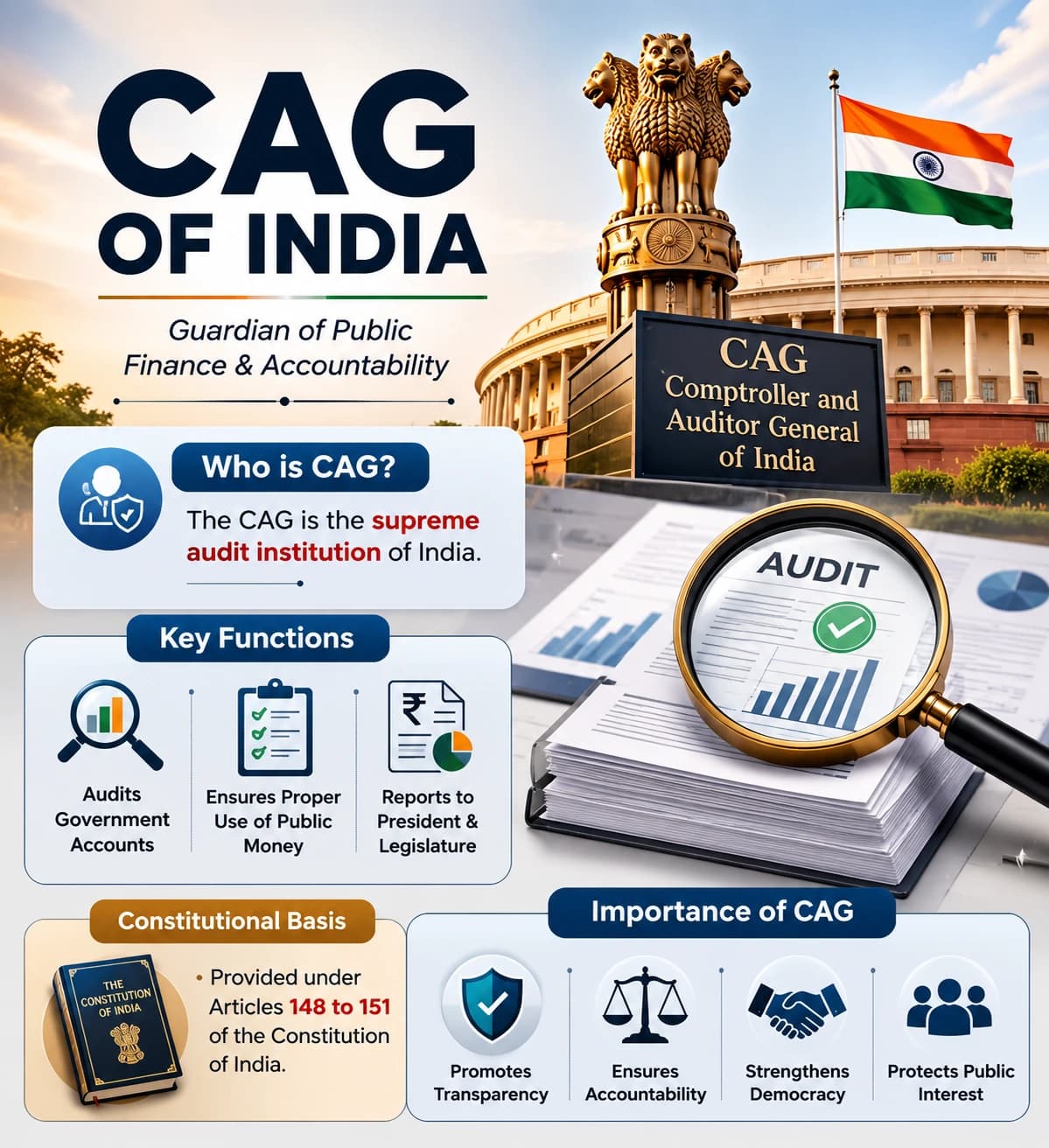
Appoints PM, other ministers, AG, CAG, CEC, UPSC Chairman, SC/HC judges, Governors
Appoints Commissions: Finance Commission, NHRC, etc.
- All executive action taken in President’s name
- Administers UTs through administrators/LGs
- Can seek info from PM on matters of administration (Art. 78)
- 📜 Legislative Powers
- Summons, prorogues, dissolves Lok Sabha
Addresses both Houses at commencement of first session each year (Art. 87)
Nominates 12 Rajya Sabha members (literature, science, art, social service)
Nominates 2 Anglo-Indian members to Lok Sabha (abolished by 104th Amendment, 2020)
- Prior recommendation for Money Bills, certain financial matters
- Lays Annual Financial Statement (Budget) before Parliament
- 💰 Financial Powers
No Money Bill can be introduced without President’s prior recommendation
- Custodian of Contingency Fund of India
- Constitutes Finance Commission every 5 years
- Causes Union Budget to be presented
- Appoints UPSC chairman and members
- ⚖️ Judicial Powers
- Appoints Chief Justice and judges of Supreme Court and High Courts
Pardoning Powers: Pardon, Reprieve, Respite, Remission, Commutation (Art. 72)
Art. 72 pardons include death sentence cases and offences under Union law
Can seek advisory opinion of Supreme Court (Art. 143) — but not binding
- 🪖 Military Powers
- Supreme Commander of all armed forces
- Declares war, concludes peace — subject to Parliament’s approval
- Appoints Chiefs of Army, Navy, Air Force
- 🚨 Emergency Powers
- Art. 352: National Emergency (armed rebellion / external aggression)
- Art. 356: President’s Rule in States (constitutional breakdown)
- Art. 360: Financial Emergency
Discretion in proclaiming — subject to Cabinet advice (after 44th Amendment)
- 🌐 Diplomatic Powers
- Represents India in international forums
All treaties and international agreements concluded in President’s name
- Receives credentials of foreign ambassadors
- Accredits Indian ambassadors and high commissioners abroad
- 🔏
- Section 08
- Veto Powers over Legislation (Art. 111)
When a Bill (other than Money Bill) is passed by Parliament and sent for Presidential assent, the President has four options under
- Article 111:
- Type of Veto
- What President does
- Effect
Can Parliament Override?
Absolute Veto
Withholds assent (for private member bills or government bills — especially if GoI changed after passing)
- Bill does not become law
- No override mechanism provided
- Suspensive Veto
- Returns the Bill for reconsideration with or without a message
Parliament reconsiders; if passed again (with or without amendment), President MUST give assent
- Yes — simple majority suffices to override
- Pocket Veto
- Neither gives assent nor returns — keeps the Bill pending indefinitely
Bill in limbo; Constitution prescribes no time limit for President to act
- No explicit override
- Assent
Gives assent (mandatory for Money Bills; must be given after Joint Sitting for ordinary bills)
- Bill becomes Act
- N/A
- Famous Pocket Veto Case:
President Zail Singh used the pocket veto on the Indian Post Office (Amendment) Bill, 1986 — the Bill was never returned, assented to, or formally rejected.
Constitutional Amendment Bills:
The President has no veto over Bills passed under Art. 368 — assent is mandatory after the 24th Constitutional Amendment.
- 📰
- Section 09
- Ordinance Making Power (Art. 123)
When Parliament is not in session and immediate action is needed, the President can promulgate an Ordinance. This is one of the most practically important presidential powers.
- 📋 Conditions to Promulgate
- Parliament must not be in session (either House in recess)
President must be “satisfied” that circumstances require immediate action
- Council of Ministers must recommend (President acts on advice)
- Subject matter must be within Parliament’s legislative competence
- ⏱️ Lifespan of an Ordinance
- Ceases to operate after
- 6 weeks of Parliament’s reassembly
- Parliament can disapprove it earlier → ceases immediately
- President can withdraw any time
- Has same force as an Act of Parliament while it remains
- Key Limitation:
The President cannot promulgate an Ordinance on matters where Parliament itself cannot legislate — e.g., he cannot amend the Constitution via Ordinance.
SC Ruling (Krishna Kumar Singh v. State of Bihar, 2017):
Re-promulgation of Ordinances without placing them before Parliament is constitutionally impermissible — it subverts democratic functioning and is a fraud on the Constitution.
- ⚖️
- Section 10
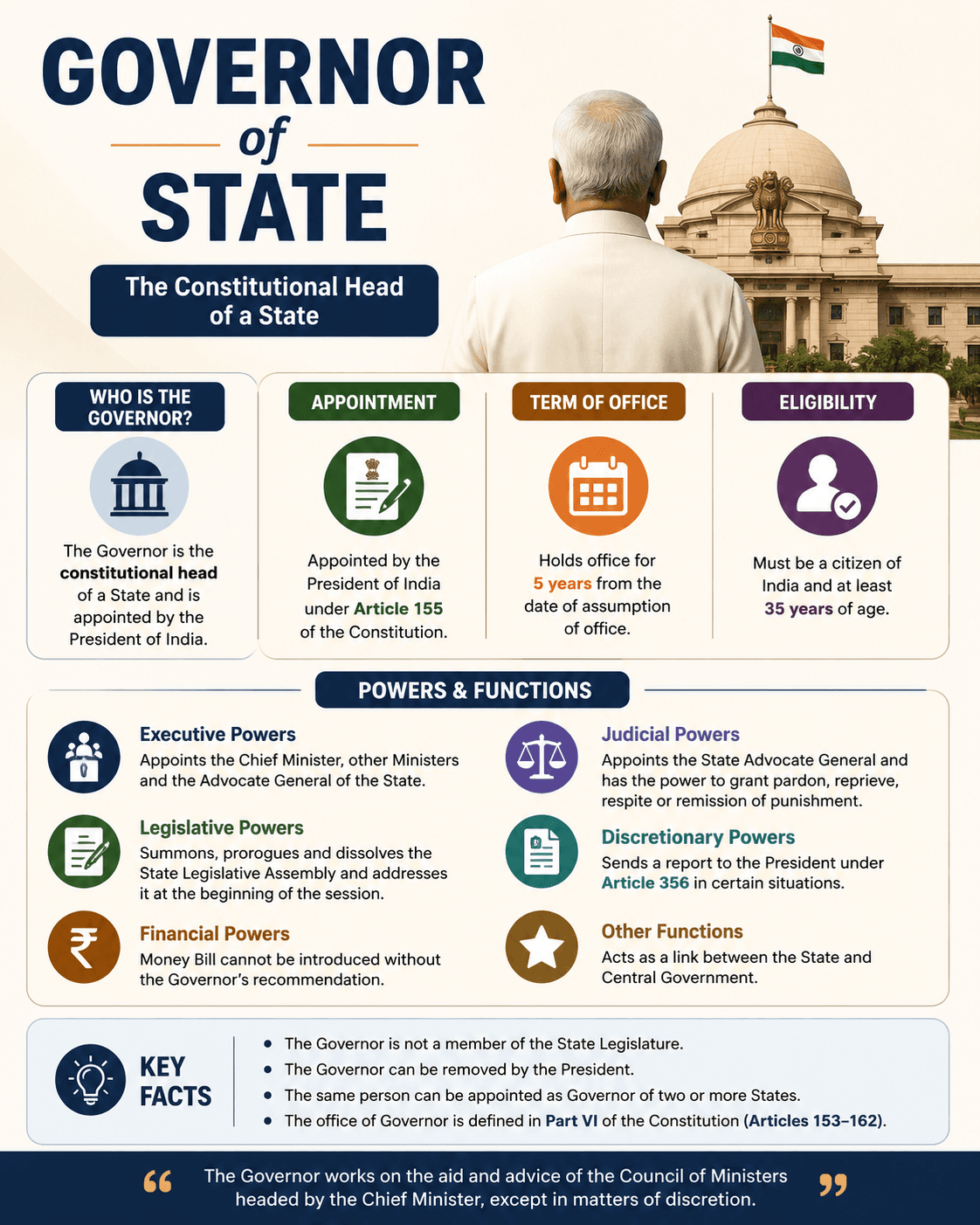
- President vs Governor vs Prime Minister
- Feature
- President
- Governor
- Prime Minister
- Constitutional basis
- Art. 52
- Art. 153
- Art. 75
- How selected
- Indirect election (Electoral College)
- Appointed by President
- Appointed by President (leader of majority)
- Term
- 5 years
- Pleasure of President (no fixed term)
- Pleasure of Lok Sabha (while majority)
- Removal
- Impeachment (Art. 61)
- President’s pleasure (no defined process)
- Vote of no-confidence / resignation
- Pardoning power
- Art. 72 – Union offences + death sentences
- Art. 161 – State offences (not death sentence)
- No pardoning power
- Emergency power
- Yes (Art. 352, 356, 360)
- Can recommend Art. 356 only
- No direct emergency power
- Acts on advice of Council of Ministers (Art. 74)
- State Council of Ministers (Art. 163)
- Leads the Council of Ministers
- Real executive
- No (PM is real executive)
- No (CM is real executive)
- Yes — real head of Union executive
- 👑
- Section 11
- Presidents of India — Complete List
- President
- Term
- Notable Firsts / Facts
- 1
- Dr. Rajendra Prasad
- 1950–1962
- First President; only President elected twice; longest serving
- 2
- Dr. S. Radhakrishnan
- 1962–1967
- His birthday (Sept 5) = Teachers’ Day; was also first VP
- 3
- Dr. Zakir Husain
- 1967–1969
- First Muslim President; first to die in office
- –
- V. V. Giri (Acting)
- 1969
- Acting President; later elected President
- 4
- V. V. Giri
- 1969–1974
- First to win with 2nd preference votes; was also Acting
- 5
- Fakhruddin Ali Ahmed
- 1974–1977
- Second to die in office; proclaimed Emergency 1975
- 6
- Neelam Sanjiva Reddy
- 1977–1982
Youngest elected; only President elected unopposed; Speaker before being President
- 7
- Giani Zail Singh
- 1982–1987
- First Sikh President; used pocket veto on Postal Bill
- 8
- R. Venkataraman
- 1987–1992
- Oldest person to become President at time of election
- 9
- Dr. Shankar Dayal Sharma
- 1992–1997
- Former Congress President and Madhya Pradesh CM
- 10
- K. R. Narayanan
- 1997–2002
- First Dalit President; first to vote in general elections
- 11
- Dr. A. P. J. Abdul Kalam
- 2002–2007
- “Missile Man of India”; only scientist-President; People’s President
- 12
- Smt. Pratibha Patil
- 2007–2012
- First woman President of India
- 13
- Pranab Mukherjee
- 2012–2017
Bharat Ratna (2019); longest-serving finance minister before becoming President
- 14
- Ram Nath Kovind
- 2017–2022
- Second Dalit President
- 15
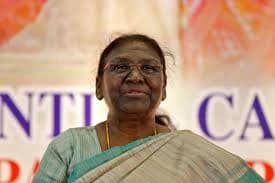
- Smt. Droupadi Murmu
- 2022– present
First tribal woman President; first President born in post-independence India
⚡ Prelims Quick-Fire Capsule
Article for President’s election?
Art. 54
Manner of election?
Art. 55 (Proportional Representation, STV)
Qualifications?
Art. 58
Term of Office?
Art. 56 (5 years)
Oath administered by?
Art. 60 — Chief Justice of India
Impeachment article?
Art. 61
Executive power vested in?
Art. 53 — President
Ordinance power?
Art. 123
Pardoning power?
Art. 72
National Emergency?
Art. 352
President’s Rule?
Art. 356
Financial Emergency?
Art. 360
First woman President?
Pratibha Patil (2007)
First tribal President?
Droupadi Murmu (2022)
First Dalit President?
K. R. Narayanan (1997)
VP acts as Prez under?
Art. 65
Immunity from court?
Art. 361
Salary charged to?
Consolidated Fund of India
SC advisory opinion?
Art. 143 (non-binding)
Resident official?
- Rashtrapati Bhavan
- ❓
- Section 13
- MCQs with Explained Answers
Q1. The President of India is elected by an Electoral College. Which of the following is NOT part of this Electoral College?
(Consider: Elected MPs, Nominated Rajya Sabha MPs, Elected MLAs, Elected MLAs of Delhi NCT)
- Elected members of Lok Sabha
- ✓ Nominated members of Rajya Sabha
- Elected members of State Legislative Assemblies
- Elected MLAs of Delhi & Puducherry
- Explanation:
Under Art. 54, only elected members of Parliament and State Legislative Assemblies (and UT Assemblies: Delhi, Puducherry, J&K) participate. Nominated members of Parliament — whether to Rajya Sabha or Lok Sabha — do NOT vote. Nominated MLC members also don’t vote.
Q2. Under which circumstance does the President exercise his/her discretion without the advice of the Council of Ministers?
- Appointing the Attorney General
- ✓ Selecting PM when no party has clear majority
- Proclaiming National Emergency
- Issuing Ordinances when Parliament is not in session
- Explanation:
Under Art. 74, the President normally acts on advice of CoM. However, when a hung Parliament results in no clear majority, the President has personal discretion in choosing who to invite to form the government. Appointing AG, Emergency, and Ordinances all require Cabinet advice (especially post-44th Amendment 1978).
Q3. The “pocket veto” power of the President of India is possible because:
- Art. 111 explicitly grants this power
- The Supreme Court upheld it in a landmark case
- ✓ The Constitution prescribes no time limit for Presidential assent
- The President can veto Money Bills
- Explanation:
Art. 111 says the President “shall” assent, return, or withhold — but sets no deadline. This gap allows a President to indefinitely sit on a Bill, creating the “pocket veto” effect. Famously exercised by Zail Singh on the Indian Post Office (Amendment) Bill, 1986.
Q4. Which of the following is incorrect regarding Presidential Impeachment?
- It can be initiated in either House of Parliament
- 14 days’ notice must be given to the President
✓ The charge must be passed by 2/3 of members present & voting
- The President can be represented during investigation by other House
- Explanation:
Art. 61 requires 2/3rd majority of the total membership of each House — NOT merely members present and voting. This is a critical distinction. The 1/4 notice, 14-day notice, and right to appear are all correct statements.
- Q5. Article 143 of the Constitution deals with:
- Power of President to issue Ordinances
- ✓ Power to consult the Supreme Court for advisory opinion
- President’s pardoning powers
- President’s power to summon Parliament
- Explanation:
Art. 143 empowers the President to refer any question of law or fact of public importance to the Supreme Court for an advisory opinion. The Court may (or may not) give its opinion, and the opinion is not binding on the President or Courts. Notable reference: Ram Janmabhoomi case (1993).
- ✍️
- Section 14
- Model Mains Answers (250 Words, 15 Marks)
Q. “The President of India is a constitutional head, yet not merely a rubber stamp.” Examine this statement in light of constitutional provisions and conventions. (GS II | 2023-type)15 Marks | 250 Words
Introduction
The President of India, as the constitutional head of the executive under Art. 52–53, operates within a parliamentary framework where the Council of Ministers (CoM) holds real executive authority. Yet, calling the President a mere “rubber stamp” oversimplifies a nuanced constitutional position.
Constitutional Head: The Formal Reality
Art. 74 mandates that the President shall act on the aid and advice of the CoM, and the 44th Amendment (1978) made this advice binding even if returned for reconsideration. All executive actions are taken in the President’s name, but as Dr. B. R. Ambedkar noted, the President’s position is akin to the King under the British constitutional model — acting on ministerial advice.
Beyond a Rubber Stamp: Discretionary Spaces
The President retains genuine discretion in specific situations: (a) selecting a Prime Minister when no party commands a clear majority — as exercised in 1979 when President Reddy invited Charan Singh despite Indira Gandhi having greater numbers; (b) sending back legislation for reconsideration under Art. 111 (suspensive veto); (c) referring questions to the Supreme Court under Art. 143; and (d) exercising the “pocket veto” by withholding indefinite action, as demonstrated by President Zail Singh in 1986. Additionally, the President’s right under Art. 78 to receive information from the PM serves as a soft check on the executive.
Way Forward
The President’s role is that of a constitutional sentinel — acting on advice under normal circumstances but possessing reserve powers to prevent unconstitutional exercises of executive authority. The position is thus best described as a “constitutional monarch in a republic” — neither powerless nor politically powerful, but institutionally vital.
~250 words | Structured: Intro → Analysis → Examples → Conclusion
Q. Critically examine the ordinance-making power of the President of India. Has it been misused? What are the constitutional safeguards against such misuse? (GS II | Practice)15 Marks | 250 Words
Introduction
Art. 123 grants the President the power to promulgate Ordinances when Parliament is not in session and urgent action is required. While designed as a short-term legislative instrument, repeated use has raised concerns about executive overreach.
Constitutional Framework
An Ordinance has the same force as an Act of Parliament and lapses six weeks after Parliament reassembles, unless passed as legislation. The President acts on Cabinet advice, and the power can only be used in areas where Parliament can legislate (Union and Concurrent Lists).
Concerns of Misuse
The practice of “Ordinance Raj” — re-promulgating Ordinances multiple times to bypass Parliament — has been documented: the Bihar Land Reform Ordinance was re-promulgated 38 times over 14 years. The Election Commission even highlighted how Ordinances have been used to announce populist measures before elections, bypassing legislative scrutiny. Between 1952 and 2019, over 700 Ordinances were promulgated at the Union level.
Constitutional Safeguards & Judicial Intervention
Key safeguards include: Parliamentary approval within 6 weeks; President’s discretion to refuse Cabinet advice (though limited); and the landmark Supreme Court ruling in Krishna Kumar Singh v. State of Bihar
(2017), where a 7-judge bench unanimously held that re-promulgation of Ordinances is a “fraud on the Constitution” and a “subterfuge of the democratic process.” The Court held that failure to lay the Ordinance before the legislature for disapproval or conversion defeats constitutional intent.
Conclusion
Ordinance power is a necessary constitutional tool but must remain exceptional, used only when Parliament’s session cannot be reasonably awaited. Judicial vigilance and parliamentary oversight are critical to preventing its conversion into a routine legislative instrument.
- ~255 words | Case: Krishna Kumar Singh 2017 cited
- ⚖️
- Section 15
- CLAT Legal Reasoning Box
- CLAT 2024-Style Passage-Based Question
- Passage:
The Constitution of India under Article 72 vests in the President the power to grant pardons, reprieves, respites, or remissions of punishment, or to commute sentences. This power covers persons convicted of any offence against any law relating to Union matters and persons sentenced to death. In Epuru Sudhakar v. Government of Andhra Pradesh
(2006), the Supreme Court held that Presidential pardon power is subject to limited judicial review — courts can examine whether the pardon was arbitrary, mala fide, or without application of mind. The exercise of the pardon power, being an executive action, must be preceded by appropriate application of mind.
In contrast, the Governor’s pardoning power under Art. 161 does not extend to sentences of death. Both powers are exercised on the aid and advice of the respective Councils of Ministers — the President on Union CoM and the Governor on the State CoM.
Questions:
Q1. Under which Article does the President grant a pardon for a death sentence confirmed by the High Court? (a) Art. 161 (b) Art. 72 (c) Art. 143 (d) Art. 74
Q2. If the President grants a pardon arbitrarily, can it be challenged in Court? (a) No — it is an absolute executive power (b) No — Art. 361 gives complete immunity (c) Yes — subject to limited judicial review (d) Only by the convicted person’s family
Q3. A person is convicted under a State law and sentenced to death. The Governor: (a) Can pardon and commute (b) Can commute but not pardon (c) Cannot act — only President can for death sentences (d) Can issue reprieve only for 30 days
Answers:
Q1 → (b) Art. 72 | Q2 → (c) Yes, limited judicial review per Epuru Sudhakar (2006) | Q3 → (c) Governor cannot grant pardons in death sentence cases even under State law — that power rests solely with the President under Art. 72.
- 📖
- Section 16
- Glossary of Key Terms
- Proportional Representation
Electoral system where parties/candidates gain representation in proportion to the votes cast for them — used in Presidential election via STV.
Single Transferable Vote (STV)
Voters rank candidates in order of preference; votes are transferred from eliminated candidates to next preferences until a quota is reached.
Pocket Veto
Informal term for President’s inaction on a Bill — neither assent, nor return, nor rejection — possible because Constitution sets no time limit.
Suspensive Veto
President returns a Bill for reconsideration; if Parliament passes it again, President must give assent. Not applicable to Money Bills.
Pardon (Art. 72)
Complete absolution — the President removes both the conviction and the sentence, restoring all rights of the convicted person.
Reprieve
Temporary stay of execution/sentence to allow for appeal or reconsideration.
Remission
Reduction of the quantum of sentence without changing its character (e.g., 10 years reduced to 7 years imprisonment).
Commutation
Substitution of a lesser punishment for a greater one (e.g., death penalty commuted to life imprisonment).
Ordinance
Executive legislation promulgated by the President under Art. 123 when Parliament is not in session; has same force as Parliament’s law but limited lifespan.
Electoral College
A specially constituted body to elect the President — comprises elected members of both Parliamentary Houses and State/UT Legislative Assemblies.
Consolidated Fund of India
The main account of the Government of India; the President’s salary and pension are charged to this fund and not voted upon by Parliament.
Impeachment
Constitutional process for removal of President (Art. 61) for violation of the Constitution — requires 2/3rd majority of total membership of each House.
- 🔭
- Way Forward
- The Presidential Office: Contemporary Relevance
▶The rise of coalition politics has revived the President’s discretionary role in government formation, making a clear understanding of Art. 54–75 critical for both polity and current affairs.
▶Debates around Ordinance promulgation — especially during election seasons — require aspirants to understand both Art. 123 and the Krishna Kumar Singh ruling.
▶Presidential pardon in death sentence cases continues to be examined by courts; the Nirbhaya case review highlighted delays in mercy petition decisions.
▶Droupadi Murmu’s election in 2022 as the first tribal President reflects India’s evolving democratic culture — a recurring theme in Essay and Ethics papers.
▶The interplay of Art. 74 (binding advice), Art. 78 (PM’s obligation to inform), and Art. 356 (President’s Rule) forms a perennial UPSC Mains theme on Centre-State relations.
Comprehensive UPSC Content for Serious Aspirants
Parliament – Election Commission of India eci.gov.inhttps://www.eci.gov.in › faq
Content is original and syllabus-mapped. For revision only — not a substitute for standard textbooks (Laxmikanth M. Indian Polity, D.D. Basu).
- UPSC Mains Study Material
- Tags:
President of India | Art. 52–78 | GS Paper II | Polity | UPSC 2025 | CLAT 2025