The Supreme Court of India -From Historical Up to Now 2026
- UPSC CSE Preparation · GS Paper II · Indian Polity & Governance
- Home › Polity › Judiciary
◆ GS Paper II — Indian Polity The Supreme Court of India — UPSC CSE
- The Supreme Court of India:
- Guardian of the Constitution
A complete UPSC-focused analysis covering constitutional provisions, jurisdiction, landmark judgments, contemporary debates, and mains practice questions and we learn The Supreme Court of India -From Historical Up to Now 2026 step by step
- GS Paper II 15 min read Mains + Prelims High Value Topic
- Art. 124Establishment
- 34 Max Judges
- 1950 Founded
- Art. 32Writ Jurisdiction
- Art. 141Binding Precedent
- Art. 143Advisory Opinion
- Constitutional Provisions & the Collegium System
From the Federal Court of 1937 to the apex court of a sovereign republic — a comprehensive UPSC guide to the Supreme Court’s evolution, its constitutional architecture under Articles 124–147, and the landmark collegium system that governs judicial appointments today.
- GS Paper IIPolity & Governance20 min readPrelims + Mains
- 1937
Federal Court est.
- 1950
- Supreme Court
- 34
- Max Judges
- Art.124–147
- Constitutional Basis
- 1993
- Collegium Born
- 4
- Judges Cases
Pre-Independence History of the Supreme Court http://Supreme Court of India | India Supreme Court of India https://www.sci.gov.in
Pre-Independence History of the Supreme Court of India begins not in 1950, but more than three centuries earlier — in the colonial courts established by the British Crown and East India Company. Understanding this history is essential because the framers of the Constitution consciously drew upon, reformed, and rejected aspects of this judicial inheritance.
- 1726
- Mayor’s Courts — The First Formal Courts
Charter Act of 1726 established Mayor’s Courts in Bombay, Calcutta, and Madras. These were the earliest formal judicial bodies under British authority in India. They applied English law and had limited jurisdiction — primarily over European settlers and traders.
- 1773
- Regulating Act & Supreme Court of Calcutta
The Regulating Act of 1773 established the Supreme Court of Calcutta in 1774, followed by Bombay (1823) and Madras (1801). These were Royal Charter Courts — independent of the Company’s administration. They had jurisdiction over British subjects and were presided over by the Chief Justice and three Puisne Judges sent from England. These courts applied English law exclusively, often clashing with local customs and the Company’s civil administration.
- 1861
- High Courts Act — Unification of Courts
The Indian High Courts Act of 1861 merged the Supreme Courts and Sadar Courts into unified High Courts at Calcutta, Bombay, and Madras. This was a landmark moment — it ended the dual judicial structure and created a more coherent system. High Courts were now the highest courts within their provinces, with criminal and civil jurisdiction over all persons regardless of religion or origin.
- 1909
- Privy Council — The Apex Court
Until 1950, the Judicial Committee of the Privy Council in London served as the apex appellate body for India. Indian litigants had to travel to London for final appeals. Many landmark constitutional interpretations for undivided India came from the Privy Council. The abolition of Privy Council jurisdiction was a key sovereignty assertion by independent India.
- 1935
- Government of India Act, 1935 — Federal Court Proposed
The Government of India Act, 1935 was the most significant constitutional document before independence. It envisaged a federal structure for India and consequently proposed an independent federal judiciary. Section 200 of the Act provided for a Federal Court — a court that would hear constitutional disputes between the Centre and Provinces, and serve as an appellate court from High Courts.
- 1937
- Federal Court of India — Established
The Federal Court of India was established on 1 October 1937, with Sir Maurice Gwyer as its first Chief Justice. It sat in Delhi in what is today Parliament’s Library Building. The Federal Court had three jurisdictions: original (federal disputes), appellate (from High Courts on constitutional questions), and advisory. It had only 3 judges initially. Crucially, the Privy Council remained the final court of appeal even above the Federal Court — India’s judicial sovereignty was still incomplete.
- 1947–1950
- Transition — Federal Court to Supreme Court
After Independence (August 15, 1947), the Federal Court continued to function under the leadership of Sir Harilal J. Kania, who would become the first Chief Justice of India. The Constituent Assembly simultaneously debated and drafted the provisions for a new Supreme Court. The Abolition of Privy Council Jurisdiction Act, 1949 ended appeals to London. On 26 January 1950, when the Constitution came into force, the Federal Court was automatically replaced by the Supreme Court of India.
Founding of the Supreme Court (1950)
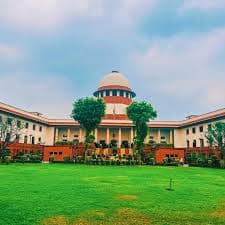
The Supreme Court of India formally came into existence on 26 January 1950 — the same day India became a republic. It began operations on 28 January 1950 in the Chamber of Princes (now the Parliament Annexe), New Delhi. The Court moved to its current building on Tilak Marg in 1958, a magnificent structure designed by Chief Justice P.B. Gajendragadkar’s era architect Ganesh Bhikaji Deolalikar in a blend of Indo-British architectural style. why we can say The Supreme Court of India -From Historical Up to Now 2026 is still reforming
Sir Harilal J. Kania became the first Chief Justice of India. The Court began with 8 judges (1 Chief Justice + 7 Judges). The initial judges were drawn largely from the Federal Court. The first session dealt primarily with procedural matters and the framing of Supreme Court Rules.
Historical Fact — UPSC Prelims
The Supreme Court held its inaugural sitting on 28 January 1950 in the Chamber of Princes in the Parliament House complex. Its current building on Tilak Marg was inaugurated on 4 August 1958. The building’s architecture features a central wing flanked by two wings — symbolising the scales of justice.
The foundational significance of the Supreme Court was immediately apparent. Within its first year, it dealt with the constitutionality of the Preventive Detention Act and began shaping the relationship between Fundamental Rights and legislative power — a tension that would define Indian constitutional law for decades.
Evolution of the Supreme Court Through the Decades
The Supreme Court’s history can be divided into distinct phases — each reflecting the political, social, and constitutional climate of its time.
- 1950 s
- The Foundational Phase — Setting the Tone
The Court established its role as constitutional interpreter. In A.K. Gopalan v. State of Madras (1950), it adopted a narrow interpretation of Art. 21, holding that “procedure established by law” meant any procedure enacted by Parliament — not necessarily fair or reasonable. This pro-legislature stance was consistent with the early deference to Parliamentary sovereignty. The First Amendment (1951) added a Ninth Schedule, shielding land reform laws from FR challenges — the SC upheld this.
- 1960 s
- Expanding Horizons — Property Rights & Federalism
Property rights dominated the 1960s docket. The SC frequently struck down land reform laws as violations of the right to property (then Art. 19(1)(f) and Art. 31). This created direct conflict with Parliament, which responded with constitutional amendments. The 17th Amendment (1964) further strengthened the Ninth Schedule. Justice Hidayatullah’s judgments laid foundations for federalism jurisprudence.
- 1970 s
- Constitutional Crisis & the Basic Structure Doctrine
The most transformative decade.
Kesavananda Bharati (1973)
— decided by a 13-judge bench — established the Basic Structure Doctrine, fundamentally limiting Parliament’s amending power. The Emergency (1975–1977) severely tested judicial independence. The infamous
ADM Jabalpur case (1976) saw the SC rule that Art. 21 rights are suspended during Emergency — a decision later described by Justice H.R. Khanna (the lone dissenter) as the Court’s darkest hour.
- 1980 s
- The PIL Revolution & Judicial Activism
Post-Emergency, the SC reinvented itself as a people’s court. Chief Justices P.N. Bhagwati and V.R. Krishna Iyer pioneered
Public Interest Litigation (PIL)
— dramatically lowering the locus standi bar so that any citizen or letter could trigger judicial action for public causes. The Court intervened in bonded labour, child labour, environmental pollution, and prison conditions.
Hussainara Khatoon (1979) and Bandhua Mukti Morcha (1984) are landmark PIL cases. The 44th Amendment (1978) abolished the right to property as a FR — a major shift.
- 1990 s
- Federalism, Corruption & the Collegium
S.R. Bommai (1994) fundamentally restructured Centre-State relations, limiting Presidential misuse of Art. 356. The Vineet Narain (Hawala) case (1997) directed the CBI to be independent of political interference — judicial oversight of executive institutions. The Second and Third Judges Cases (1993, 1998) established the Collegium system, marking a decisive shift in judicial appointments from executive to judicial primacy.
- 2000 s–2010s
- Rights Expansion & Democratic Interventions
- The Court expanded Art. 21 to include rights to education (
Unnikrishnan), health, food, livelihood, and environment.
I.R. Coelho (2007) held that even Ninth Schedule laws can be judicially reviewed for Basic Structure violations. The 2010s saw major interventions in coal block allocations, Commonwealth Games corruption, electoral reform (NOTA, declaration of criminal antecedents), and the NJAC judgment (2015).
- 2017– Present
- Privacy, Identity, Democracy & New Frontiers
- The Puttaswamy judgment (2017)
— unanimously declaring Right to Privacy a FR — reshaped Indian constitutional law profoundly.
Navtej Singh Johar (2018) decriminalised same-sex relations. The Ayodhya verdict (2019) resolved a 500-year-old dispute. The Electoral Bonds judgment (2024) struck down anonymous political funding. The SC continues to navigate contentious questions about freedom of speech, sedition law, and the limits of executive power.
Constitutional Provisions — Articles 124 to 147
Part V, Chapter IV of the Indian Constitution (Articles 124–147) provides the complete constitutional framework for the Supreme Court. These provisions cover establishment, composition, appointment, removal, jurisdiction, powers, and procedure. Every single article is important for UPSC — both Prelims and Mains.
- Article
- Provision
- Key Point
- Art. 124(1)
- Establishment and constitution of the Supreme Court of India
- Max 34 judges incl. CJI
- Art. 124(2)
Appointment of judges by the President after consultation with CJI and such judges as deemed necessary
- Collegium basis
- Art. 124(3)
Qualifications for appointment — advocate of HC for 5 years, or judge of HC for 5 years, or distinguished jurist
- Eligibility criteria
- Art. 124(4)
Removal of a judge only by order of the President after an address of each House of Parliament supported by special majority
- Impeachment process
- Art. 124(5)
Parliament may regulate the procedure for presentation of address for removal under clause (4)
- Judges Inquiry Act, 1968
- Art. 125
Salaries and conditions of service of judges shall be determined by Parliament and charged to Consolidated Fund of India
- Financial independence
- Art. 126
When office of CJI is vacant or CJI is unable to perform duties, the President shall appoint another judge as Acting CJI
- Acting CJI
- Art. 127
When a quorum of judges is not available, CJI may request a HC judge (with President’s consent) to sit as an ad hoc judge
- Ad hoc judges
- Art. 128
With consent of President, CJI may at any time request a retired SC judge to sit and act as a judge of the SC
- Retired judges
- Art. 129
Supreme Court is a Court of Record and has all powers of such a court including power to punish for contempt
- Contempt power
- Art. 130
Supreme Court shall sit in Delhi or such other place(s) as the CJI may appoint with the approval of the President
- Seat of SC
- Art. 131
Original jurisdiction of the SC in disputes between Government of India and States, or between States inter se, involving legal rights
- Federal disputes
- Art. 132
Appellate jurisdiction in constitutional cases — appeal from HC judgment if HC certifies a substantial question of law
- Constitutional appeals
- Art. 133
Appellate jurisdiction in civil cases from HC if HC certifies it involves a substantial question of general importance
- Civil appeals
- Art. 134
Appellate jurisdiction in criminal matters — includes cases where HC sentences to death or withdraws from Sessions Court
Criminal appeals
Art. 134A HC may on its own or on application certify a case for appeal to SC. Inserted by 44th Amendment, 1978.
- Certificate of fitness
- Art. 135
Jurisdiction and powers exercisable by Federal Court before commencement of Constitution are now exercisable by SC
- Continuity provision
- Art. 136
SC may grant Special Leave to Appeal from any judgment, decree, or order of any court or tribunal in India — widest appellate power
- SLP — Art. 136
- Art. 137
SC has power to review its own judgments or orders subject to provisions of law made by Parliament and rules under Art. 145
- Review jurisdiction
- Art. 138
Parliament can extend SC’s jurisdiction and powers by legislation with respect to matters in the Union List
- Enlargement by law
- Art. 139
Parliament may confer on SC power to issue directions, orders, or writs for purposes other than Art. 32
Additional writ powers
Art. 139A SC may transfer cases from one HC to another or to itself in the interest of justice. Inserted by 42nd Amendment, 1976.
- Transfer of cases
- Art. 140
Parliament may make provisions for conferring ancillary powers on SC as appear necessary for effectual exercise of its jurisdiction
- Ancillary powers
- Art. 141
The law declared by the Supreme Court shall be binding on all courts within India — doctrine of precedent
- Binding precedent
- Art. 142
SC may pass such decree or order as is necessary for doing complete justice in any cause or matter pending before it
- Complete justice
- Art. 143
President may refer any question of law or fact of public importance to SC for its advisory opinion (consultative jurisdiction)
- Advisory opinion
- Art. 144
All civil and judicial authorities in India shall act in aid of the Supreme Court
- Enforcement support
- Art. 145
SC may make rules for regulating its practice and procedure with the approval of the President
- Rule-making power
- Art. 146
Appointments of officers and servants of SC made by CJI or judge appointed by CJI; conditions of service regulated by SC with President’s approval
- SC administration
- Art. 147
Interpretation of the Constitution and laws — any reference to a substantial question of law regarding the Constitution shall be heard by a Bench of minimum 5 judges
- Constitution Bench
- UPSC Prelims Alert
Art. 124(3) allows “distinguished jurists” as a qualification — but no such person has ever been appointed to the SC in India’s history. Art. 130 allows SC to sit outside Delhi — but this power has never been exercised. Art. 142’s “complete justice” power has no parallel in most democratic constitutions and is uniquely powerful.
- UPSC Mains Study Material
- Jurisdiction of the Supreme Court — Detailed Analysis
- Type of Jurisdiction
- Constitutional Basis
- Scope & Key Points
- Original Jurisdiction
- Art. 131
Disputes between: (i) GOI vs. one or more States, (ii) GOI + one or more States vs. other States, (iii) Two or more States inter se. Must involve a question of law or fact on which the existence of a legal right depends. Excludes inter-state water disputes (Art. 262) and commercial disputes.
- Writ Jurisdiction
- Art. 32
SC can issue 5 writs — Habeas Corpus, Mandamus, Prohibition, Certiorari, Quo Warranto — ONLY for enforcement of Fundamental Rights. Art. 32 itself is a FR. HC has wider writ power under Art. 226 (for FR and any other purpose). SC’s writ jurisdiction is concurrent with HC’s but cannot be suspended except by Art. 359 during Emergency.
- Appellate — Constitutional
- Art. 132
Appeal from any HC judgment in civil, criminal, or other proceedings if HC certifies a substantial question of law as to the interpretation of the Constitution is involved.
- Appellate — Civil
- Art. 133
Appeal from HC civil judgments if HC certifies that (a) the case involves a substantial question of general importance, and (b) SC should decide it.
- Appellate — Criminal
- Art. 134
Appeal lies as of right when HC: (a) reversed acquittal and sentenced to death, (b) withdrawn a case from Sessions Court and convicted, (c) certified it as fit for appeal to SC.
- Special Leave Petition
- Art. 136
Most powerful appellate provision. SC has discretionary power to grant special leave to appeal from any judgment of any court or tribunal in India (except military tribunals under Art. 136(2)). Used extensively — now largest part of SC’s docket.
- Advisory Jurisdiction
- Art. 143
President can refer: (i) question of law or fact of public importance, or (ii) pre-constitution treaty/agreement disputes. SC’s opinion is not binding on President. SC may decline to give opinion (has done so twice — Special Courts Bill reference and Ayodhya reference). Distinguished from judicial power as it is not a judgment.
- Review Jurisdiction
- Art. 137
SC can review its own judgment on grounds of: (i) error apparent on face of record, (ii) new evidence discovered, (iii) any other sufficient reason. Review must be filed within 30 days. Heard by same bench as original — usually in chambers without oral hearing (except death penalty cases).
- Curative Petition
- Judicial Creation
Evolved in Rupa Ashok Hurra v. Ashok Hurra (2002). Filed after review petition is dismissed. Last resort — grounds are very narrow: violation of principles of natural justice or bias of judge. Heard by 3 senior-most judges in chambers.
Important Comparison — Art. 32 vs. Art. 226
Art. 32 (SC): Only for enforcement of Fundamental Rights. Art. 32 itself is a FR — cannot be waived. Art. 226 (HC): For enforcement of FR and for any other purpose (wider). HC’s writ jurisdiction is not a FR. However, SC under Art. 32 gives binding national effect, while HC writs are limited territorially. During proclamation of Emergency, Art. 32 can be suspended under Art. 359 — but NOT Art. 226. This is a critical Prelims distinction.
The Collegium System — Origin & Background
The Indian Constitution does not use the word “collegium” anywhere. The collegium system is entirely a judicial creation — born through a series of Supreme Court judgments that progressively shifted the power of judicial appointments from the executive to the judiciary itself.
The constitutional text of Art. 124(2) says:
“Every Judge of the Supreme Court shall be appointed by the President… after consultation with such of the Judges of the Supreme Court… as the President may deem necessary.”
The crucial interpretive question was: does “consultation” mean the executive must merely ask the judiciary’s opinion, or must it “concur” with it?
Constitutional Text vs. Judicial Interpretation
The word used in Art. 124(2) is “consultation” — not “concurrence” or “consent.” The Supreme Court, through the Three Judges Cases (1981, 1993, 1998), progressively reinterpreted “consultation” to mean “concurrence” of a collegium — fundamentally rewriting the constitutional text through judicial interpretation. This remains one of the most contested exercises of judicial power in Indian constitutional history.
The background to this shift lies in the Emergency of 1975–77. During the Emergency, the Indira Gandhi government transferred judges perceived as independent (the “committed judiciary” controversy) and superseded senior judges in appointing Chief Justices. The appointment of A.N. Ray as CJI (1973), superseding three senior judges who had ruled against the government in Kesavananda, was seen as executive retaliation. Post-Emergency, the judiciary was determined to insulate appointments from political interference — leading to the Three Judges Cases.
The Four Judges Cases — Complete Explanation
The collegium system evolved through four landmark Supreme Court cases spanning nearly four decades. Each case fundamentally altered how India’s judges are appointed. These are among the most important cases for UPSC Mains — especially questions on judicial independence, separation of powers, and constitutional interpretation.
- First Judges Case
- S.P. Gupta v. Union of India
- 1981 | 7-Judge Bench
Held that “consultation” in Art. 124(2) does NOT mean “concurrence.” The executive (President/Law Minister) has primacy in judicial appointments. The CJI’s opinion must be obtained but the President is not bound by it. Transfer of High Court judges can be done without consent of the judge concerned. Justified as maintaining executive accountability.
- ❌ Later Overruled in 1993
- Second Judges Case
- Supreme Court Advocates-on-Record Association v. Union of India
- 1993 | 9-Judge Bench
Overruled the First Judges Case. “Consultation” in Art. 124(2) means “concurrence.” The CJI’s recommendation, made in consultation with the 2 senior-most judges of the SC, has primacy and is binding on the President. If President returns a recommendation, CJI must reconsider — but if the collegium reiterates, the President must appoint. Birth of the modern collegium (CJI + 2 senior-most judges).
- ✔ Collegium Born
- Third Judges Case
- Special Presidential Reference under Art. 143
- 1998 | 9-Judge Bench
President referred nine specific questions about collegium functioning to SC under Art. 143. SC clarified and expanded the collegium: CJI should consult the 4 senior-most judges (not just 2). Consultees must give written opinions. If 2 of the 4 disagree, CJI should not send the recommendation to the President. Eligibility and seniority norms clarified. Collegium expanded to CJI + 4 senior-most judges.
- ⬆ Collegium Expanded to 5
- Fourth Judges Case
- Supreme Court Advocates-on-Record v. Union of India (NJAC Case)
- 2015 | 5-Judge Constitution Bench
Struck down the 99th Constitutional Amendment and the National Judicial Appointments Commission Act, 2014 by 4:1 majority. The NJAC was unconstitutional because it undermined the independence of judiciary — a basic feature of the Constitution. Including the Law Minister and two eminent persons (who could be politically influenced) in the NJAC gave the executive a veto over judicial appointments. Restored the collegium system.
- ⚡ NJAC Struck Down
- UPSC Mains Insight
The four Judges Cases represent a remarkable evolution: 1981 gave primacy to the executive; 1993 gave it to the CJI + 2 judges; 1998 expanded it to CJI + 4 judges; 2015 reaffirmed this against legislative intervention. The entire system rests on judicial interpretation of the word “consultation” — there is no explicit constitutional mandate for a collegium anywhere in the text.
How the Collegium System Works Today
The Supreme Court collegium consists of the Chief Justice of India and the four senior-most judges of the Supreme Court. For High Court appointments and transfers, the High Court collegium (Chief Justice of HC + 2 senior-most judges) also has a role. Here is the step-by-step process for appointment of a SC judge:
HC CollegiumRecommends names
State Govt.
- Sends comments
- SC CollegiumCJI + 4 senior judges
- RecommendationTo President
- PresidentAppoints or returns
- If returnedCollegium reconsiders
- ReiterationPresident must appoint
- Key features of the collegium as it currently functions:
- Aspect
- Details
- Composition
CJI + 4 senior-most judges of the Supreme Court (for SC appointments). CJI + 2 senior-most judges for HC appointments.
Decision Making
Majority opinion prevails. If 2 out of 4 consultee judges disagree, CJI should not forward the recommendation. Unanimity is preferred but not mandatory.
Seniority
For appointment as CJI, the senior-most SC judge is invariably recommended (convention since 1970, with one exception — supersession of judges in 1973 and 1977 by Indira Gandhi government).
Transparency
Since October 2017, the SC collegium publishes names of recommended judges on the SC website with a brief statement of reasons — a partial move towards transparency following public criticism.
Government’s Role
Government can return a recommendation once for reconsideration with reasons. If collegium reiterates (even unanimously), the President is constitutionally bound to make the appointment. However, in practice, delay in processing reiterated names is a grey area.
Intelligence Bureau Role
IB conducts a background check on recommended names and submits a report to the government, which is shared with the collegium. The collegium can override IB objections if it chooses.
MoP (Memorandum of Procedure)
The detailed procedure governing collegium recommendations and government processing. The original MoP dates to 1999. A revised MoP has been under negotiation between the judiciary and government since 2015 — it remains unfinalized as of 2024.
The NJAC — What It Was & Why It Was Struck Down
The National Judicial Appointments Commission (NJAC) was established by the 99th Constitutional Amendment Act, 2014, which inserted Articles 124A, 124B, and 124C into the Constitution, and the NJAC Act, 2014. The NJAC was supposed to replace the collegium system with a more transparent, accountable, and inclusive appointments body.
- Component
- Details
- Composition of NJAC
- (1) Chief Justice of India — Chairperson
- (2) Two senior-most judges of SC
- (3) Union Law Minister
(4) Two eminent persons nominated by a committee of CJI + PM + Leader of Opposition (for 3 years, non-renewable)
Veto Power
Any 2 members of NJAC could veto a recommendation — meaning the Law Minister + one eminent person could block any appointment
Passed By Both Houses of Parliament unanimously; ratified by more than 15 State Legislatures — one of the most democratically endorsed amendments
Struck Down
Fourth Judges Case, 2015 — 4:1 (Justice Chelameswar dissented, supporting NJAC)
Why the SC struck down NJAC:
The majority (4 judges) held that NJAC violated the independence of judiciary — a basic feature of the Constitution established in Kesavananda Bharati. Specific grounds included:
Participation of the Law Minister (executive) in judicial appointments compromises the separation of judiciary from executive — a basic structure feature.
The “two-member veto” could effectively allow the executive (Law Minister + one eminent person) to block appointments of independent judges.
The selection of “eminent persons” lacked objective criteria and could be politically motivated.
The amendment gave equal weight to judicial and non-judicial members — undermining judicial primacy in appointments.
Justice Chelameswar’s Dissent — Important for Mains
Justice J. Chelameswar was the lone dissenter — he upheld the NJAC, arguing that the collegium system lacks accountability and transparency, and that parliamentary democracy requires some executive oversight over judicial appointments. His dissent is cited in all discussions on judicial reforms. He wrote that the collegium system had no constitutional basis and that the NJAC represented the Parliament’s legitimate attempt to introduce accountability.
Criticism of the Collegium & Reform Debate
The collegium system remains the most debated aspect of India’s judicial system. Arguments exist on both sides — UPSC Mains questions often ask for a critical analysis, requiring familiarity with both perspectives.
✔ Arguments in Favour of Collegium
Safeguards judicial independence from political interference — essential basic structure feature
Judges best understand what qualities are needed in a judge — merit over politics
Historical record shows executive appointments led to “committed judiciary” under Emergency
Post-1993, no judge has been appointed purely on political considerations
Constitution Bench in NJAC case unanimously found judicial independence was at risk from NJAC
Even democracies like the UK and USA involve judiciary heavily in appointments
✗ Arguments Against Collegium
Lacks transparency — appointments made in secrecy with no written criteria or public accountability
“Judges appointing judges” — a self-perpetuating oligarchy with no democratic oversight
Nepotism concerns — children and relatives of sitting/retired judges disproportionately represented in bar
Poor diversity — women, SCs/STs, minorities, and regional representation severely lacking
No timeline — names pending for years; government can informally delay through inaction on reiterated names
No constitutional basis — the word “collegium” appears nowhere in the Constitution
Proposed Reforms:
The Law Commission, NITI Aayog, and various constitutional scholars have suggested: (a) establishing a Judicial Appointments Commission with judicial majority but some civilian participation, (b) fixed timelines for processing recommendations, (c) mandatory written, published reasons for all appointments and rejections, (d) diversity benchmarks, and (e) finalizing the revised Memorandum of Procedure.
Way Forward — Model Answer Points
The debate is not binary — between the opaque collegium and the politically susceptible NJAC. The ideal solution lies in a reformed collegium with: (i) codified objective criteria for appointments, (ii) mandatory publication of reasons, (iii) binding timelines for government processing, (iv) a diversity mandate, and (v) a statutory basis to give democratic legitimacy to the process while preserving judicial primacy. The MoP must be finalized urgently. As the Supreme Court itself said in the NJAC case, the collegium system has “grave defects” that must be remedieamework
Appointment & Removal of Judges
Judges of the Supreme Court are appointed by the President under Art. 124(2) after consultation with the CJI and other judges deemed necessary. The term “consultation” has been judicially interpreted to mean “concurrence,” giving rise to the Collegium system.
- The Collegium System emerged from three landmark cases:
- 1981
- First Judges Case (S.P. Gupta):
Executive primacy in judicial appointments — “consultation” does not mean “concurrence.”
- 1993
- Second Judges Case (Advocates-on-Record):
Overruled 1981 judgment; CJI’s opinion has primacy; collegium of 2 senior-most judges.
- 1998
- Third Judges Case (Presidential Reference):
Expanded collegium to CJI + 4 senior-most judges of the SC.
- 2015
- Fourth Judges Case (NJAC):
99th Amendment and NJAC Act struck down; collegium system restored as it protects “independence of judiciary” — a basic feature.
Removal (Impeachment) requires an address by each House of Parliament supported by: (a) a majority of total membership of the House, and (b) not less than two-thirds of members present and voting — followed by a Presidential order.
No Supreme Court judge has ever been removed in independent India.
Exam Alert: The MoP (Memorandum of Procedure) between government and judiciary for finalising appointment criteria remains unresolved — a live contemporary issue for Mains.
Judicial Review & Basic Structure Doctrine
Judicial Review — the power of courts to examine the constitutional validity of legislative and executive actions — is an implied feature derived from Art. 13, Art. 32, Art. 131–136, and Art. 226–227. India follows a limited judicial review model, unlike the broad American model.
The Basic Structure Doctrine, propounded in Kesavananda Bharati v. State of Kerala (1973) by a 13-judge bench (7:6), holds that Parliament cannot amend the Constitution so as to damage or destroy its basic structure. Key features considered part of basic structure include:
ConfirmedSupremacy of the Constitution, republican and democratic form of government
ConfirmedSecularism and federalism — part of the indestructible core
ConfirmedSeparation of powers, judicial review, independence of judiciary
ConfirmedFree and fair elections, rule of law, unity and integrity of India
ConfirmedHarmony between Part III (FR) and Part IV (DPSP) — Minerva Mills, 1980
The Basic Structure Doctrine has no explicit mention in the Constitution — it is entirely a judicial creation. It has been invoked to strike down the 39th Amendment (1975), 42nd Amendment provisions, NJAC (99th Amendment), and electoral bond anonymity.
Landmark Judgments — Must Know for UPSC
These are the most frequently cited cases in UPSC Mains and Prelims. Each represents a turning point in constitutional interpretation.
Kesavananda Bharati v. Kerala
Basic Structure Doctrine; Parliament cannot alter fundamental features of the Constitution
- 📅 1973 | 13-judge bench
- Maneka Gandhi v. Union of India
Expanded Art. 21; “procedure established by law” must be fair, just, and reasonable
- 📅 1978 | Art. 21 & 19
- Minerva Mills v. Union
Balance between FR (Part III) and DPSP (Part IV); neither can destroy the other
- 📅 1980 | 42nd Amendment
- S.R. Bommai v. Union
Curtailed arbitrary use of Art. 356; floor test is necessary before dismissing state govt.
- 📅 1994 | Federalism
- Vishaka v. State of Rajasthan
Laid down guidelines against sexual harassment at workplace before POSH Act, 2013
- 📅 1997 | Art. 14, 19, 21
- I.R. Coelho v. Tamil Nadu
Laws placed in 9th Schedule are subject to judicial review if they violate basic structure
- 📅 2007 | 9th Schedule
- Puttaswamy v. Union of India
Right to Privacy declared a Fundamental Right under Art. 21; 9-judge bench, unanimous
- 📅 2017 | Art. 21
- Navtej Singh Johar v. Union
Decriminalised consensual same-sex relations; partially struck down Section 377 IPC
- 📅 2018 | LGBTQ+ rights
- Indian Young Lawyers (Sabarimala)
Allowed entry of women of all ages into Sabarimala temple; religious practice vs. equality
- 📅 2018 | Art. 14, 17, 25
- Electoral Bonds Case
Electoral Bonds Scheme struck down; voters’ right to information is a Fundamental Right
- 📅 2024 | Art. 19(1)(a)
- Contemporary Issues & Debates
- Judicial Activism vs. Judicial Overreach:
While judicial activism fills the vacuum left by executive inaction (environment, child labour, bonded labour), critics argue SC has overstepped in areas like BCCI regulation, liquor ban on highways, and demonetisation. The thin line between activism and overreach remains a contested terrain.
Pendency Crisis:
Over 70,000 cases are pending before the SC and over 4.5 crore cases across all courts in India. The Law Commission and NITI Aayog have recommended Mission Mode Case Management, All-India Judicial Services, and appointment of more judges.
Transparency in Collegium:
Demands for greater transparency, written objective criteria, and representation of women and marginalised communities in judicial appointments continue. Currently, the collegium publishes names with limited reasoning.
Article 142 — Complete Justice:
SC’s extraordinary power to pass any decree or order necessary for “complete justice” has been creatively — and controversially — used in Ayodhya dispute, electoral bonds judgment, and Cauvery water dispute. It raises questions about SC acting as super-legislature.
PIL (Public Interest Litigation):
Originally conceived to give access to justice to the poor and marginalised (Hussainara Khatoon, 1979), PIL has evolved into a tool of governance — and sometimes misuse. Courts have intervened in administrative decisions through PIL, blurring separation of powers.
For Mains: Always link judicial issues to constitutional values — separation of powers, independence of judiciary, rule of law, and access to justice. These are the evaluative parameters examiners look for.
✎ UPSC Mains Questions — Practice Set
10-mark (150 words) and 15-mark (250 words) questions modelled on UPSC CSE Mains patterns
1.”The collegium system, despite its shortcomings, remains the best available mechanism to safeguard judicial independence in India.” Critically examine.
GS Paper II15 marks / 250 wordsCollegium & NJACJudicial Independence
2. The Basic Structure Doctrine has been called both a bulwark of constitutional democracy and an undemocratic judicial veto. Analyse with reference to landmark judgments.
- GS Paper II15 marks / 250 wordsBasic StructureJudicial Review
- 3
Distinguish between judicial activism and judicial overreach. With examples, discuss how the Supreme Court has evolved from a constitutional court to a policy-maker.
- GS Paper II10 marks / 150 wordsJudicial ActivismPIL
- 4
Article 32 has been described as the ‘heart and soul’ of the Constitution. In what ways has the Supreme Court expanded the scope of Article 21 through its writ jurisdiction?
- GS Paper II10 marks / 150 wordsArt. 21 & 32Fundamental Rights
- 5
Examine the role of the Supreme Court in protecting federalism in India. Has its interpretation evolved from a ‘quasi-federal’ to a more ‘cooperative federal’ framework?
- 🔗 Related Topics for UPSC Preparation
- UPPCS – Foundation Course 10-11 Months
High Courts (Art. 214–231)Public Interest LitigationSeparation of PowersNHRC & Human RightsTribunals (Art. 323A & 323B)Lokpal & LokayuktaIndian FederalismFundamental Rights (Part III)Directive Principles (Part IV)President’s Rule (Art. 356)Emergency ProvisionsConstitutional AmendmentsAttorney General of IndiaContempt of CourtAll India Judicial Services