CSMP IAS : India's Premier Coaching Institute for IAS / PCS
Feeding 81 Crore People in the Digital Age — how SARTHAK Works
Editorial Reference: “PDS Integration Push” — The Hindu BusinessLine, June 3, 2026
For: UPSC CSE (Prelims + Mains GS-II & GS-III + Essay)
Table of Contents
Before You Read: Map This to Your Syllabus
http://Cabinet approves technology-driven PDS scheme to …
Think of this editorial as sitting at a crossroads — welfare delivery meets digital governance meets food policy meets fiscal management. Every angle leads back to a core UPSC theme.
| Where It Appears | What to Focus On |
|---|---|
| Prelims | SARTHAK, NFSA 2013, ONORC, FCI, ePoS, AAY, PMGKAY — expect MCQs on scheme details and full forms |
| Mains GS-II | Delivery of welfare, transparency in governance, Centre-State relations in food policy |
| Mains GS-III | Food subsidy, buffer stocks, supply chain management, technology in agriculture |
| Essay | “Good intentions are not enough — governance is in the details”; hunger as a political, not just agricultural, failure |
Now let’s get into it.
Think About This First
Imagine a daily wage worker from Jharkhand who migrates to work at a construction site in Bombay. Back home, he has a ration card — entitled to subsidised rice and wheat under the National Food Security Act. But in bombay, that card is useless. He either buys food at market price, eating into his already thin income, or goes hungry.
This one scenario captures the central failure of India’s Public Distribution System for decades — it was designed for people who stayed put in villages, not for the 45 crore Indians who move across the country chasing work.
The government’s new SARTHAK-PDS scheme is, at its heart, an attempt to fix this — and a dozen other problems — in one sweeping technological push. But as The Hindu BusinessLine’s June 3rd editorial argues, a ₹25,530 crore digital makeover alone won’t cut it if the man at the ration shop earns a pittance and the system still hands out only rice and wheat to a country battling anaemia.
Let’s unpack all of this.
India’s Ration System: The World’s Biggest, and Still Imperfect
India’s PDS is not a small welfare programme — it is the largest food security operation on the planet. Over 81.35 crore people receive subsidised foodgrains through more than 5.33 lakh Fair Price Shops spread across urban slums, remote tribal belts, and coastal fishing villages. The state spends well over ₹2 lakh crore every year maintaining this system.
The legal foundation is the National Food Security Act, 2013, which transformed food from a welfare entitlement into a statutory right — 75% of rural India and 50% of urban India are entitled to subsidised grain. The most vulnerable households fall under the Antyodaya Anna Yojana (AAY) category and receive the highest quantum of support.
But size and scale haven’t automatically meant efficiency. For decades, the PDS was infamous for three things: leakages (grain diverted to open markets), ghost beneficiaries (ration cards issued to people who don’t exist or are dead), and exclusion errors (genuine poor left out because of bureaucratic lapses).
How did we get here, and where are we now?
The system was born in the 1940s, when the British introduced food rationing during the Second World War to manage scarcity. After Independence, it continued as a tool against inflation and shortage. In 1997, the government made it targeted — the Universal PDS gave way to the Targeted PDS (TPDS), with different ration quantities for BPL and APL households.
Then came the digital revolution in PDS governance:
- 2013 — NFSA turns food into a right; beneficiary numbers get locked in law.
- 2016 — End-to-end computerisation begins; ration card databases go online.
- 2018 — ONORC pilot launched; migrants can now access ration anywhere.
- 2020 — During COVID-19, PMGKAY provides free grain to 80 crore people — one of the largest emergency food operations in history.
- 2023 — SMART-PDS introduces real-time monitoring and AI tools.
- 2026 — Enter SARTHAK-PDS, the most ambitious integration yet.
So What Exactly is SARTHAK?
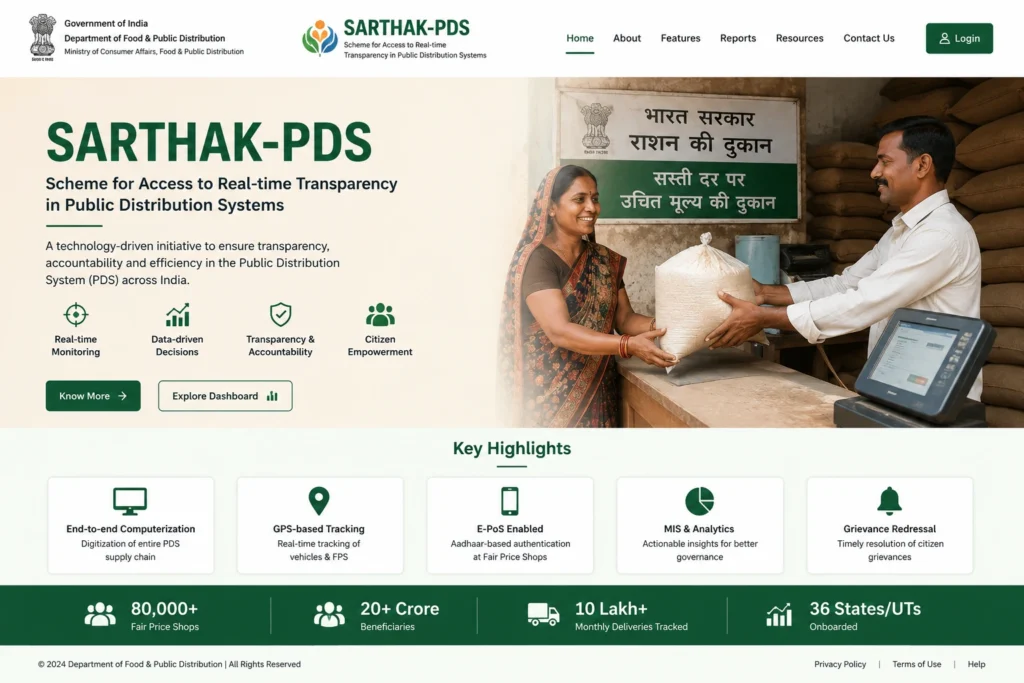
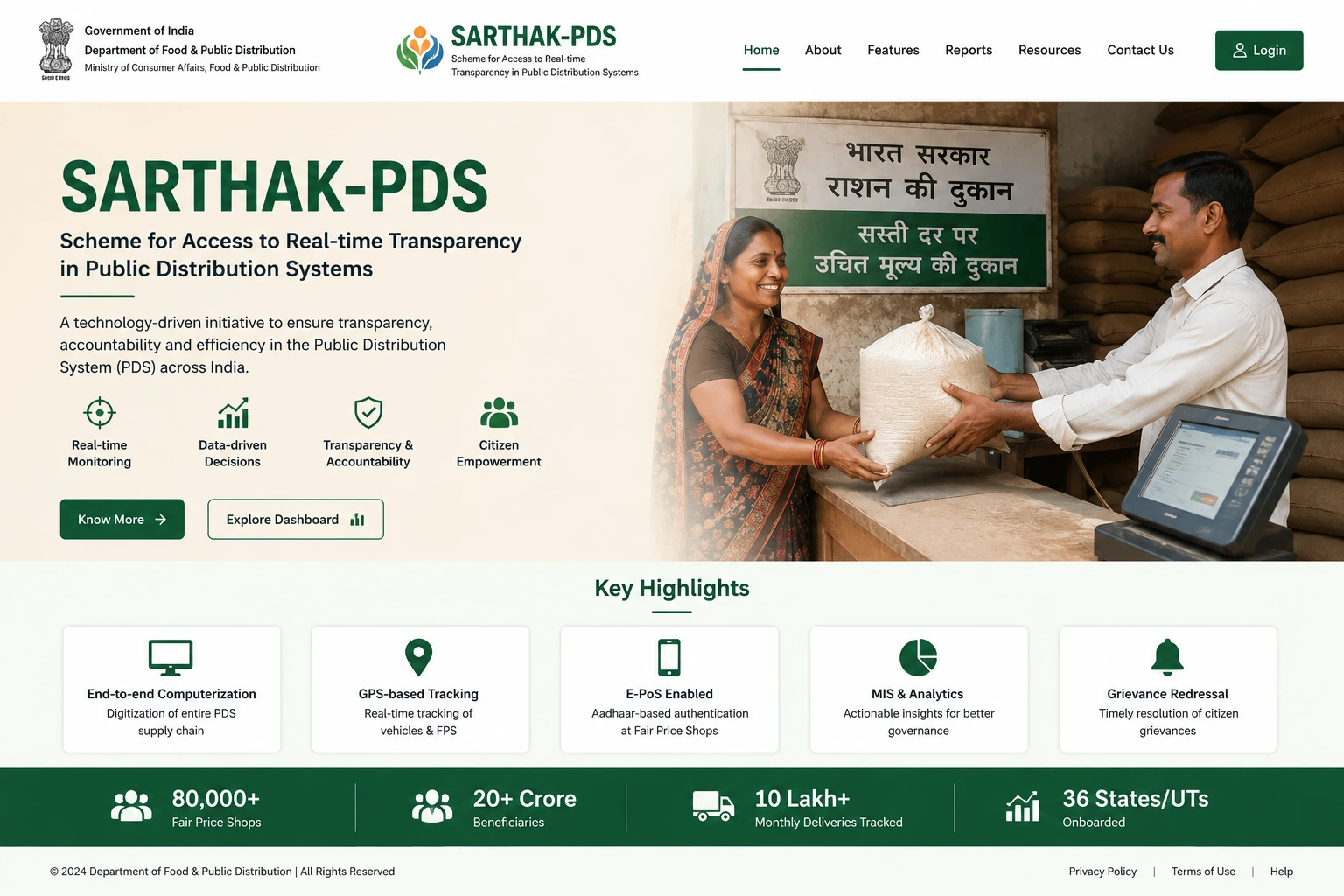
SARTHAK is an acronym that the government has constructed carefully: Scheme for Assistance in Ration Transport and Handling–Income with Automation in the Public Distribution System. It was approved by the Cabinet Committee on Economic Affairs (CCEA) with a budget of ₹25,530 crore for five years — April 2026 to March 2031.
What makes it different from what came before? Primarily, it merges two existing schemes into one umbrella and gives them a common technology backbone:
- The old scheme that helped states with the cost of moving foodgrains from FCI godowns to ration shops — and paid FPS dealers their margins.
- SMART-PDS — the earlier digital reform push.
By bringing these together, the government eliminates fragmented implementation, ensures a single data architecture, and makes accountability clearer.
The Three Pillars (Worth Memorising for Prelims and Mains)
Nirmal — The Clean Registry Think of this as India’s attempt to finally answer the question: who exactly are the beneficiaries? Nirmal is an AI-driven, real-time database that talks to other government databases — income tax records, death registrations, birth records — to automatically remove ghost beneficiaries and flag duplicates. It uses Aadhaar seeding as the unique identifier. For Mains, this connects to the broader debate around inter-ministerial data integration and evidence-based welfare targeting.
ASHA — The Citizen’s Voice ASHA is a multilingual, AI-powered grievance platform. If a beneficiary is denied their ration, if the shop was shut, if the biometric device failed — they can raise a complaint through WhatsApp or a dedicated app in their own language. The significance here is immense: earlier, a poor migrant worker who couldn’t read English had no easy way to complain to the system. ASHA attempts to close that gap. This directly relates to the right to grievance redressal as a component of good governance.
Saksham — The Smart Supply Chain This is the logistics backbone. Every truck carrying grain from a godown can be tracked. Every gunny bag has a QR code. AI predicts how much grain each FPS needs based on past consumption patterns, seasonal migration, and demographic data. This tackles one of PDS’s oldest wounds — grain “disappearing” between the godown and the shop. For GS-III answers on supply chain management and food storage, Saksham is a ready-made example.
Technology Stack (Prelims Checklist)
- Artificial Intelligence and Machine Learning for fraud detection and demand forecasting
- Blockchain for end-to-end traceability of foodgrain consignments
- Natural Language Processing for the multilingual grievance interface
- ePoS devices at all FPS for biometric authentication
- State-level Command and Control Centres for real-time oversight
- Citizen apps: Mera Ration 2.0, Anna Mitra, Anna Sahayata, Rightful Targeting Dashboard
ONORC: The Reform That Should Have Changed Everything — and Partially Did
The One Nation One Ration Card initiative deserves special attention because it is simultaneously one of India’s most elegant welfare ideas and one of its most imperfectly implemented ones.
The concept is simple: your ration entitlement travels with you, wherever you go. A worker from Bihar working in Gujarat should be able to walk into any Fair Price Shop in Surat and get her allotted grain, just by scanning her Aadhaar-linked ration card.
By 2022, ONORC had been rolled out across all 36 states and Union Territories. On paper, this was a landmark achievement. In practice, the gaps are still real.
What works: Millions of migrant workers have used ONORC successfully. The system has processed over 100 crore portability transactions — a staggering number that shows the scale of need and the scale of reach.
What doesn’t: In states where Aadhaar seeding remains incomplete, biometric verification at an FPS fails — and the worker goes home empty-handed. In tribal regions and hilly terrains where internet connectivity is unreliable, the ePoS device simply can’t communicate with the server. A migrant who doesn’t speak the local language often can’t navigate an unfamiliar FPS or complain to local authorities. And data synchronisation between states still lags, meaning real-time portability isn’t always real-time.
SARTHAK’s Nirmal and ASHA pillars directly target these gaps — but the editorial rightly notes that technology alone cannot fix what are essentially problems of political will, infrastructure investment, and administrative coordination.
The Three Hard Problems SARTHAK Must Confront
Problem One: The Ration Shop Dealer’s Impossible Economics
Here is an uncomfortable truth: the person most critical to PDS delivery — the Fair Price Shop dealer — is often earning so little that the system is set up to incentivise dishonesty.
In many states, a dealer earns a commission of ₹70 to ₹90 per quintal for distributing grain. Running a shop with storage, electricity, an ePoS device, and staff on this margin is, for many, not financially viable. The result? Some dealers quietly divert a portion of grain to the open market, where they can earn far more. Others just shut their shops during inconvenient hours. A few abandon dealership altogether.
The editorial makes a pointed argument: you can build the most sophisticated blockchain-powered tracking system in the world, but if the person at the last mile has no economic reason to distribute grain honestly and efficiently, the technology sits idle. FPS viability is not a secondary concern — it is foundational.
SARTHAK does include provisions for revising dealer margins, but critics argue the revision is not adequate in many states, and without Centre-State coordination on this issue, the problem will persist.
Problem Two: India is Feeding Its Poor, But Not Nourishing Them
Ask yourself this: what does India’s PDS basket contain? Rice and wheat. Mostly that. In some states, you might get a small allocation of pulses or sugar. But largely, the PDS has been, for decades, a calorie delivery system, not a nutrition delivery system.
Now consider what India’s health data tells us. Nearly 57% of women of reproductive age are anaemic. A significant proportion of children under five are stunted. Micronutrient deficiencies — in iron, Vitamin A, zinc, iodine — are widespread even in states where food is technically available. These are not hunger problems in the traditional sense. They are hidden hunger — the body gets enough calories but not the right nutrients.
The POSHAN Abhiyaan (National Nutrition Mission) and India’s commitments under SDG Goal 2 (Zero Hunger) both demand a shift in how we think about food security. The editorial argues this shift must be reflected in the PDS itself:
- Millets (Shree Anna) — India is promoting millet cultivation; the PDS is the most natural channel for distributing these nutritionally dense grains to the poor.
- Pulses — protein deficiency is as real as calorie deficiency for many poor households; dal should be in the ration basket.
- Fortification — PDS rice and wheat should be fortified with iron, folic acid, and Vitamin B12 at the FCI level itself, so every beneficiary automatically gets micronutrients without any additional step.
This is perhaps the most important long-term reform the editorial calls for, and SARTHAK currently does not address it directly.
Problem Three: Technology Can Create New Exclusions
Every time India digitises a welfare system, there is a group of people who slip through — not because they are ineligible, but because the technology doesn’t work for them.
In 2017–18, several cases of starvation were reported in Jharkhand where individuals died after being denied ration because their Aadhaar fingerprints didn’t match — an old person’s worn fingerprints, a labourer’s rough hands, a partially sighted person unable to complete biometric verification. These incidents forced a national conversation about the right to food versus the convenience of digital systems.
SARTHAK, to its credit, includes the ASHA grievance mechanism. But the editorial — and sound governance thinking — demands more:
- Manual override provisions so a dealer can issue ration to a genuine beneficiary even if biometric authentication fails, subject to documentation.
- Offline ePoS capability — devices that can record transactions locally and sync later, rather than failing when connectivity drops.
- Gram Sabha-level social audit — community verification of beneficiary lists so exclusions are caught and corrected locally, not after months of bureaucratic review.
Digital inclusion cannot be an afterthought in a scheme serving 81 crore people, many of whom are elderly, disabled, or living in the country’s most remote corners.
The Fiscal Reality: The Bill India Pays
India’s food subsidy bill is not a small number. In recent years it has exceeded ₹2 lakh crore annually — and that’s after accounting for PMGKAY being wound down in 2024.
The money flows across a complex chain: the government procures grain from farmers at the Minimum Support Price (MSP), which in many years is significantly above what the market would pay. The grain is stored by the Food Corporation of India (FCI) in godowns across the country — and carrying costs (storage, fumigation, staff, spoilage) add another significant expense. The grain is then allocated to states and sold to beneficiaries at heavily subsidised prices — ₹1 to ₹3 per kilogram — recovering only a fraction of cost.
SARTHAK’s Saksham pillar — with AI-based demand forecasting and better supply chain tracking — has the potential to reduce waste and improve offtake efficiency. But the deeper structural issue is that MSP-based procurement creates a grain mountain that FCI struggles to manage. At times, India stores more grain than its buffer stock norms require, while also having people go underfed.
A more rational approach would involve better calibration of procurement based on consumption need, rather than political compulsions around MSP. This is politically difficult, but fiscally necessary.
What Has Actually Worked — Credit Where It’s Due
Before we become entirely critical, it’s worth noting that the PDS has made genuinely remarkable strides.
Leakage — the portion of PDS grain that never reaches the beneficiary — has fallen sharply. Studies based on National Sample Survey data suggest leakage dropped from roughly 40% in the early 2010s to somewhere around 15% by the early 2020s. That is a massive improvement, driven by Aadhaar seeding, digitisation of ration cards, and ePoS devices.
During COVID-19, the government ran PMGKAY — providing free grain to 80 crore people for over two years without letting the supply chain collapse. This was a genuine administrative achievement, widely cited internationally as a model of emergency food response.
ONORC has processed billions of portability transactions. The Mera Ration app has empowered millions of beneficiaries to check their entitlements and nearby FPS locations.
SARTHAK builds on these foundations. It is not a replacement for what worked — it is an attempt to systematise and scale it.
The Way Forward — What a Complete Reform Looks Like
In the next one to two years, the urgent priorities are:
Getting dealer margins to a level where running an FPS is genuinely viable — not as a sideline but as a livelihood. Completing Aadhaar seeding in the states that still lag, while simultaneously ensuring manual override systems are in place everywhere. Rolling out ASHA in all 22 scheduled languages, not just the major ones.
Over the medium term (two to four years), the reform agenda must widen:
UPPCS – Foundation Course 10-11 Months
Millets, pulses, and fortified oils need to enter the PDS basket, at least for the AAY (most vulnerable) category as a pilot. SARTHAK’s database should be integrated with POSHAN Abhiyaan’s nutrition tracking systems so we can measure not just whether grain reached a beneficiary, but whether it is actually improving nutritional outcomes. Blockchain-based QR tracing should cover 100% of FCI consignments.
Looking further ahead, the larger philosophical shift needed is from measuring inputs (how much grain was distributed) to measuring outcomes (are beneficiaries healthier, less anaemic, less stunted?). This requires linking PDS data with health data, and building an evaluation culture into the scheme itself. In mature urban markets, a Direct Benefit Transfer (DBT) approach — transferring the food subsidy value to bank accounts — may be more efficient than physical grain distribution. But in remote and food-insecure regions, in-kind distribution must continue.
Practice Questions for Your Mains Answer Writing
GS Paper II:
“India’s SARTHAK-PDS scheme represents a leap in digital governance, but digital infrastructure cannot substitute for economic viability at the last mile.” Discuss. (250 words)
“Examine the role of the One Nation One Ration Card initiative in strengthening food security for internal migrants. What structural barriers limit its effectiveness?” (150 words)
GS Paper III:
“India’s PDS has evolved from a calorie delivery system to a platform for comprehensive food security. Critically evaluate how far this transformation is complete.” (250 words)
Essay Connections:
This editorial pairs well with essays on: technology and governance, inclusive growth, India’s demographic dividend and its preconditions, or what it means to be a welfare state in a middle-income country.
One-Page Prelims Reference
| Term | What It Means |
|---|---|
| SARTHAK-PDS | Scheme for Assistance in Ration Transport and Handling–Income with Automation in PDS |
| NFSA 2013 | National Food Security Act — makes subsidised food a legal right for 67% of population |
| ONORC | One Nation One Ration Card — ration portability across all states |
| TPDS | Targeted PDS — replaced Universal PDS in 1997 |
| AAY | Antyodaya Anna Yojana — for the poorest of the poor households |
| FPS | Fair Price Shops — local ration distribution points |
| FCI | Food Corporation of India — central procurement and storage agency |
| ePoS | Electronic Point of Sale — biometric authentication device at FPS |
| PMGKAY | Pradhan Mantri Garib Kalyan Anna Yojana — free grain scheme during COVID |
| MSP | Minimum Support Price — price at which government buys grain from farmers |
| CCEA | Cabinet Committee on Economic Affairs — approved SARTHAK |
| POSHAN Abhiyaan | National Nutrition Mission — targets malnutrition, especially in children and women |
| SMART-PDS | Earlier tech reform scheme, now merged into SARTHAK |
The Core Argument, Distilled
If you have to summarise this entire editorial in three sentences for a Mains answer, here it is:
India’s SARTHAK-PDS is a well-designed, ambitiously funded attempt to bring the country’s massive food distribution network into the digital age — using AI, blockchain, and real-time tracking to reduce leakages, improve portability, and empower beneficiaries. However, the scheme’s success will depend not just on technology, but on three things that technology alone cannot fix: making Fair Price Shop dealership economically sustainable, closing the remaining gaps in ONORC portability for migrant workers, and expanding the PDS from a system that merely prevents hunger to one that actively promotes nutrition. Until the grain reaches the right person, in the right condition, with the right nutritional content, the promise of SARTHAK remains work in progress.
Written for UPSC CSE aspirants. Based on “PDS Integration Push,” The Hindu BusinessLine, June 3, 2026.